In this series: Maine 2025-26 Enrollment.
Maine's high schools look stable. From 2017 to 2026, grades 9 through 12 lost just 2,417 students, a 4.3% decline spread over nine years. Grade 12 enrollment, at 13,665, sits only 2.2% below where it started. For a state where overall enrollment has fallen to an all-time low, those numbers could pass for good news.
They are not. The K-8 pipeline feeding those high schools has shed 11,198 students over the same period, a 9.4% decline. Elementary schools (K-5) have been hit hardest, losing 10.3% of their enrollment. Kindergarten alone is down 14.8%, from 12,665 to 10,786. This year's kindergarten class has 2,320 fewer students than this year's ninth grade class, a gap that did not exist at this scale in 2017.
The math is straightforward: today's shrinking elementary classes become tomorrow's shrinking high schools. The stability that Maine's high schools currently enjoy is borrowed time.
A flat line hiding a steep gradient
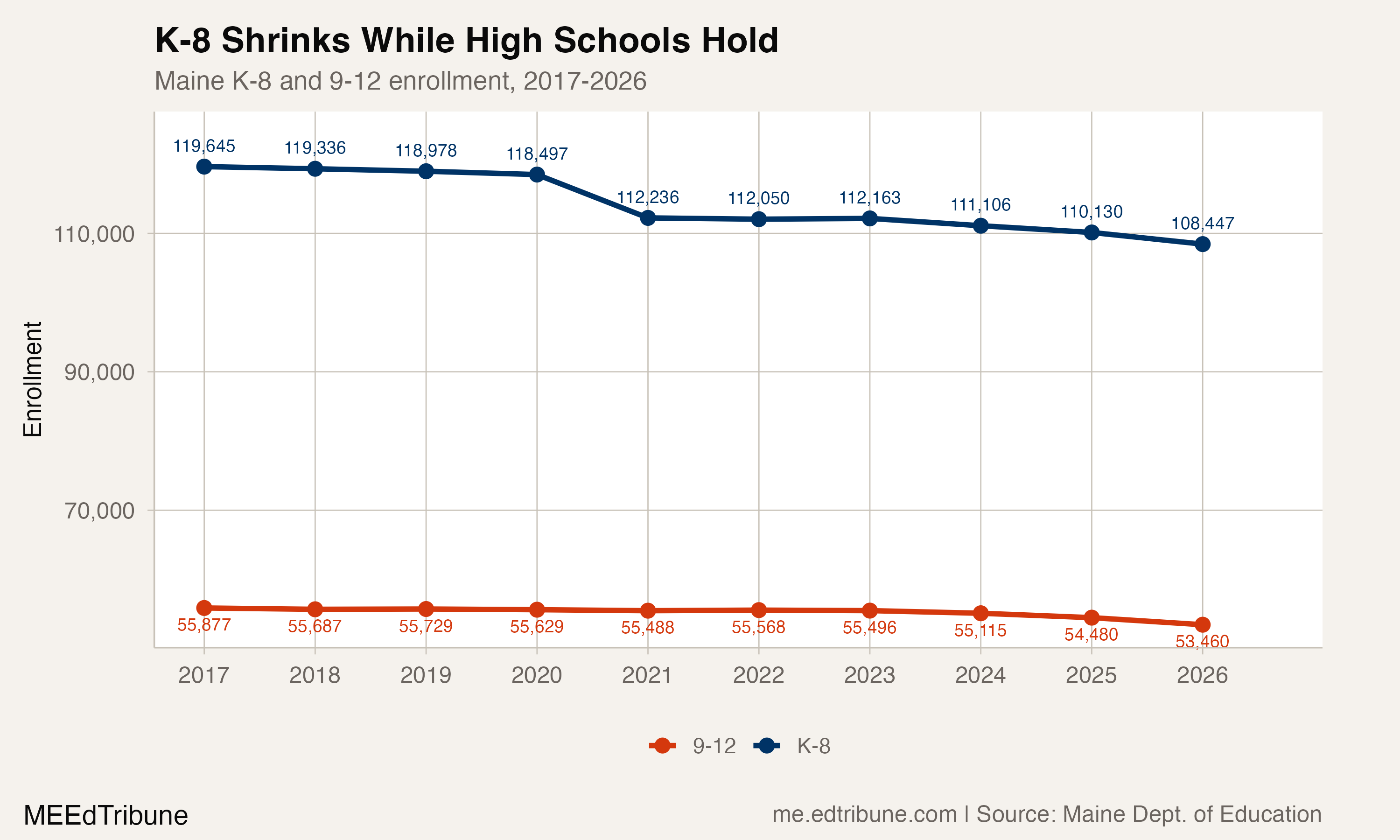
Between 2017 and 2020, K-8 and 9-12 enrollment moved in rough parallel, both drifting slowly downward. Then COVID split them apart. K-8 lost 6,261 students in a single year (2020 to 2021), a 5.3% drop. High schools, by contrast, lost just 141 students over the same period, a decline of 0.3%.
That divergence never closed. K-8 managed only a brief, partial rebound in 2022-2023 before resuming its decline. High schools, meanwhile, held above 55,000 through 2023 before beginning a late, slower slide. The result: K-8 has absorbed the overwhelming majority of Maine's enrollment losses while high schools have remained largely insulated.
The insulation is mechanical. High school enrollment in any given year reflects the size of cohorts that entered kindergarten nine to 12 years earlier. The large classes that entered Maine's elementary schools between 2008 and 2014 have been cycling through high school over the past decade, propping up 9-12 numbers even as the classes behind them shrank. That buffer is now running out.
The grade-by-grade picture
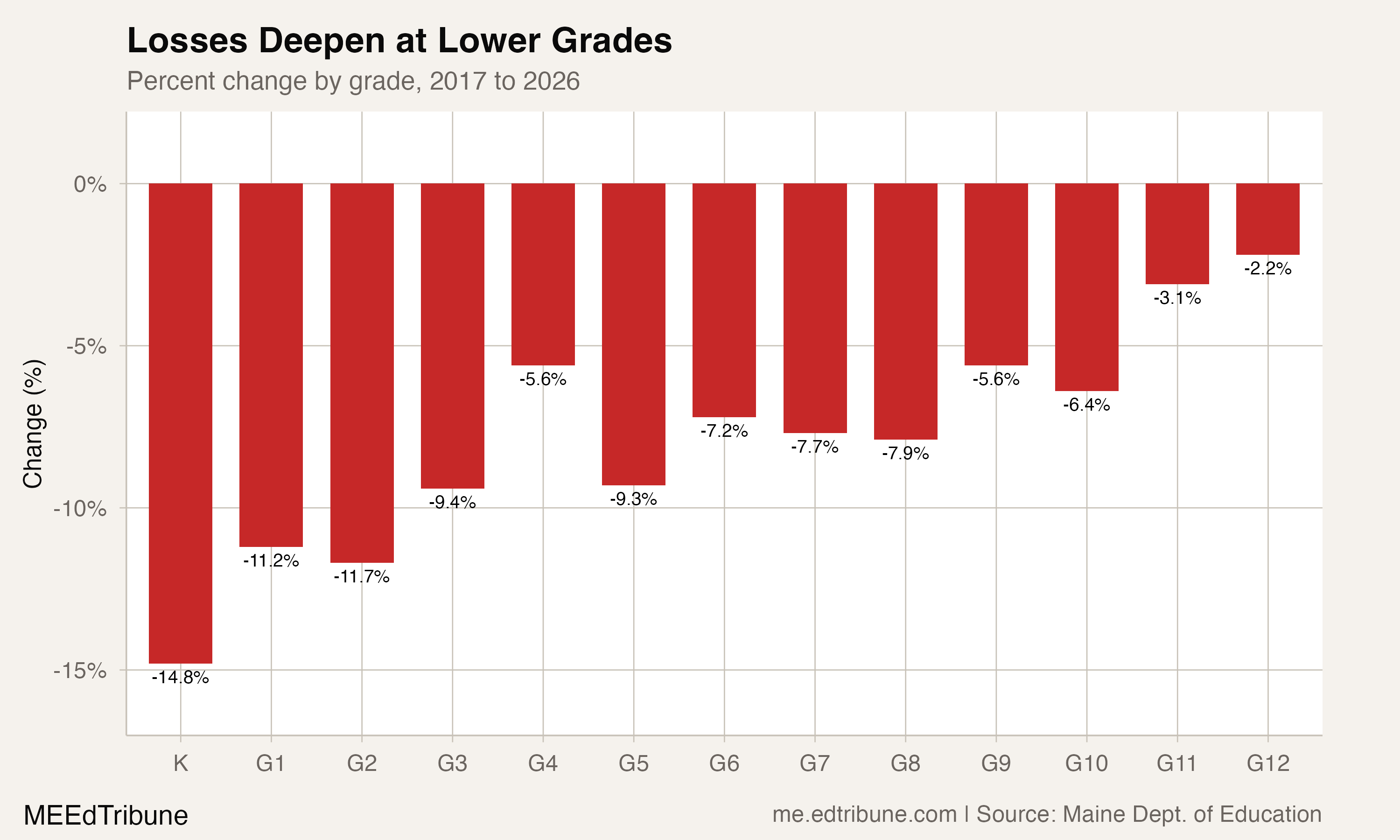
The relationship between grade level and enrollment loss is nearly linear. Kindergarten has lost 14.8% of its enrollment since 2017. Grades 1 and 2 have lost 11.2% and 11.7%, respectively. By grade 4, losses have moderated to 5.6%. The gradient continues upward: grade 9 is down 5.6%, grade 11 is down 3.1%, and grade 12 is down just 2.2%.
This pattern is consistent with a demographic contraction that entered the school system at the bottom and has been working its way up. Each year, a smaller kindergarten class pushes the smaller cohorts one grade higher. The effect has now reached middle school: grades 6 through 8 have lost 7.6% of their enrollment, a steeper decline than any high school grade.
The K-to-G12 ratio captures the trajectory. In 2017, Maine enrolled 90.7 kindergartners for every 100 twelfth graders. By 2026, that ratio has fallen to 78.9. Fewer than four kindergartners now enter the system for every five seniors who leave it.
Where the stability ends
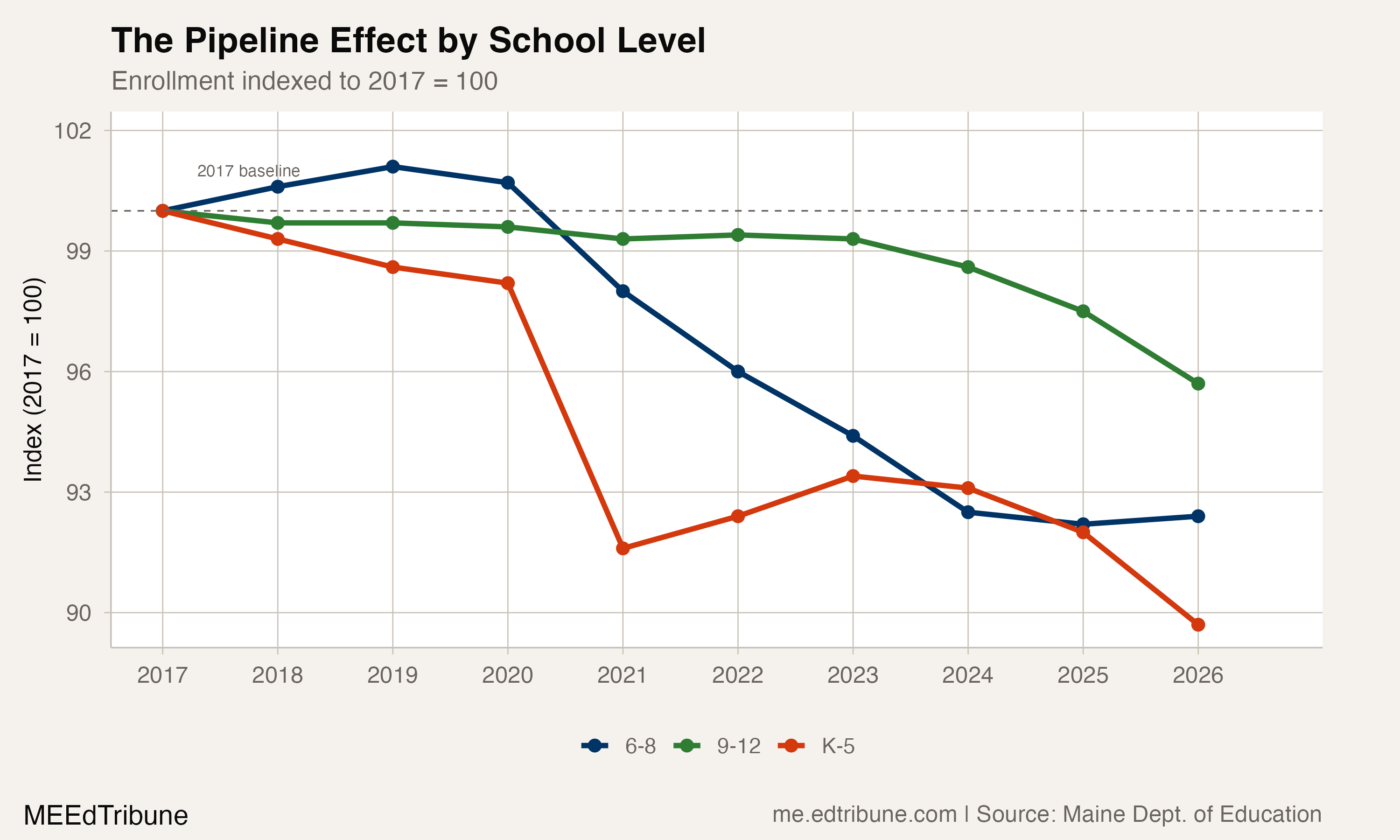
Indexing enrollment to 2017 reveals how the contraction has moved through the system. Elementary schools (K-5) fell first and fastest, dropping to 90 by 2026 on a scale where 2017 equals 100. Middle schools (6-8) held above the baseline through 2019 before beginning their own descent, now sitting at 92.4. High schools (9-12) stayed within two points of baseline until 2024, then began a steeper decline, reaching 95.7 in 2026.
The lag between levels is consistent. K-5 started falling in 2018. Middle schools followed in 2020. High schools did not begin declining meaningfully until 2024. Each level has roughly a two-to-three year delay behind the one below it, which matches the time it takes for smaller cohorts to cycle upward through grade bands.
High school's recent acceleration is notable. After years of fluctuating within a narrow band (never moving more than 190 students in either direction year-over-year), 9-12 enrollment dropped by 635 in 2025 and 1,020 in 2026. The flat era is ending.
High school's growing share
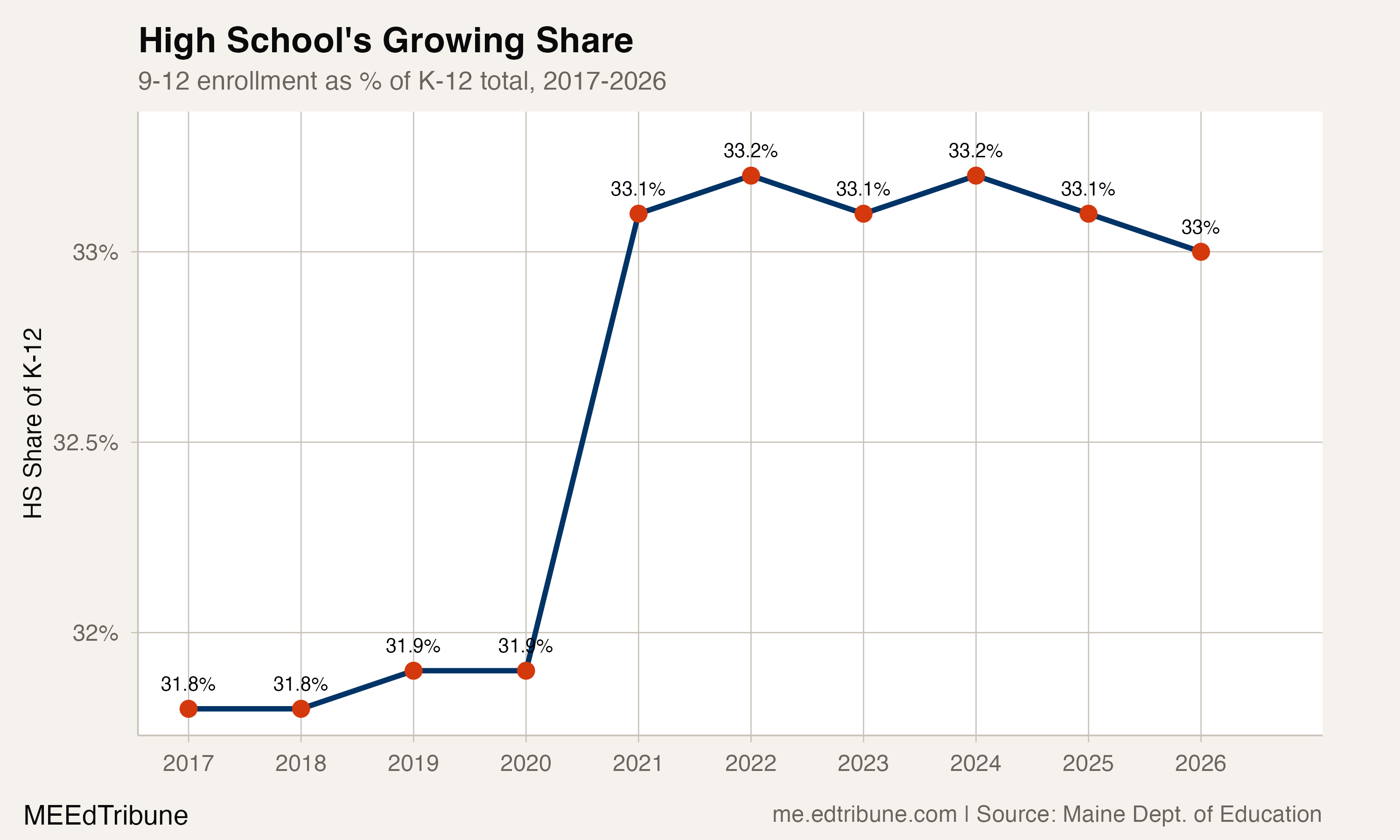
Because K-8 has been shrinking faster than 9-12, high school's share of total K-12 enrollment has grown from 31.8% in 2017 to 33.0% in 2026. The jump was sharpest during COVID, when K-8 lost students at 44 times the rate of high school (6,261 versus 141), pushing the HS share from 31.9% to 33.1% in a single year.
That share has plateaued since 2021, hovering between 33.0% and 33.2%. The plateau reflects a new phase: high schools are now losing students too, roughly in proportion to K-8. But the share itself tells the story of the past decade. One in three Maine K-12 students is now in high school, up from fewer than one in 3.15 nine years ago. That shift has implications for how districts allocate staff, course offerings, and building capacity across grade levels.
What is driving the K-8 collapse
The primary driver is demographic. Maine experienced more deaths than births every year since 2012, and its natural population decline reached 5,019 people in 2025, even as in-migration partially offset the losses. The state has the second-oldest population in the nation, behind only Vermont, with 82.7% of residents at voting age or older. Fewer women of childbearing age means fewer births, which means smaller kindergarten classes five years later.
The birth rate dimension is compounded by choices. Homeschooling spiked during the pandemic and has remained elevated. Maine's school entity count has grown from 493 to 661 since 2017, an increase of 168 entities (34%), reflecting the state's school choice framework that allows towns without their own schools to send students to private academies with public tuition dollars. Some students who would have been in public K-8 classrooms are now scattered across a growing constellation of alternatives.
The high school stability, meanwhile, has a simpler explanation: the large cohorts born between 2002 and 2008, before the birth rate began its steepest decline, are still moving through 9-12. Grade 12 in 2026 consists primarily of students born in 2007 or 2008. When the smaller post-2010 birth cohorts reach high school, the decline that has already swept through elementary and middle schools will arrive at the secondary level.
The fiscal fuse
The delayed nature of this pipeline effect creates a planning trap. Right now, high school enrollment is declining slowly enough that most districts can manage through attrition and minor adjustments. But the data makes the arrival of steeper losses predictable.
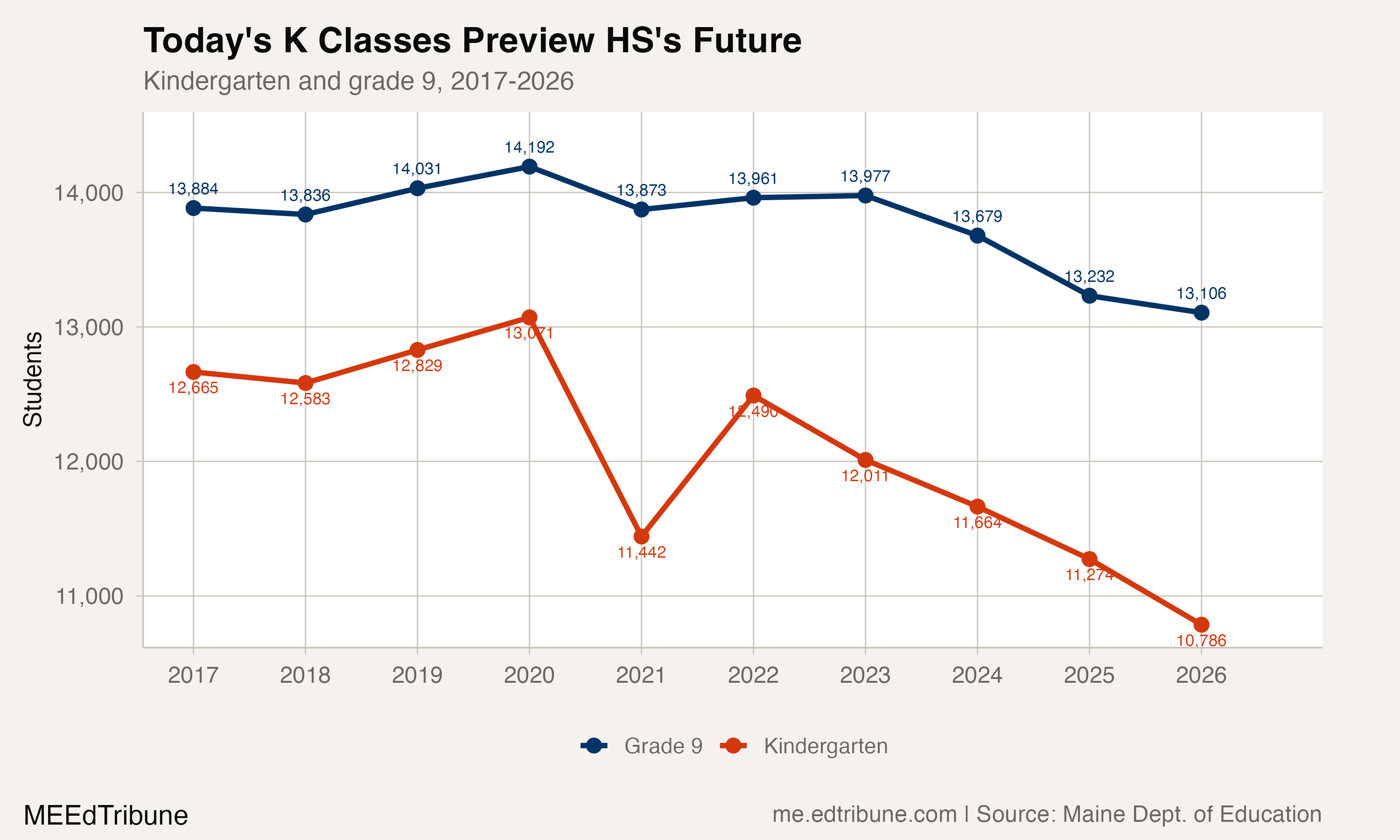
This year's kindergarten class of 10,786 will become roughly next decade's ninth grade class. This year's ninth grade class is 13,106. Even accounting for the students who enter Maine's public high schools from private middle schools (Maine's 8th-to-9th grade transition rate consistently runs above 100%), the incoming pipeline is substantially smaller than what high schools currently serve.
Districts that are already cutting positions and closing buildings at the elementary level will face a second round of contraction at the high school level starting around 2030 to 2034. In Aroostook County, three of the region's largest high schools, Presque Isle, Caribou, and Fort Fairfield, are already exploring consolidation with a combined enrollment of roughly 1,050 students.
"We have to explore all opportunities." — Jane McCall, RSU 39 Superintendent, Bangor Daily News, December 2025
South Portland's school board voted in April 2026 to close Kaler Elementary in June and cut more than 70 positions as declining enrollment eroded its budget. Those cuts targeted the elementary level. The pipeline data says high schools are next.
Aroostook County is not waiting
In the state's far north, three high schools are already acting on what the pipeline data predicts. Presque Isle, Caribou, and Fort Fairfield -- combined enrollment roughly 1,050 -- have applied for a state pilot grant to build a single regional high school with an integrated career and technical education center. RSU 39 Superintendent Jane McCall put it plainly: "If it doesn't happen now, eventually, this likely will happen."
The grant will fund only one project statewide. But the enrollment data makes clear that Aroostook County's math is everyone's math, on a different timeline. This year's kindergarten class of 10,786 is 2,320 students smaller than this year's ninth grade class. Those kindergartners will reach high school around 2035. When they do, every district in Maine will be looking at the same question Presque Isle, Caribou, and Fort Fairfield are trying to answer now.
Detailed code that reproduces the analysis and figures in this article is available exclusively to EdTribune subscribers.
Discussion
Sign in to join the discussion.
Loading comments...