In this series: Maine 2025-26 Enrollment.
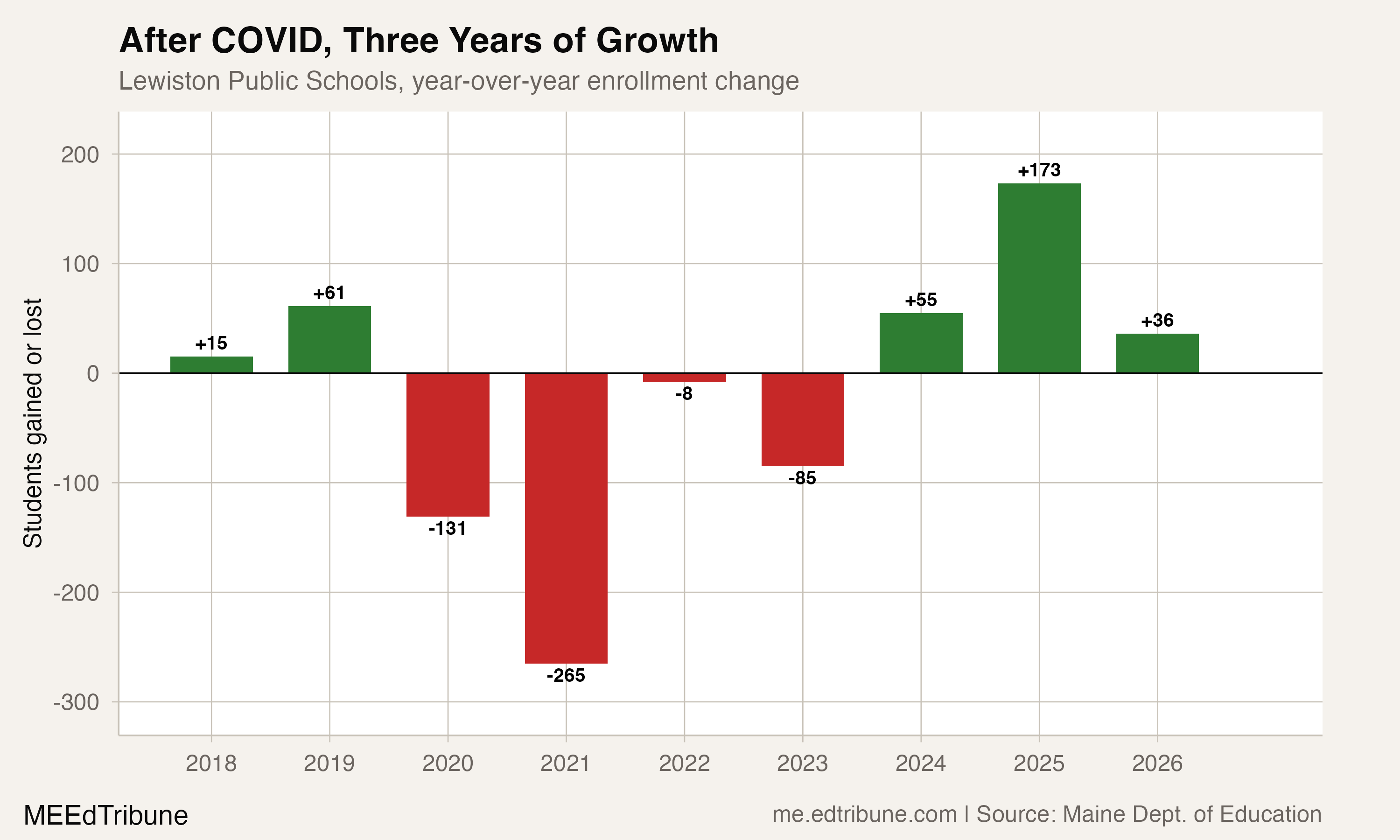
Across the river from Auburn, which has lost 331 students since 2017, Lewiston↗ET is doing something almost no district in Maine can claim. It is growing. Three consecutive years of enrollment gains, from a trough of 5,085 students in 2023 to 5,349 in 2026, have made Maine's second-largest district an outlier in a state that just hit its lowest public school enrollment in at least a decade.
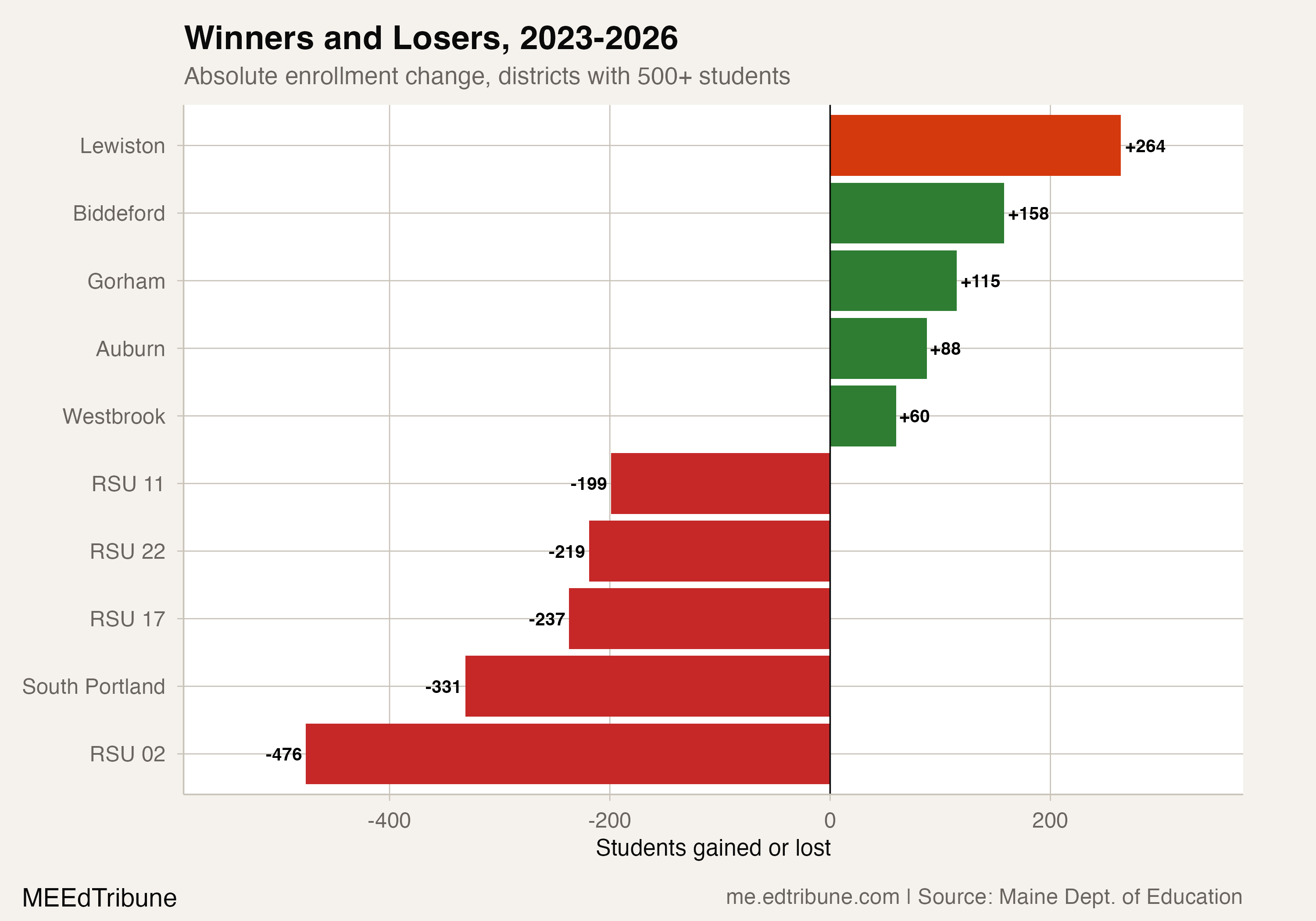
Only 13 of Maine's 254 districts managed to add students in each of the last three years. Lewiston led them all, gaining 264 students since 2023, more than any other district with at least 500 students. The growth is modest in absolute terms. But in a state losing more than 2,000 students a year, any district moving in the opposite direction demands attention.
A Mill Town That Found a Second Act
The story of Lewiston's enrollment trajectory is inseparable from the city's transformation over the past two decades. In 2001, a Somali refugee family discovered Lewiston's affordable housing and low crime and began spreading word to immigrant networks across the country. What followed was one of the most significant secondary migration events in New England history.
By the early 2010s, approximately 7,500 immigrants lived in Lewiston, a city of roughly 37,000. Somali, Congolese, Sudanese, and other African families have settled in what was once a declining post-industrial city. The Lewiston school district now serves students speaking 42 different languages, with Somali the most common non-English language. The district's student body is 42% Black and 46% white, a demographic profile that would be unremarkable in most American cities but is extraordinary in Maine, where 84.4% of all public school students statewide are white.
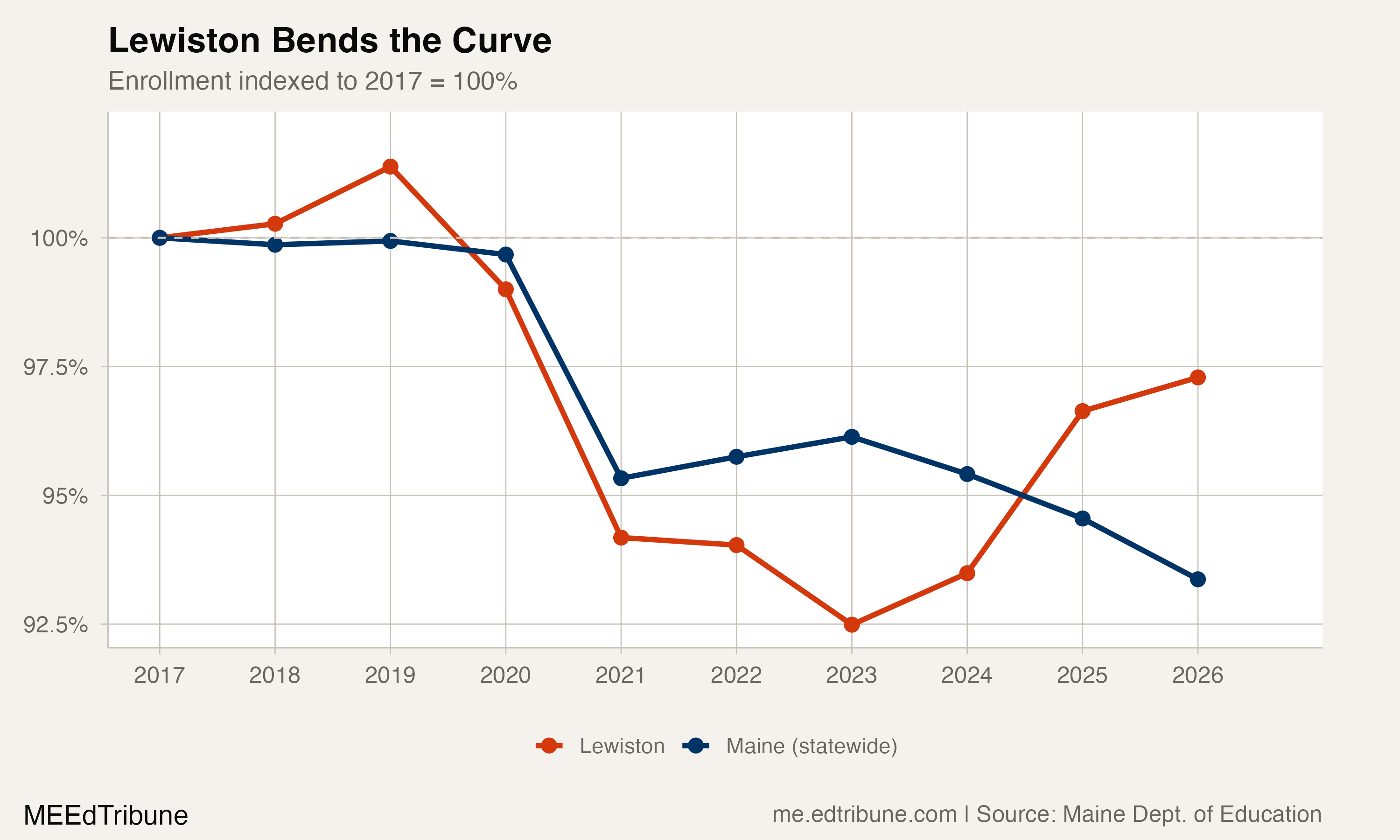
The enrollment numbers trace the arc of this transformation. Lewiston peaked at 5,574 students in 2019, lost 489 students through the pandemic years to bottom out at 5,085 in 2023, then reversed course. The 173-student gain in 2025 was Lewiston's largest single-year increase in the dataset.
The Twin City Divergence
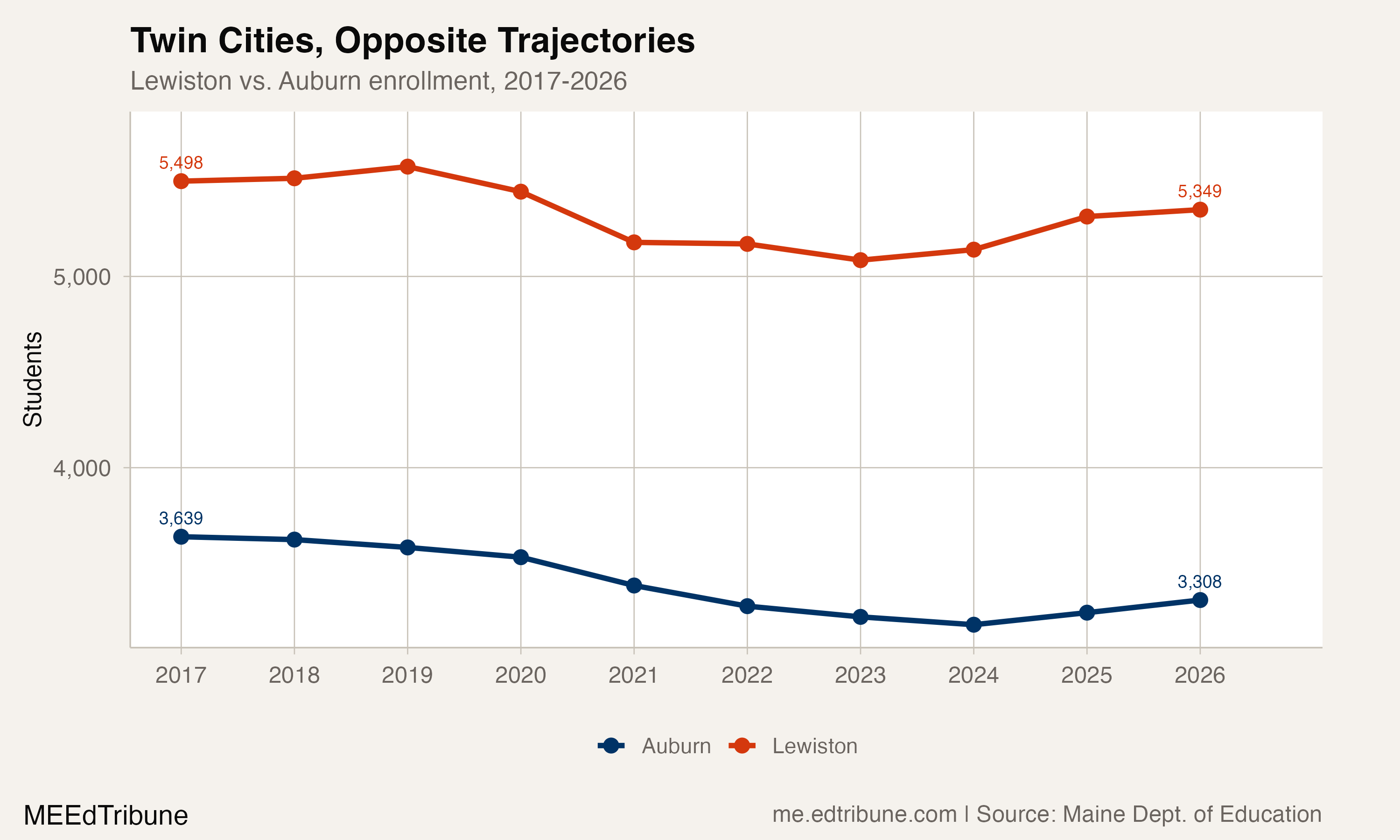
The contrast with Auburn↗ET sharpens the picture. The two cities sit on opposite banks of the Androscoggin River, share a metro area, and are often spoken of in the same breath. Their school systems have followed opposite paths.
Auburn enrolled 3,639 students in 2017. By 2024, after seven consecutive years of decline, it had fallen to 3,179, a loss of 460 students (12.6%). Auburn has shown signs of stabilizing in the last two years, adding 63 and 66 students respectively, but it remains 331 students below its 2017 level.
Lewiston, by contrast, is only 149 students (2.7%) below its 2017 mark and closing the gap. The difference between the two cities is not geography, not economics, not school quality ratings. It is immigration. Auburn does not have a large immigrant community. Lewiston does.
Growing Pains Are Real
Lewiston's growth has created a problem most Maine districts would envy: the schools are running out of room. Superintendent Jake Langlais told city councilors in April 2025 that enrollment had surpassed 6,000 students (a figure that includes programs beyond the state's October count), adding roughly 1,000 students in four years. "I'm hopeful it grows more slowly, because if it grows too quickly, we will reach capacity all over the place," Langlais said.
The district purchased a former Central Maine Healthcare building on Main Street and requested $1 million in the city's Capital Improvement Plan to design its conversion into educational space. Mayor Carl Sheline framed the capacity crunch as a sign of vitality: "This is really a good problem to have."
The infrastructure challenge underscores a paradox in Maine's funding formula. Per-pupil funding follows students, so growing districts receive more state aid. But Lewiston's growth comes with disproportionate costs. The district's multilingual education department, led by Director Lysa McLemore, supports students across seven primary languages. The instructional programs these students receive carry higher per-pupil costs than general education, and the gap between state reimbursement and actual cost of multilingual services is a persistent pressure point.
The State Is Going the Other Direction
Lewiston's trajectory is notable precisely because Maine's is so bleak. The state lost 11,994 students between 2017 and 2026, a 6.6% decline to an all-time low of 168,923. The losses are accelerating: 1,307 in 2024, 1,562 in 2025, 2,134 in 2026.
Maine's demographics explain much of it. The state recorded 5,019 more deaths than births in 2025, and its total fertility rate of 1.45 births per woman ranks among the lowest nationally. Any population growth the state experiences comes entirely from migration.
That is precisely what makes Lewiston's story significant at scale. Statewide, Black student enrollment grew 50.3% between 2017 and 2026, from 6,256 to 9,403, driven overwhelmingly by immigrant families in Lewiston and Portland↗ET. English learner enrollment grew 54.3% over the same period, from 5,376 to 8,293. These are the fastest-growing segments of Maine's student population, and they are concentrated in a handful of cities.
The January 2026 Disruption
The growth trajectory hit a sudden complication in January 2026 when ICE launched "Operation Catch of the Day" across southern and western Maine, arresting more than 200 people. Across Maine's most diverse districts, absence rates for multilingual students approached or exceeded 50% at the height of the operation, with more than 4,000 students statewide missing school on a single day.
In Lewiston, Superintendent Langlais confirmed that ICE had not conducted enforcement at schools, bus stops, or school events, but acknowledged a rise in absences as fear spread through the community. Mayor Sheline disputed ICE's characterization of the operation as targeting criminals, noting that agents had detained "a Lewiston mother of an autistic son" and "a father of a newborn child."
The enrollment data in this analysis reflects the state's October count, taken months before the ICE operation began. Whether immigration enforcement affects Lewiston's 2027 enrollment count, through families leaving or keeping children home, is the most consequential open question facing the district.
A building on Main Street
The tension between a city running out of classroom space and a state running out of students is the Lewiston story in miniature. The district now accounts for 3.17% of Maine's total enrollment, up from 3.04% in 2017. That share will keep climbing as long as the state shrinks and Lewiston does not. After the January ICE operations, the more urgent question is whether the families who filled those classrooms will still be in Lewiston when the October count arrives.
Detailed code that reproduces the analysis and figures in this article is available exclusively to EdTribune subscribers.
Discussion
Sign in to join the discussion.
Loading comments...