In this series: Maine 2025-26 Enrollment.
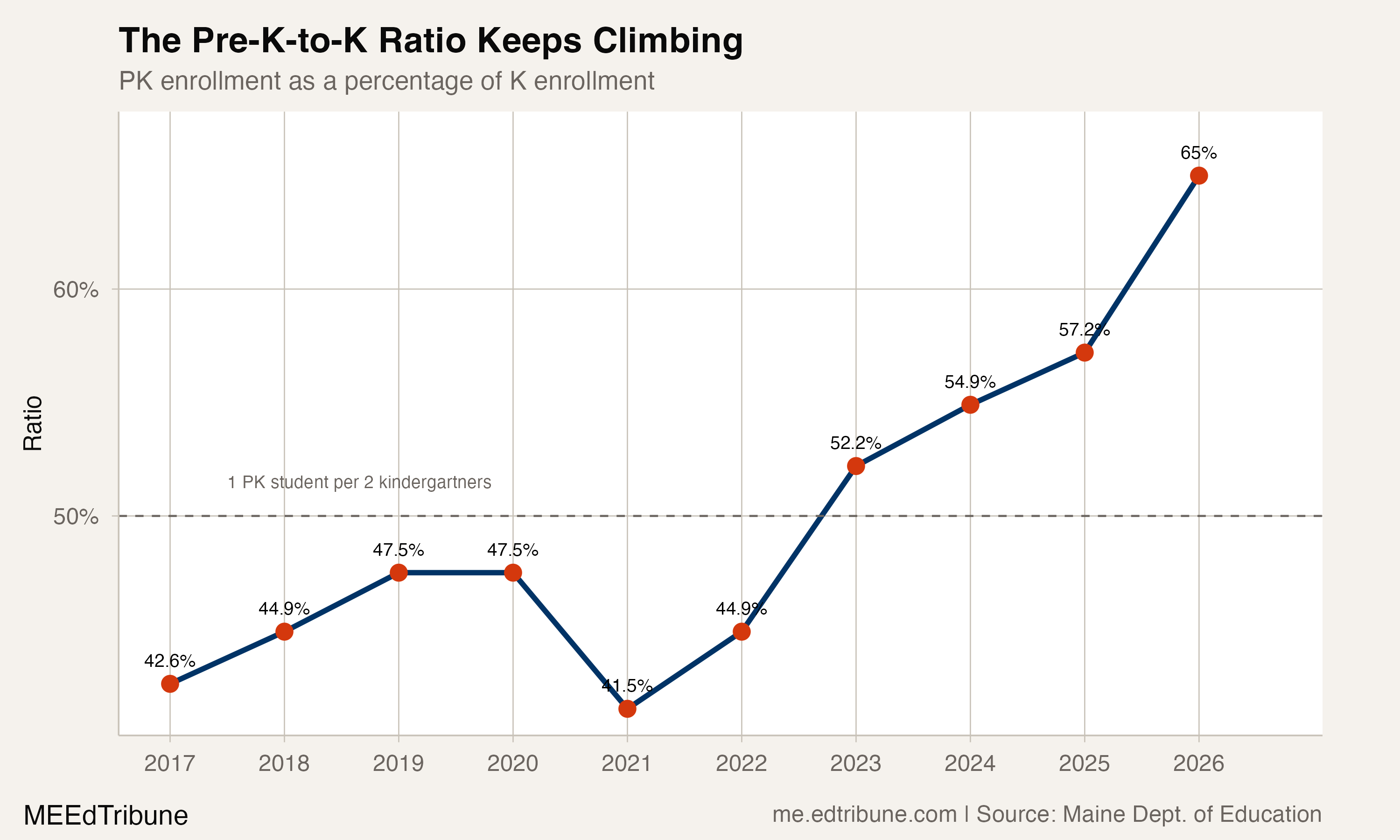
Maine now enrolls nearly two pre-kindergarten students for every three kindergartners. In 2017, the ratio was closer to two for every five.
That shift, from 42.6% to 65.0%, captures two forces pulling in opposite directions. Pre-K enrollment grew 30.0% over nine years, from 5,395 to 7,016 students, as the state pushed toward universal access for four-year-olds. Kindergarten enrollment fell 14.8% over the same period, from 12,665 to 10,786, the steepest decline of any grade. No other grade lost more students in absolute terms or percentage terms. The state's pre-K classrooms are filling; the pipeline feeding kindergarten is not.
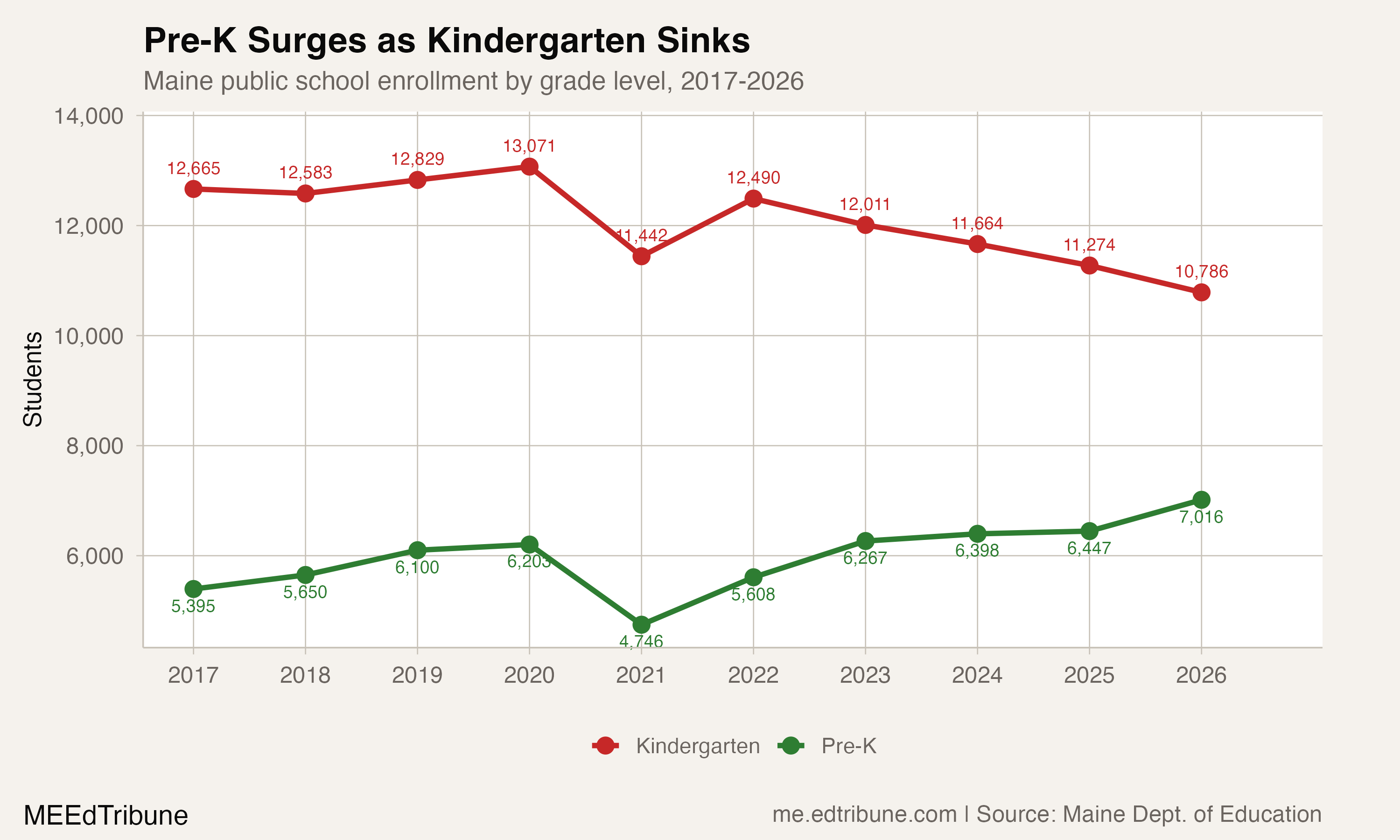
The kindergarten cliff is accelerating
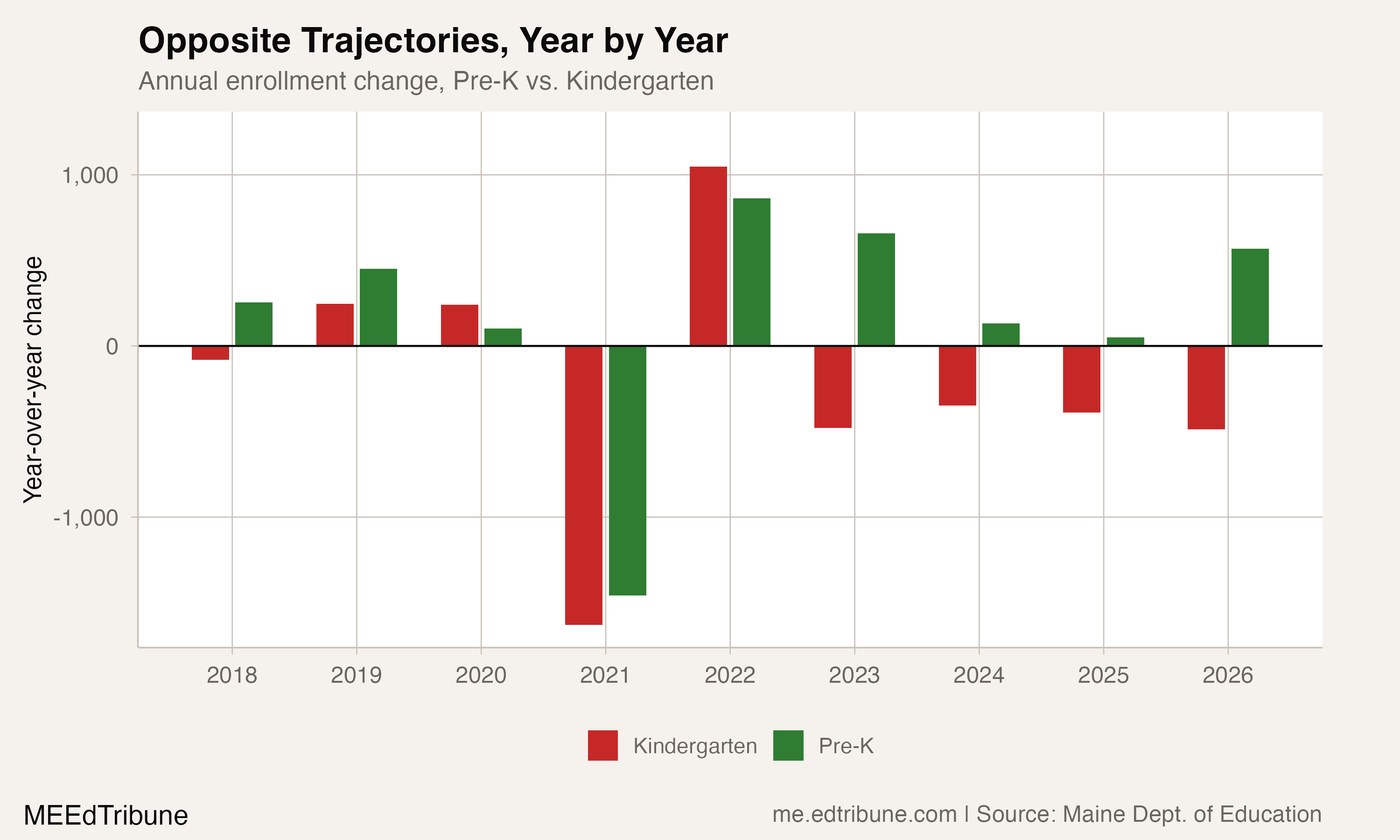
Kindergarten has fallen every year since a brief COVID recovery in 2022 (when K enrollment bounced back to 12,490). The losses: 479 students in 2023, 347 in 2024, 390 in 2025, and 488 in 2026. The 2026 drop was the largest of the four. The 2026 kindergarten class of 10,786 is the smallest in the dataset.
The pattern tracks roughly by age: younger grades lost more. Kindergarten fell 14.8%. Second grade fell 11.7%. First grade fell 11.2%. By 12th grade, the decline was just 2.2%. This is the signature of a birth rate decline working its way through the system. Smaller birth cohorts hit kindergarten first, then ripple upward year by year.
Pre-K is the sole exception. It is the only grade level in Maine that grew over nine years, adding 1,621 students while every other grade shrank.
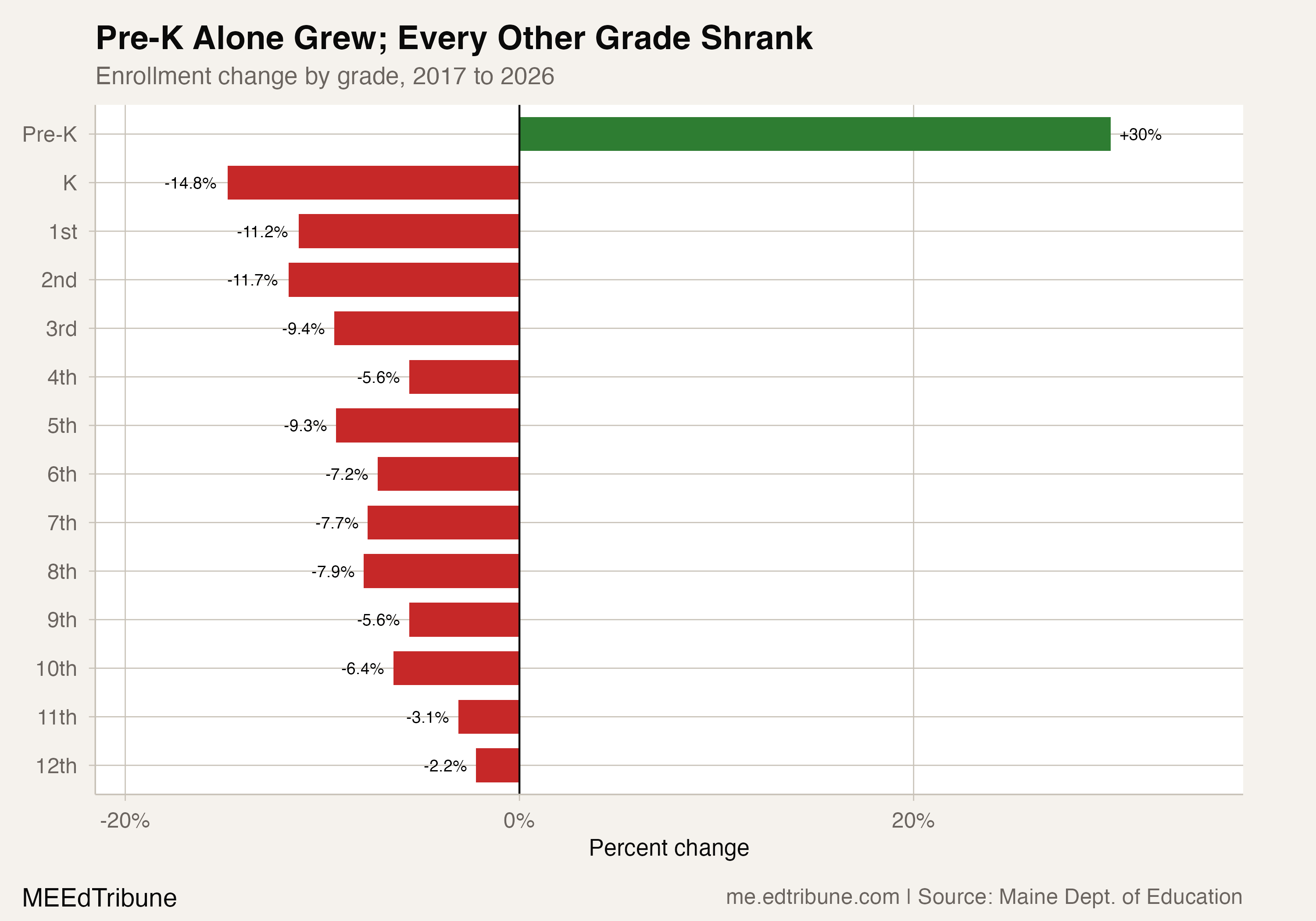
A policy success running into a demographic wall
The pre-K surge is not organic. It is the direct result of state policy. In July 2023, Maine passed LD 1799, setting targets for universal pre-K: access for 60% of four-year-olds by 2024-25, 80% by 2025-26, and 100% by 2026-27. Before that, the state had already allocated $10 million from the Maine Jobs and Recovery Plan for pre-K expansion grants, funding 32 school administrative units across four rounds.
The results show in the enrollment data. Pre-K grew in eight of nine year-over-year comparisons, including a jump of 569 additional students in 2026, an 8.8% increase in a single year. By 2023, roughly 52% of Maine's four-year-olds were enrolled in public pre-K, up from a far smaller share years earlier.
But the expansion has not been smooth. As of early 2024, only 43% of districts offered universal pre-K access, well short of the 60% target. The state's education funding formula is the central obstacle: it provides the same per-pupil amount for half-day and full-day programs, and does not account for the higher staffing ratios that pre-K requires. Pre-K classrooms need one staff member for every eight students, compared to one for every 25 in kindergarten.
"That's probably one of the biggest issues... the way the funding formula is operating, it's not accounting for that extra staffing." — Lee Anne Larsen, Early Learning Director, Maine Department of Education, Piscataquis Observer, March 2024
The perverse result: districts are incentivized to run multiple half-day sessions rather than offer full-day programming, because more students cycling through shorter sessions generates more state funding.
What pre-K growth cannot fix
The PK-to-K ratio has climbed from 42.6% to 65.0% since 2017. That number could be read as progress: more children entering the public school system earlier. But it also reflects the denominator shrinking.
The combined PK-plus-K pipeline tells a more sobering story. In 2020, Maine enrolled 19,274 students across those two grades. By 2026, that number had dropped to 17,802, a loss of 1,472 students, or 7.6%. Pre-K's growth partially offset kindergarten's collapse, but not enough. There are simply fewer young children in Maine.
Maine's deaths outnumber its births, a pattern that has persisted for over a decade. The state recorded approximately 11,621 births in 2023, with a fertility rate of 47.0 per 1,000 women ages 15-44, below the national average. The children entering kindergarten in 2025-26 were born in 2019 and 2020. The children entering kindergarten in 2030 were born in 2024, in a state where births continue to hover near historic lows.
This is the uncomfortable math behind the PK-to-K ratio. Even if Maine achieves universal pre-K by its 2026-27 deadline, the kindergarten classes those children feed into will keep shrinking unless birth trends reverse. Pre-K expansion is a policy success. It is not a demographic solution.
The budget squeeze is already here
The fiscal consequences are not abstract. Roughly 40% of Maine's districts will see their state funding share decrease in 2026-27. Maine's EPS formula sends dollars based on student counts. Fewer kindergartners in 2025-26 means fewer first graders in 2026-27, and the funding reduction follows the cohort upward.
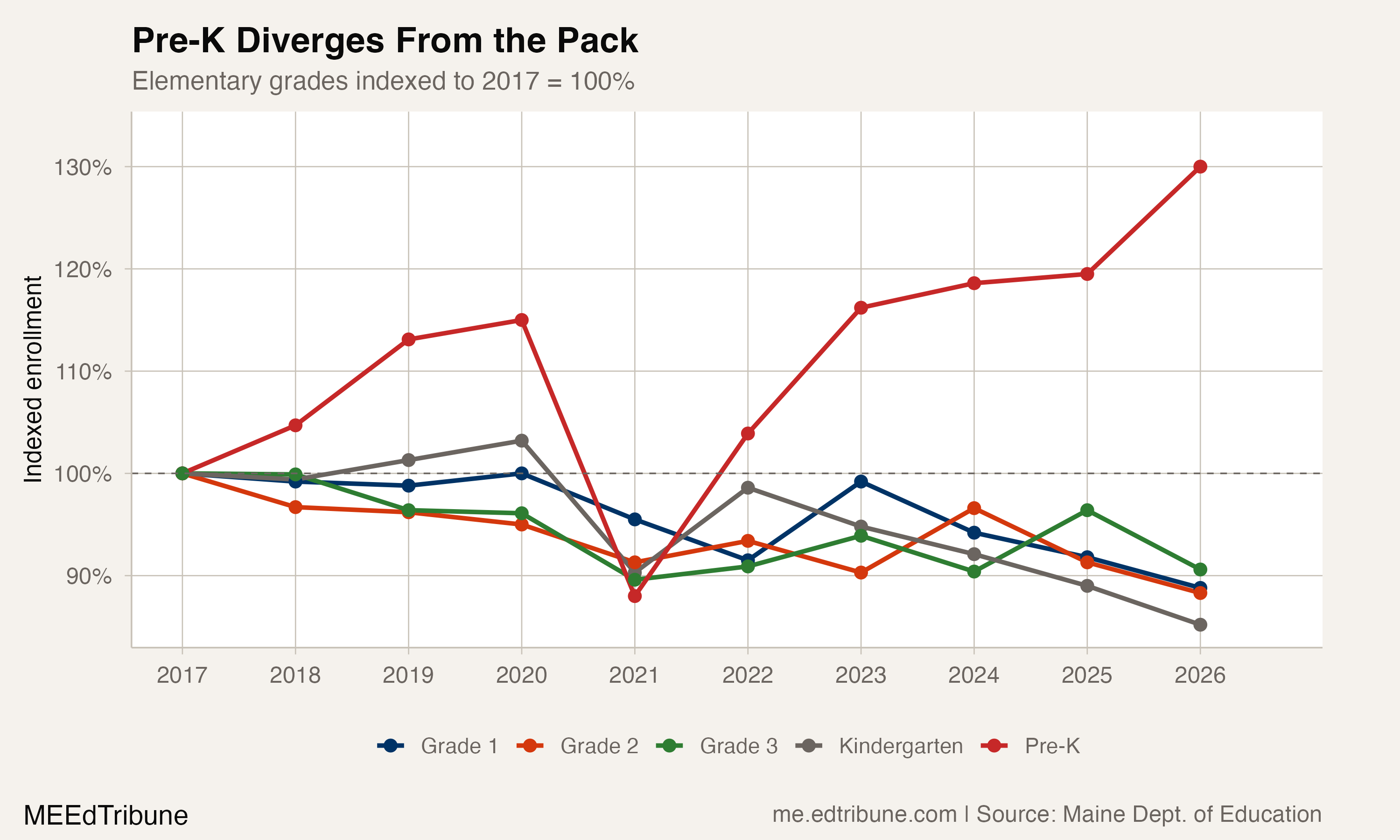
The indexed pipeline chart reveals how far pre-K has diverged from its peers. When each grade's enrollment is benchmarked to its 2017 level, pre-K stands at 130% while kindergarten sits at 85%. Grades 1 through 3 cluster between 88% and 91%, tracking closer to kindergarten than to pre-K. The expansion of public preschool created a new peak at one end of the pipeline without preventing the erosion at the other.
The deadline arrives
The 2026-27 school year is the deadline for Maine's universal pre-K mandate: 100% access for four-year-olds. Only 43% of districts offered it as of early 2024. The funding formula pays the same per-pupil rate for half-day and full-day programs and does not account for the one-to-eight staffing ratio pre-K requires. Districts have been running multiple half-day sessions instead of full-day programs because the math works better that way.
In Bangor, early results from full-day pre-K show students reading by the end of the year and arriving at kindergarten more prepared. That is the case for the investment. The case against is arithmetic: Maine recorded approximately 11,621 births in 2023. Those children will enter kindergarten around 2028 or 2029, and there will be fewer of them than the 10,786 who showed up in 2025-26. Pre-K expansion is working. The children it serves are a shrinking group.
Detailed code that reproduces the analysis and figures in this article is available exclusively to EdTribune subscribers.
Discussion
Sign in to join the discussion.
Loading comments...