In this series: Maine 2025-26 Enrollment.
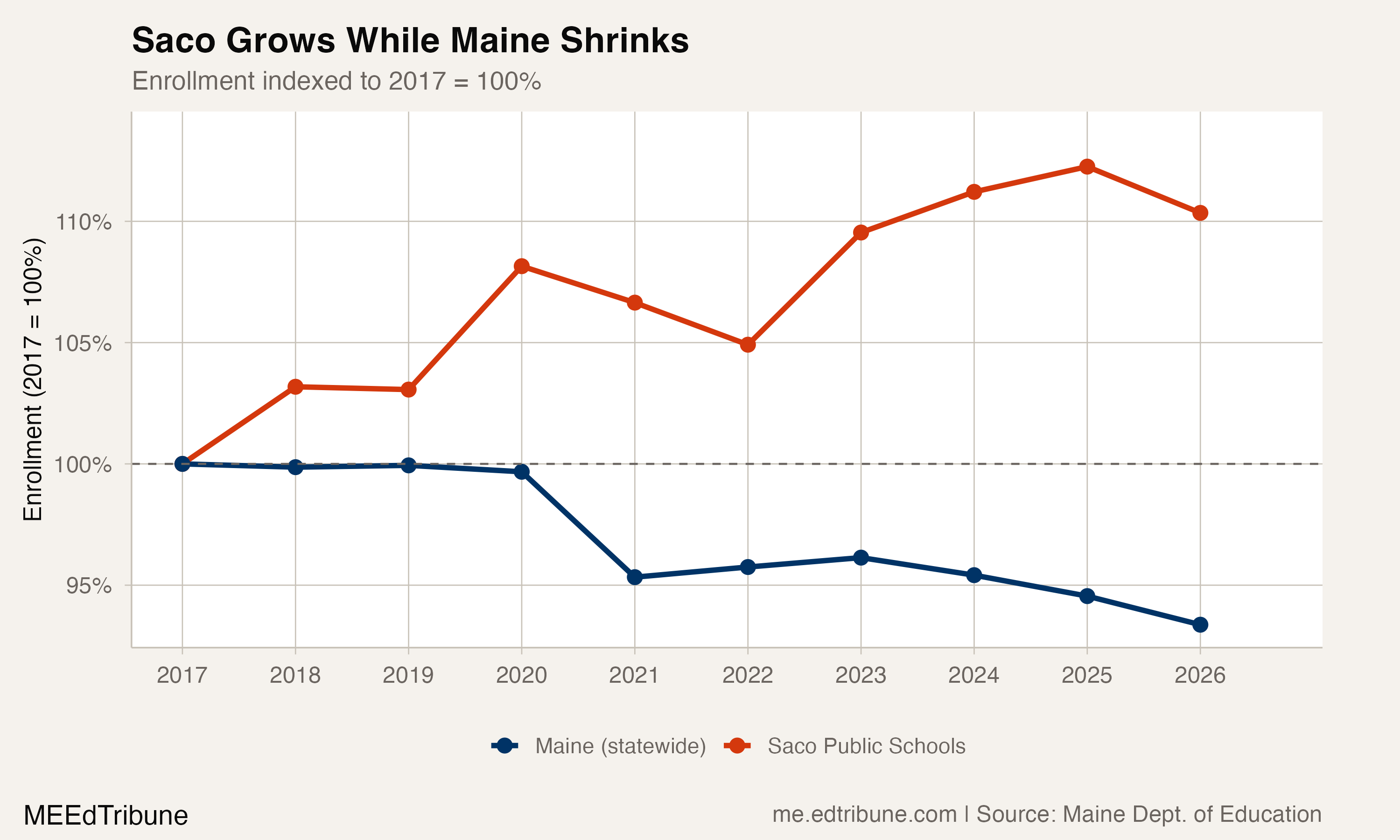
In a state where 88 districts just hit their lowest enrollment on record, Saco↗ET added 179 students. That 10.3% gain since 2017 makes Saco Public Schools the largest traditional district gainer in Maine, a distinction that belongs to a city of 21,000 wedged between Portland's rising prices and the Turnpike's southbound on-ramp.
The growth is real but not linear. Saco peaked at 1,942 students in 2025 before dipping to 1,909 this year, a 33-student pullback that still leaves the district 10.3% above its 2017 baseline of 1,730. Statewide, Maine lost 11,994 students over the same span, a 6.6% decline to an all-time low of 168,923.
Where Portland's housing market meets the Turnpike
The most likely explanation for Saco's growth is straightforward: families priced out of Greater Portland are moving north along the I-95 corridor, and Saco sits at the sweet spot where commute times remain tolerable and home prices have not yet caught up.
Portland's median home price has climbed past $525,000 in the coastal southern Maine market, according to housing analysts. Portland real estate broker Rob Edgerley described the dynamic to the Bangor Daily News:
"Portland has gotten very expensive and the peninsula of Portland has almost become a luxury market." — Bangor Daily News, Jan. 2026
Edgerley noted that buyers have "had to go further away or up the turnpike because the price point in Portland has risen." The Bangor Daily News analysis found that Maine's hottest housing markets in 2025 clustered almost entirely around Portland commuter towns, with no northern or central Maine communities making the list.
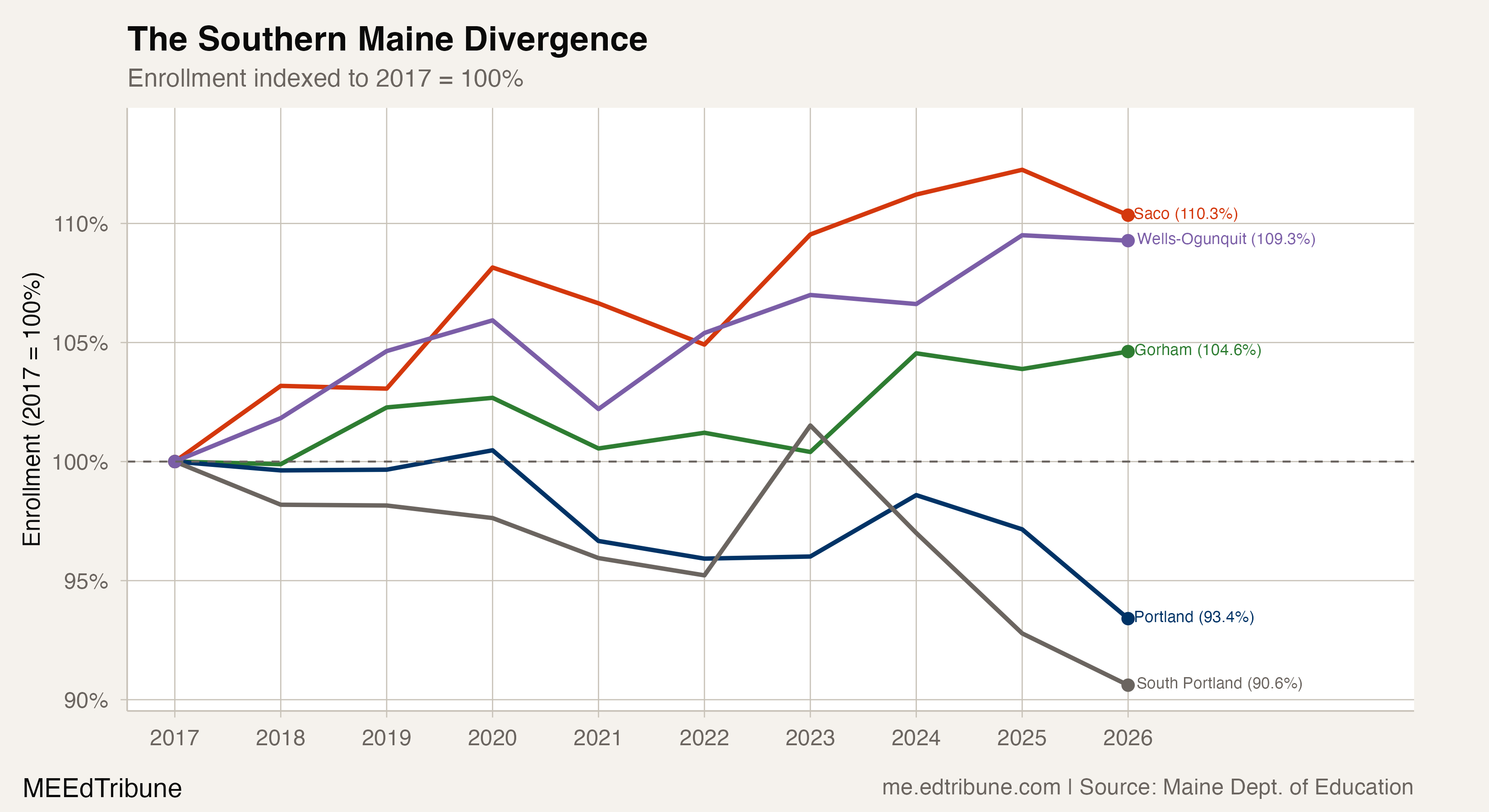
Portland↗ET itself lost 445 students over the same period, a 6.6% decline that mirrors the state average exactly. South Portland↗ET fell harder, losing 285 students (9.4%).
Saco is building where others are not
Saco's enrollment growth tracks with an active residential construction pipeline. The Portland Press Herald reported in February 2025 that the city could add over 200 new housing units across several projects, including a 34-duplex apartment complex near Thornton Academy projected for 2026 completion, a 195-unit development at Park North, and a 126-unit project on Portland Road. The city is seeing what planners describe as "tons of single-family development" in the 1,800- to 2,200-square-foot range.
Saco's population grew 4.7% between the 2020 census (20,419) and 2026, reaching an estimated 21,386, compared to essentially flat population growth statewide.
The growth corridor has limits
Saco does not grow alone. Wells-Ogunquit↗ET added 122 students (+9.3%) and Gorham↗ET gained 126 (+4.6%) over the same period. These three districts form a corridor of growth in a region where most of their neighbors are shrinking.
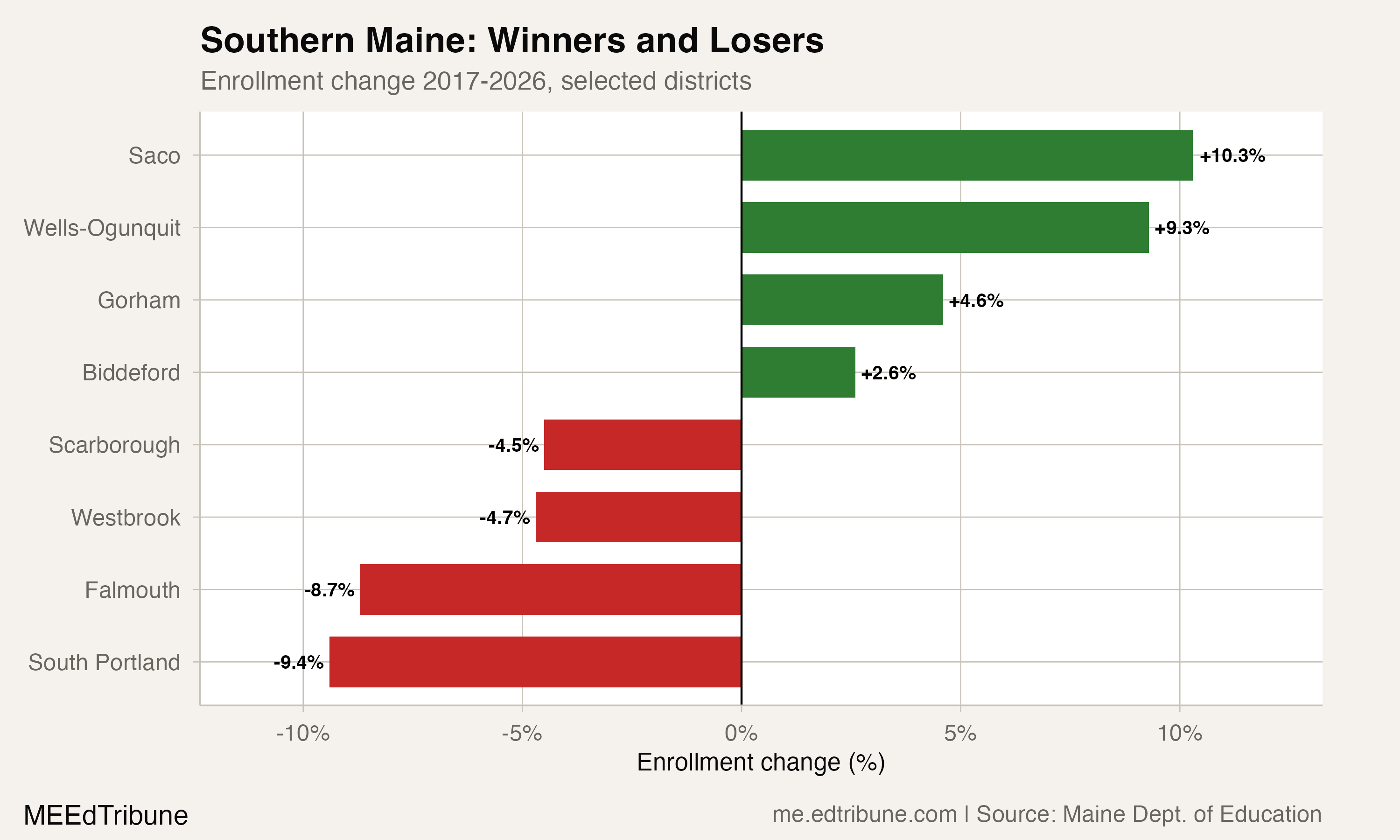
The split is sharp. Falmouth lost 8.7%. Cape Elizabeth lost 7.1%. Scarborough, which sits between Portland and Saco, lost 4.5%. The pattern suggests that growth is concentrating in communities where housing remains relatively affordable, not in affluent suburbs where home prices have already risen beyond young-family budgets.
Gorham's trajectory may steepen. A 565-unit residential development on Robie Street received Planning Board approval in February 2026. Gorham Superintendent Heather Perry estimated the full build-out could add 75 to 95 students, though she told the Press Herald that "it is probably still too early to tell what the impacts on the schools may be." Village Elementary School already operates at 94% capacity.
Five growth years, four decline years
Saco's trajectory is not a simple upward line. The district grew in five of nine years, with two pronounced surges: +88 students in 2020 (pre-COVID data, reflecting fall 2019 arrivals) and +80 in 2023. The intervening COVID years brought back-to-back losses of 26 and 30 students in 2021 and 2022 before the rebound.
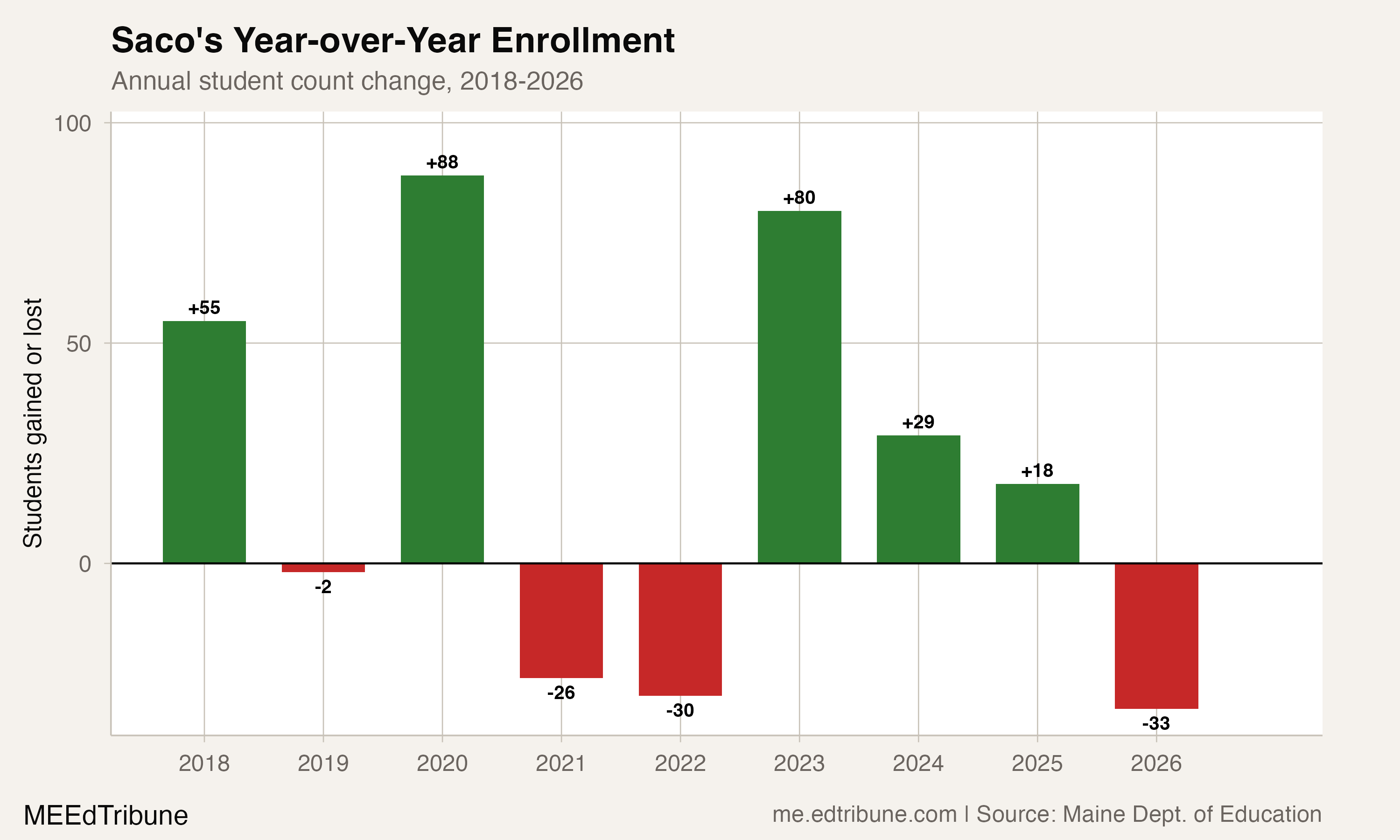
The 2026 dip of 33 students is worth watching. It could be normal fluctuation in a district of fewer than 2,000 students, where a single large kindergarten class rolling through can swing the total. It could also reflect the broader headwinds that have pushed Maine's decline past 2,000 students per year for the first time.
What housing growth cannot solve
Maine's enrollment problem is fundamentally demographic. The Federal Reserve Bank of Boston found that northern New England faces structurally declining K-12 enrollment driven by low birth rates and an aging population. The state needs 84,000 new housing units by 2030 to address its shortage, but more housing does not automatically mean more school-age children. Many new units serve retirees, remote workers, or childless households drawn to Maine's quality of life.
Even in the growth corridor, the numbers are modest. Saco's 179-student gain over nine years represents 1.5% of the state's 11,994-student loss. If every district in southern Maine grew at Saco's rate, it would barely dent the broader decline.
Maine Public reported that 73% of Maine school districts lost enrollment between 2019 and 2024, compared to 68% nationally. Saco's housing pipeline has fueled its growth so far. The 2026 dip, the first in four years, will tell us whether the corridor is still expanding or starting to converge with the rest of the state.
Detailed code that reproduces the analysis and figures in this article is available exclusively to EdTribune subscribers.
Discussion
Sign in to join the discussion.
Loading comments...