In this series: Maine 2025-26 Enrollment.
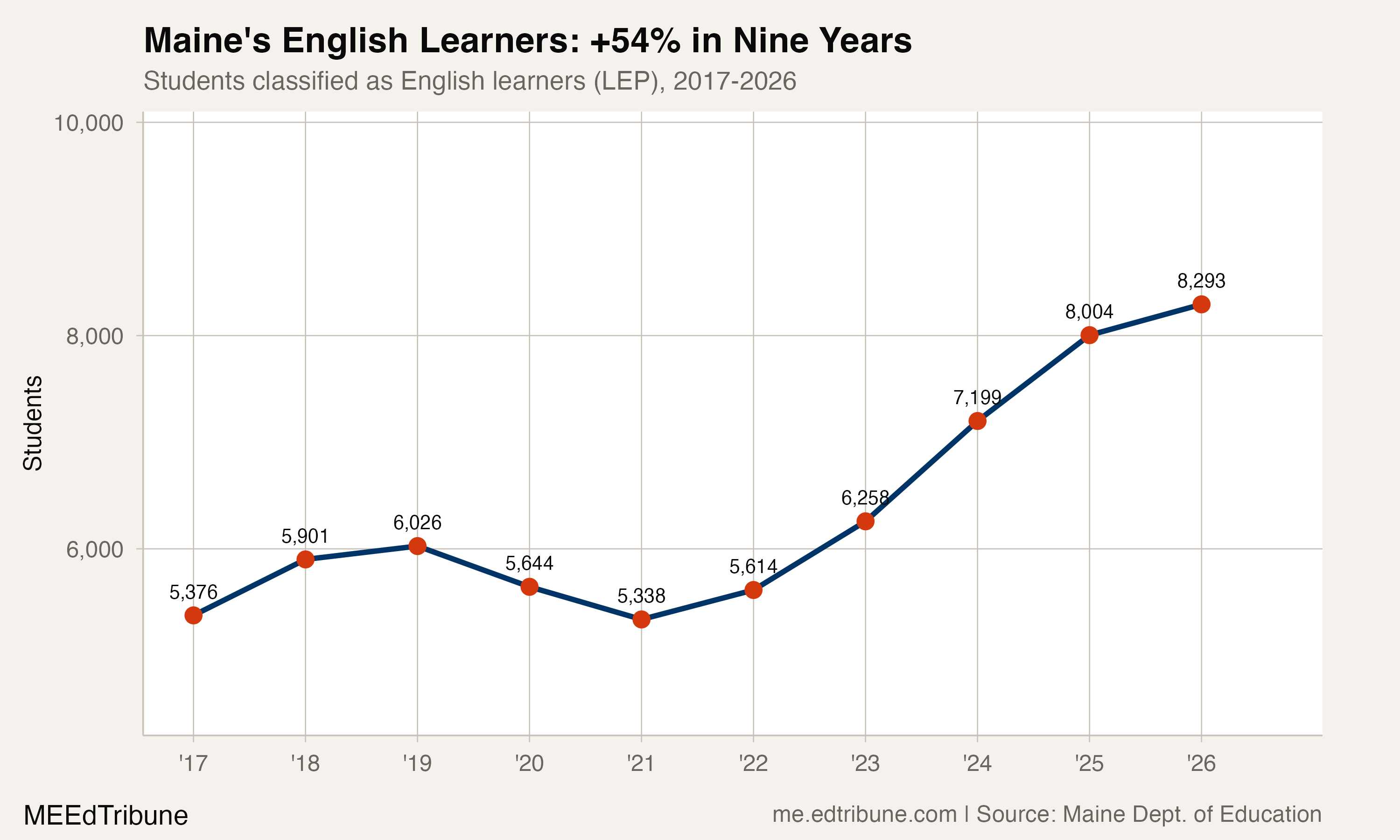
Nine years ago, Maine's public schools enrolled 5,376 English learners. This year, the number is 8,293. That 54.3% increase happened while the state lost nearly 12,000 students overall, a collision of trends that is changing what Maine classrooms look like, what they cost, and who teaches in them.
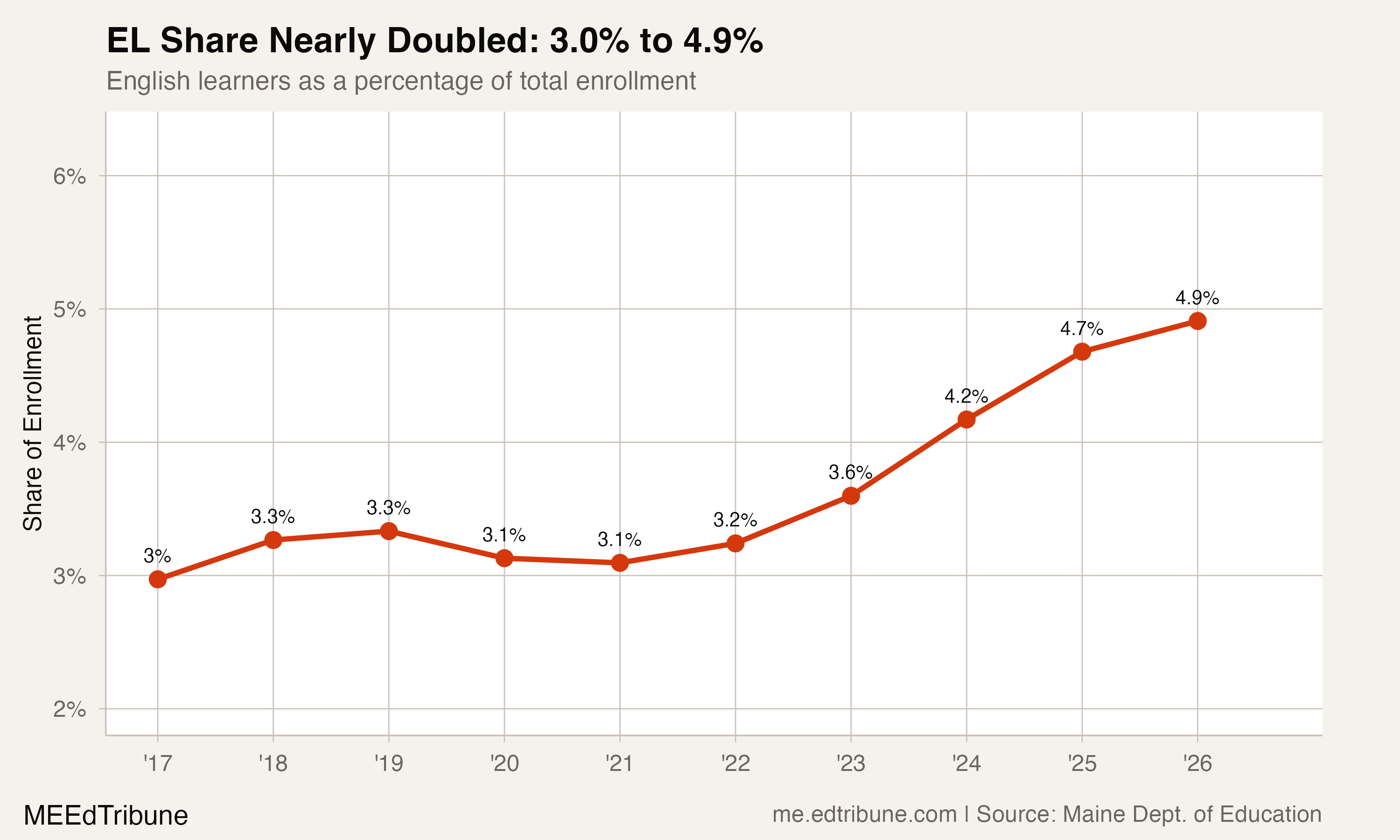
English learners now account for one in 20 Maine students, up from one in 33 in 2017. The share has grown from 3.0% to 4.9%, a shift that looks modest as a percentage but represents 2,917 additional students who need specialized instruction in a state where "English for Speakers of Other Languages" is already a designated teacher shortage area.
The growth is not evenly distributed across the decade. From 2018 to 2022, Maine's EL count barely moved, averaging a net gain of just 48 students per year. Then something broke open. From 2023 to 2026, the average annual gain jumped to 670, a fourteen-fold acceleration that tracks directly with a surge in asylum seekers arriving in southern Maine.
The acceleration, year by year
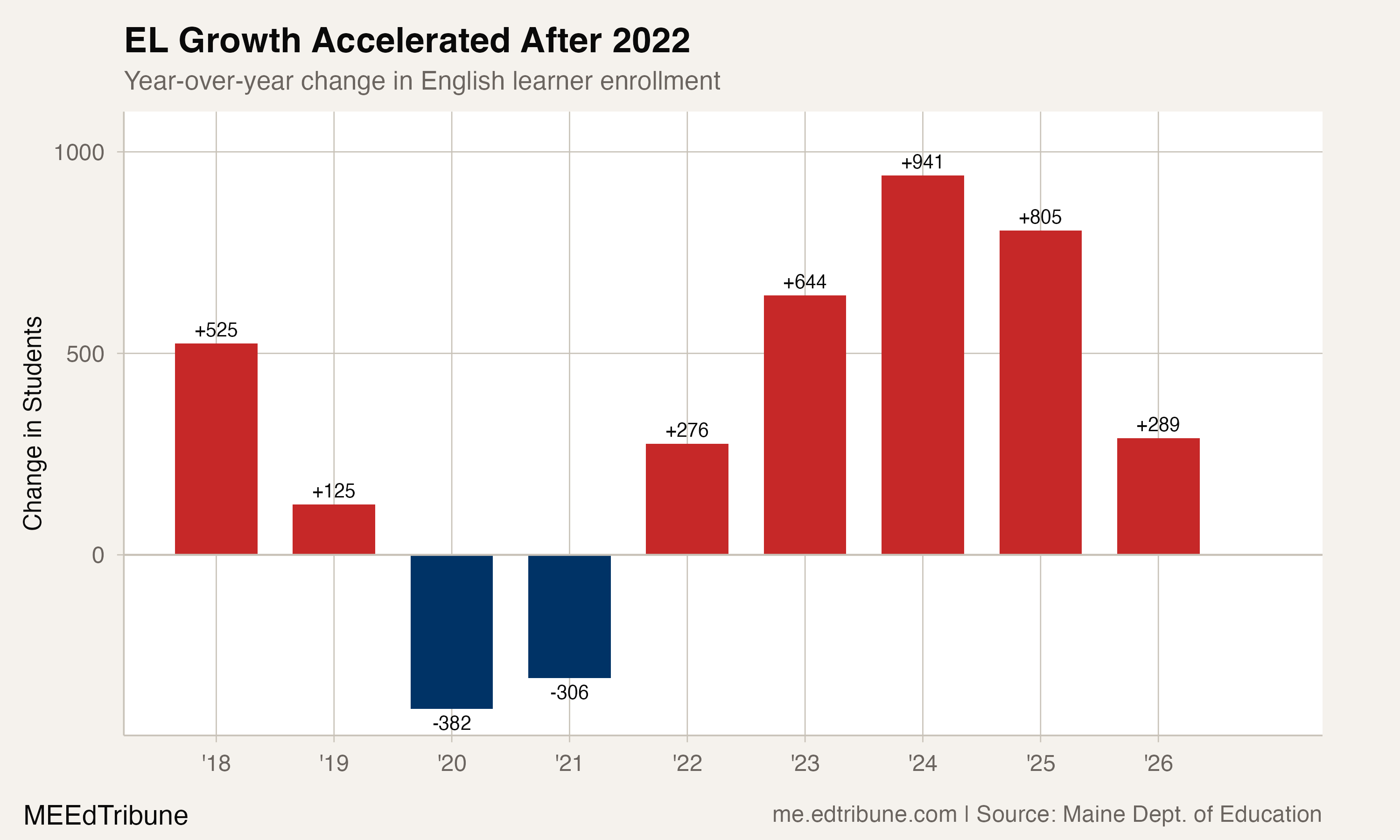
The year-over-year pattern tells the story more precisely than the nine-year total. Maine's EL population actually fell during COVID: down 382 students in 2020, down another 306 in 2021. International migration slowed, visa processing froze, and some immigrant families left the state.
Recovery began in 2022 (+276), then escalated: +644 in 2023, +941 in 2024, +805 in 2025. Of the 2,917 EL students Maine added over the full nine-year window, 2,679 arrived in the last four years alone. That concentration matters for school budgets, staffing pipelines, and classroom composition: districts had little time to ramp up capacity before the demand arrived.
The 2026 number (+289) marks a sharp deceleration from the prior three years. Whether that reflects a natural plateau, changes in federal immigration enforcement, or the state's decision to wind down its transitional housing program for asylum seekers is not yet clear from enrollment data alone.
Where the students are, and where they are not
Maine's EL data is available only at the state level, so the enrollment figures here cannot be broken into district-by-district counts. But the geographic concentration is well documented. Portland Public Schools↗ET enrolls roughly 2,000 multilingual learners, approximately 30% of its student body. Lewiston Public Schools↗ET is the other major hub, where Somali has been the dominant non-English language for over a decade, with Arabic, French, and Lingala also widely spoken.
The $3.5 million ELL Hardship Fund that the Legislature established in 2023 offers a rough proxy for which districts are absorbing the most growth. Portland received $784,174, Lewiston $630,689, South Portland $302,066, and smaller allocations went to Saco, Freeport, Westbrook, and Brunswick. Those seven districts received almost all of the state's emergency EL funding.
The concentration creates a two-speed system. Portland's language development director, Carlos Gomez, told Maine Public that his district is "starting to look a lot more like the rest of the country in terms of that multilingual, cultural diversity." Most of Maine's other 250-plus districts, however, remain almost entirely English-speaking, with no multilingual staff and no EL programming at all.
New arrivals vs. newly identified
Not all of the growth in EL counts reflects new students walking through the door. A portion represents existing students who were identified as English learners through improved screening, reclassified from other categories, or enrolled in programs that trigger EL designation. The distinction matters: new arrivals require intake screening, transcript evaluation, and often trauma-informed support. Reclassified students may already be in the system.
The evidence in Maine leans heavily toward actual arrivals. Black enrollment grew 50.3% over the same period (+3,147 students), driven by Somali, Congolese, and other African immigrant families. Hispanic enrollment rose 70.8% (+2,705). These are not overlapping populations with English learners in a simple one-to-one way, but the growth curves track closely enough to suggest a shared driver: international migration into a state that was, nine years ago, 89.7% white in its public schools.
The post-2022 timing also aligns with a documented wave of asylum seekers from Angola, the Democratic Republic of Congo, and other nations. Portland schools struggled to screen children fast enough in spring 2023, with families waiting weeks for enrollment assessments. Over 1,600 asylum-seeking individuals arrived in Maine in 2023 alone.
The fiscal math
The instructional programs English learners receive carry higher per-pupil costs than general education. EL students are entitled to language development services, bilingual aides, specialized curriculum materials, and state-mandated progress assessments. In a state already losing enrollment and facing a structural teacher shortage, those costs fall disproportionately on a handful of districts.
The ELL Hardship Fund was a legislative acknowledgment that the standard funding formula could not absorb the pace of change. But $3.5 million spread across seven districts is roughly $1,300 per new EL student per year, a fraction of what comprehensive EL programming costs. Rep. Michael Brennan, chair of the House Education Committee, noted that the funding would allow Portland "to hire staff and provide important services," but districts have still had to raise property taxes to cover the remaining gap.
Two enrollment stories
The divergence chart makes the structural reality visible. Indexed to 2017, Maine's English learner enrollment stands at 154, meaning it has grown 54% from its starting point. Non-EL enrollment stands at 91, meaning it has fallen 8.5%. The lines crossed in opposite directions around 2022 and have been pulling apart since.
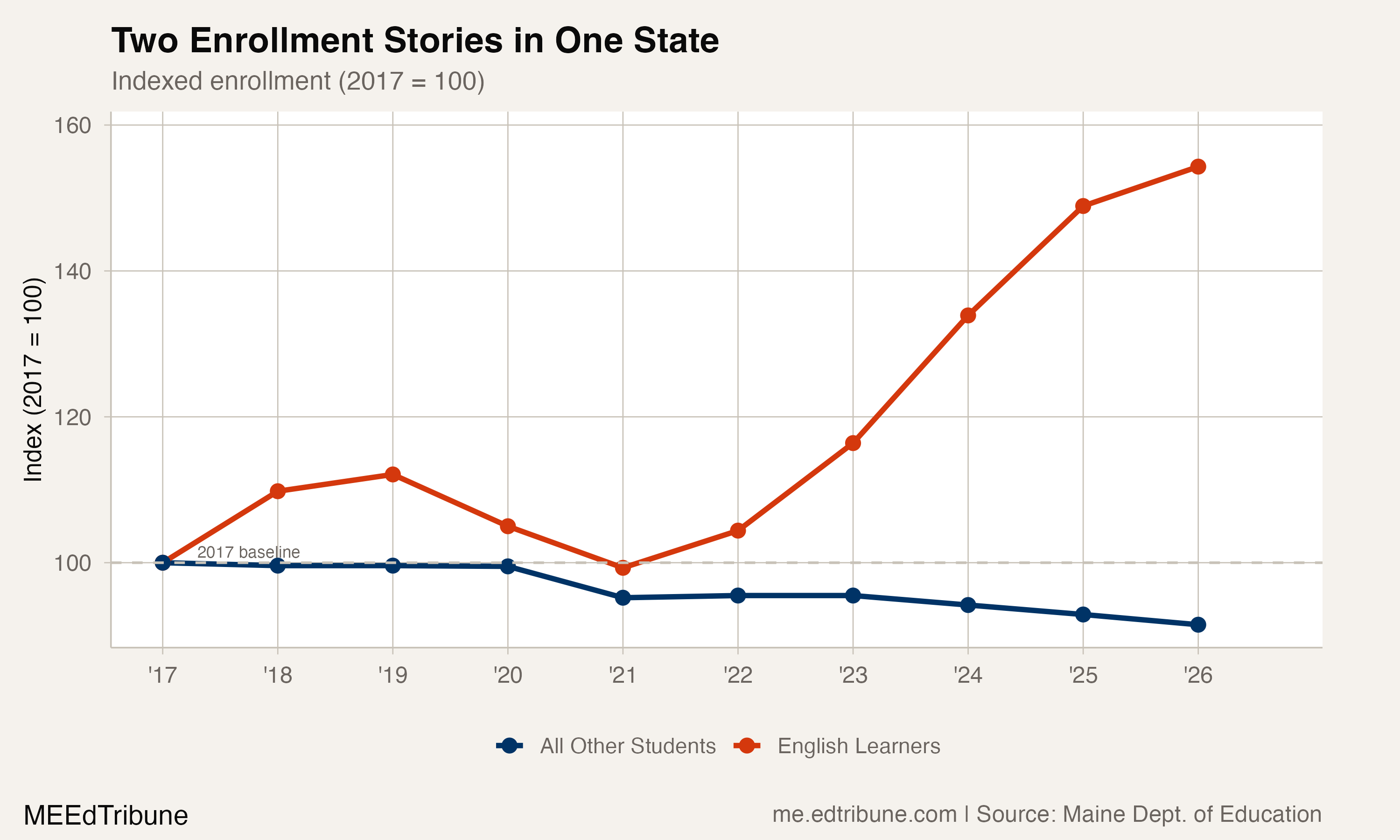
Strip out English learners, and Maine's remaining 160,630 non-EL students represent a loss of 14,911 from 2017, an 8.5% decline. The EL population did not prevent overall enrollment from falling. It cushioned the fall. Without the 2,917 additional EL students, Maine would have lost closer to 15,000 students instead of 12,000.
What January 2026 may signal
The 2026 slowdown in EL growth (+289, after three years averaging +797) arrived alongside federal immigration enforcement operations in Portland and Lewiston that sent attendance plummeting at schools with large immigrant populations. Portland superintendent Ryan Scallon reported attendance drops of 15-20% at some schools during the January operations.
It is too early to know whether the enforcement actions will durably reduce new arrivals, prompt families to leave, or simply suppress enrollment temporarily as families weigh the risks of sending children to school. The state's decision to wind down its asylum-seeker housing program as new arrivals dwindled, combined with the federal suspension of refugee admissions, suggests the pipeline of new arrivals is narrowing from both directions.
Portland hired multilingual staff, expanded intake screening, and built infrastructure for growth. If the arrivals slow, the city will have capacity it does not need. If they resume, the $3.5 million ELL Hardship Fund -- roughly $1,300 per new EL student -- will not come close to covering it. Either way, 234 multilingual teachers serving a state of 254 districts is not a staffing plan. It is a concentration that leaves most of Maine unprepared for the students who are already there.
Detailed code that reproduces the analysis and figures in this article is available exclusively to EdTribune subscribers.
Discussion
Sign in to join the discussion.
Loading comments...