In this series: Maine Chronic Absenteeism.
Correction (August 21, 2026): A ledger audit removed several uncited contextual figures from the article. No package-backed attendance rate changed.
Correction (July 23, 2026): An earlier version said the narrowed gap between Native American students and the statewide average was larger than the chronic absenteeism rates for Asian students (19.2%) and non-economically-disadvantaged students (17.6%). The 14.7-point gap is in fact smaller than both. The comparison now refers to the Native American rate of 39.3%, which does exceed both figures.
In 2021-22, three out of four students at Indian Township, a Passamaquoddy tribal school in Washington County, were chronically absent. The rate was 74.5%. That figure is real, and it reflects attendance patterns in one of Maine's most isolated communities.
Two years later, Indian Township had cut that rate to 50.9%. That is a 23.6 percentage point improvement, and it is still a crisis: half the student body is missing 10% or more of the school year.
The Indian Township school's trajectory mirrors the broader story of Native American attendance in Maine. This is the subgroup improving fastest from the worst starting point, and the subgroup that remains furthest from the statewide average even after two years of significant gains.
39.3% and falling
Statewide, 39.3% of Native American students were chronically absent in 2023-24, down from 54.2% in 2021-22. That 14.9 percentage point improvement is the largest of any racial group, more than double the improvement for white students (7.3 points) and well above the statewide gain of 6.9 points.
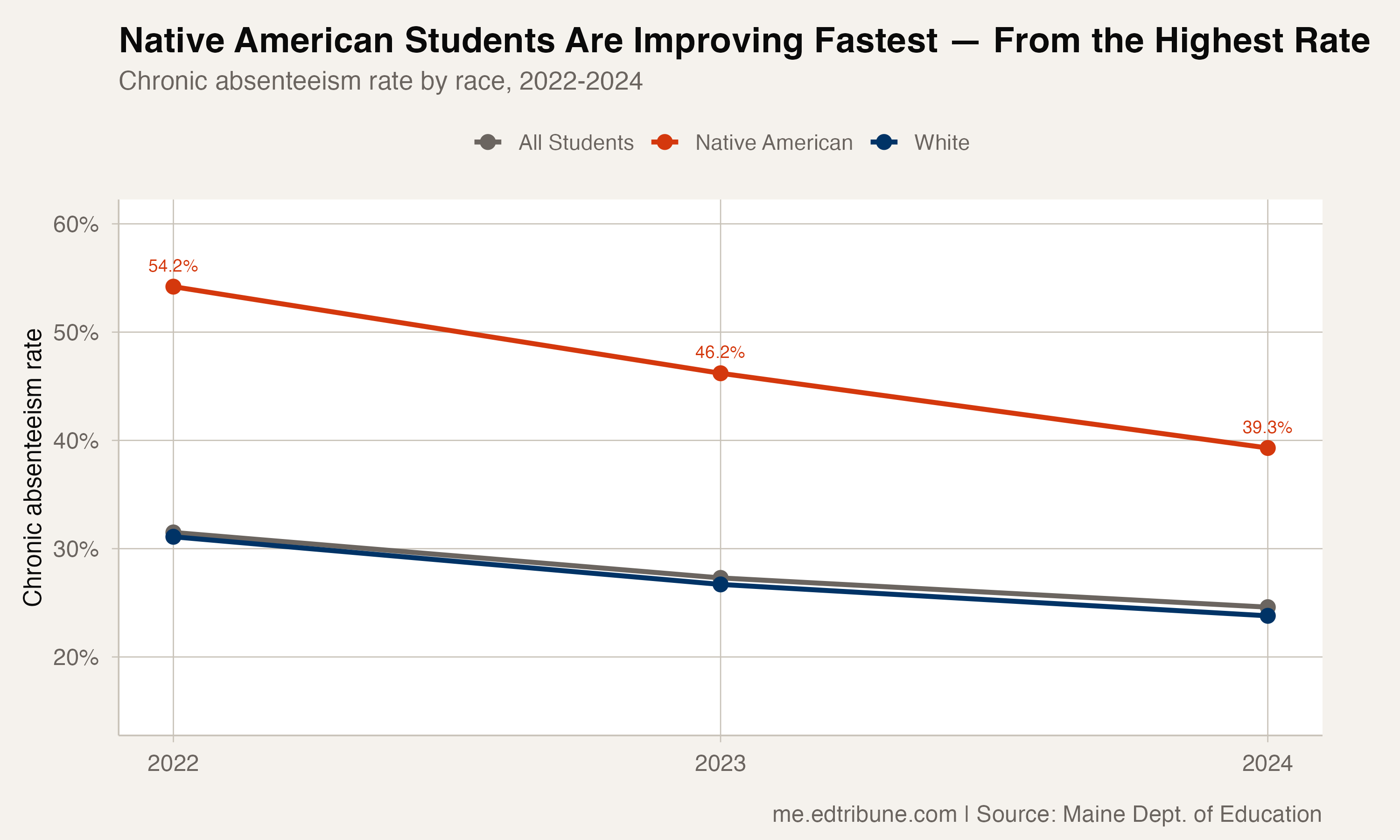
The gap between Native American students and the statewide average has narrowed from 22.7 percentage points to 14.7. That is meaningful progress. But at 39.3%, the Native American rate still exceeds the entire chronic absenteeism rate for Asian students (19.2%) or non-economically-disadvantaged students (17.6%). Native American students are chronically absent at 1.6 times the state rate, down from 1.7 times in 2022.
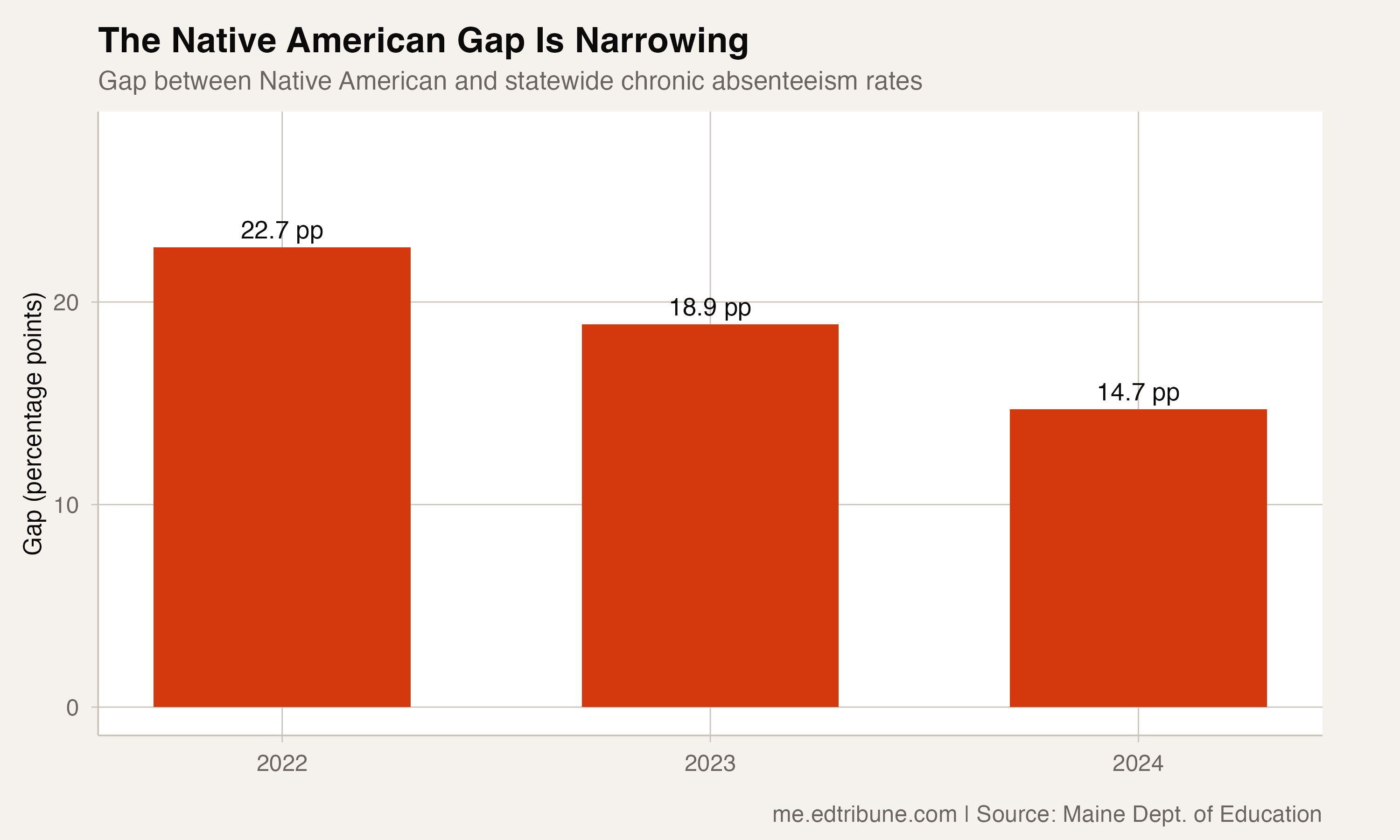
No other racial group faces a gap this wide. Hispanic students, the next-highest group, are at 32.9%, which is 6.4 points below Native American students. The racial hierarchy of chronic absenteeism in Maine, with Native American students at the top by a wide margin, mirrors patterns in states across the country but takes on a particular shape here because of Maine's tribal schools.
Two schools, two communities, one pattern
Maine Indian Education, a tribally controlled education agency serving the Wabanaki Nations, runs three PK to 8 schools in the eastern part of the state: Indian Island School, which serves the Penobscot Nation on Indian Island in the Penobscot River; Indian Township School, which serves the Passamaquoddy Tribe at Indian Township; and Sipayik Elementary School, which serves the Passamaquoddy Tribe at Pleasant Point. The state's chronic absenteeism data reports rates for Indian Township and Indian Island. Sipayik is not broken out separately in that data, so it does not appear in the figures here.
The two schools the state does report are both improving. Both still miss school at rates far above the state's.
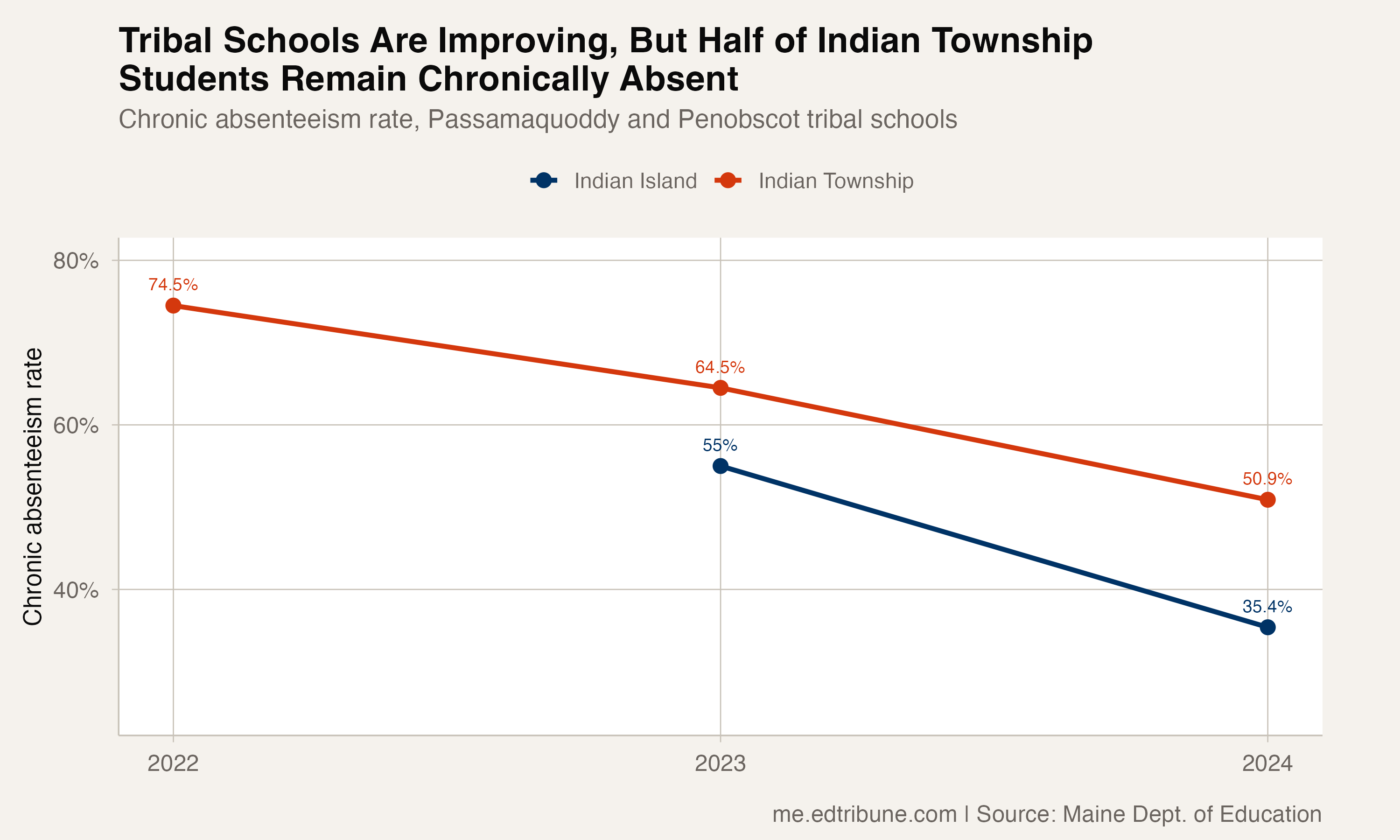
Indian Township went from 74.5% in 2022 to 64.5% in 2023 to 50.9% in 2024. Indian Island, which has data only for 2023 and 2024, dropped from 55.0% to 35.4%, a 19.6-point improvement in a single year that brought it below the state's Native American average.
The two communities face different circumstances. Indian Island is closer to Bangor, with somewhat better access to services and employment. Indian Township is more remote, deeper into Washington County, where poverty rates are among the highest in the state and transportation infrastructure is sparse. That geographic difference may explain why Indian Island's rate dropped below Indian Township's despite starting at a similar level.
What sits behind the numbers
"Historical trauma is not a metaphor," said Dr. Reza Namin, superintendent of Maine Indian Education. "Many of the families we serve have their own memories, or their parents' memories, of compulsory schooling as something done to Indigenous children, not for them. Every absence is not disengagement. Sometimes it's a family ceremony, a funeral following traditional protocol, a harvest. Our attendance frameworks were not built with that reality in mind."
Chronic absenteeism in tribal communities is entangled with factors that attendance policies alone cannot address. The Indian Health Service, which provides health care to tribal members, has faced chronic underfunding nationally, and access in rural Maine is particularly limited. Mental-health access, trauma, substance use and intergenerational challenges are part of the context.
Geography compounds everything. Both MIE school communities reported in the state data serve families spread across large areas with limited road infrastructure. A single vehicle breakdown, a sick parent, or an ice storm can mean missing a week of school. A sick child in Indian Township may result in a parent missing work to drive to medical care, followed by an absence the next day to recover. "There is no Uber. There is often no backup," Namin said.
Maine Indian Education sits in an unusual place, distinct from the state's public school system and answering to two authorities at once: the federal Bureau of Indian Education and the Maine Department of Education. Its governance runs through a separate School Committee for each of the three schools, plus a Joint School Committee that handles agency-wide matters. The state's Maine Engagement and Attendance Center is designed to coordinate attendance improvement statewide, but Namin is candid about its limits in tribal schools. "MEAC was built with the architecture of a mainstream Maine district in mind: dedicated attendance staff, tiered intervention systems, data infrastructure," he said. "A statewide initiative designed for the average district will help the average district. We are not the average district, and the state should not be satisfied when our numbers improve just enough to fall off the priority list."
What actually happened at Indian Township
The 14.9-point statewide improvement for Native American students, and the even larger gains at the tribal school level, happened without a single well-publicized initiative. But Namin pushes back on the idea that the improvement was automatic or unexplained.
"What shifted was a sustained, quiet effort by staff and families to rebuild trust in the school as a place that genuinely belongs to the community," he said. "We invested in staffing stability. When families see the same faces year after year, when a teacher knows a child's grandmother, something changes."
Part of it was what Namin calls the "threshold experience," making sure that when a student comes through the door after an absence, two days or two weeks, "they feel welcomed back, not punished for being gone. That posture matters enormously in communities that have complicated historical relationships with formal schooling."
Post-COVID re-engagement was real, Namin said, but not automatic. "It required outreach, home visits, and a willingness to meet families where they are rather than where a policy manual says they should be."
He wants the state to fund something new: a tribal-specific attendance support model designed from the ground up in partnership with tribal nations. "That means funding for outreach workers who are community members, flexibility in how attendance is defined to honor cultural obligations, and a direct funding relationship that doesn't require us to translate our reality into a framework built without us."
Indian Township at 50.9% is better than Indian Township at 74.5%, and the people who made it happen, teachers, staff, families, deserve recognition. But Namin does not want the trend line to breed complacency.
"I'd rather people in Augusta sit with that number uncomfortably than feel reassured by the trend line."
Detailed code that reproduces the analysis and figures in this article is available exclusively to EdTribune subscribers.
Discussion
Sign in to join the discussion.
Loading comments...