In this series: Maine Chronic Absenteeism.
Every August, hundreds of migrant farmworker families arrive in Maine's Washington County for the wild blueberry harvest. Their children have been attending the Blueberry Harvest School, a summer program run by Mano en Mano for more than 30 years, designed to keep learning going while families follow the crop. It is one of the few educational programs in the country built specifically around the rhythms of agricultural work.
Between 2022 and 2024, students from Maine's migrant farmworker families cut their chronic absenteeism rate by 21.9 percentage points, the largest gain posted by any subgroup the state tracks. The next-largest improvement, by Native American students, was 14.9 points. The statewide average improved 6.9 points.
The largest gain came from the steepest starting point
In 2021-22, roughly 64.7% of Maine's students from migrant families were chronically absent, the highest rate of any demographic subgroup that year. By 2023-24, that rate had fallen to 42.8%.
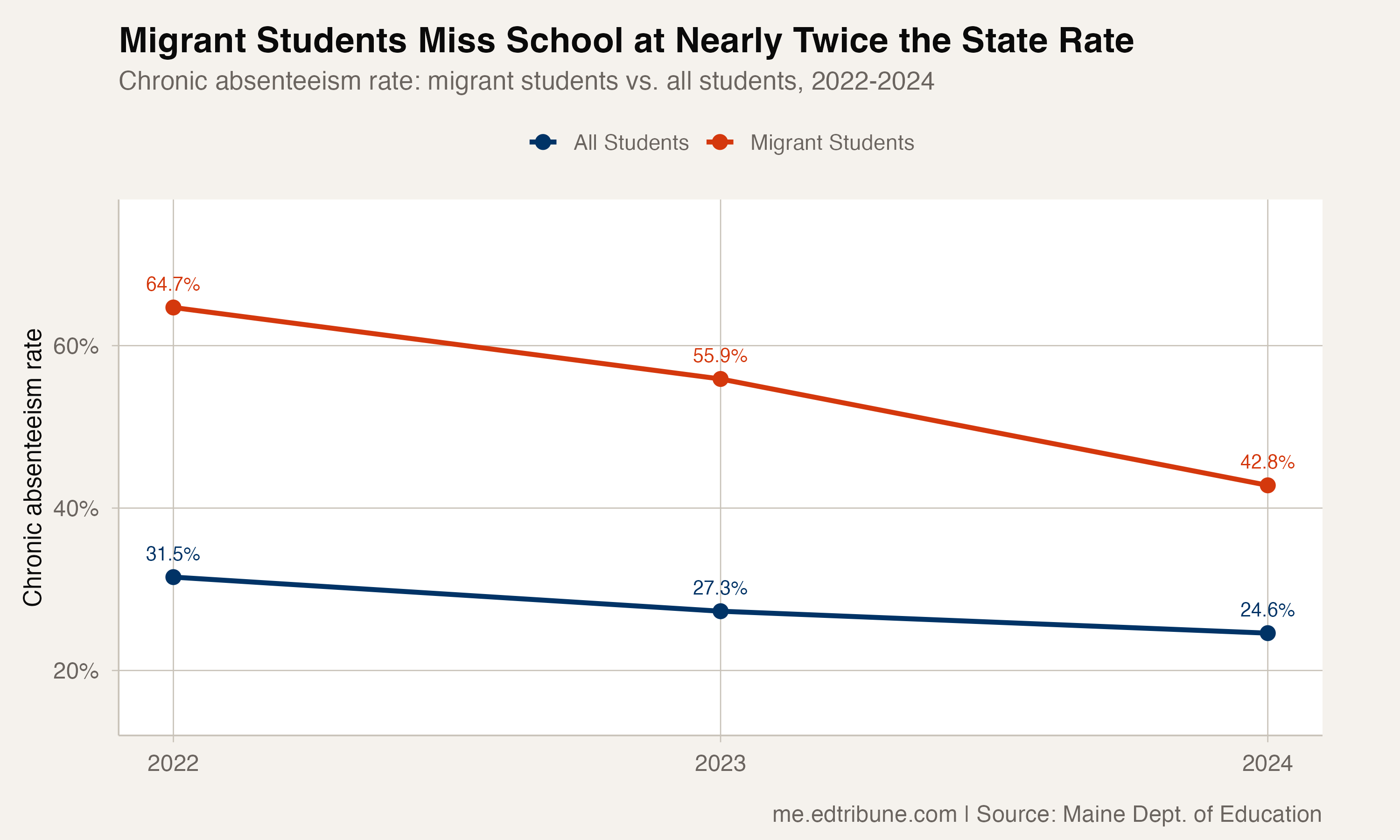
The 22-point improvement is a genuine shift, and at 42.8% it still sits about 1.7 times the statewide rate. Roughly two in five students from migrant families are missing 10% or more of the school year.
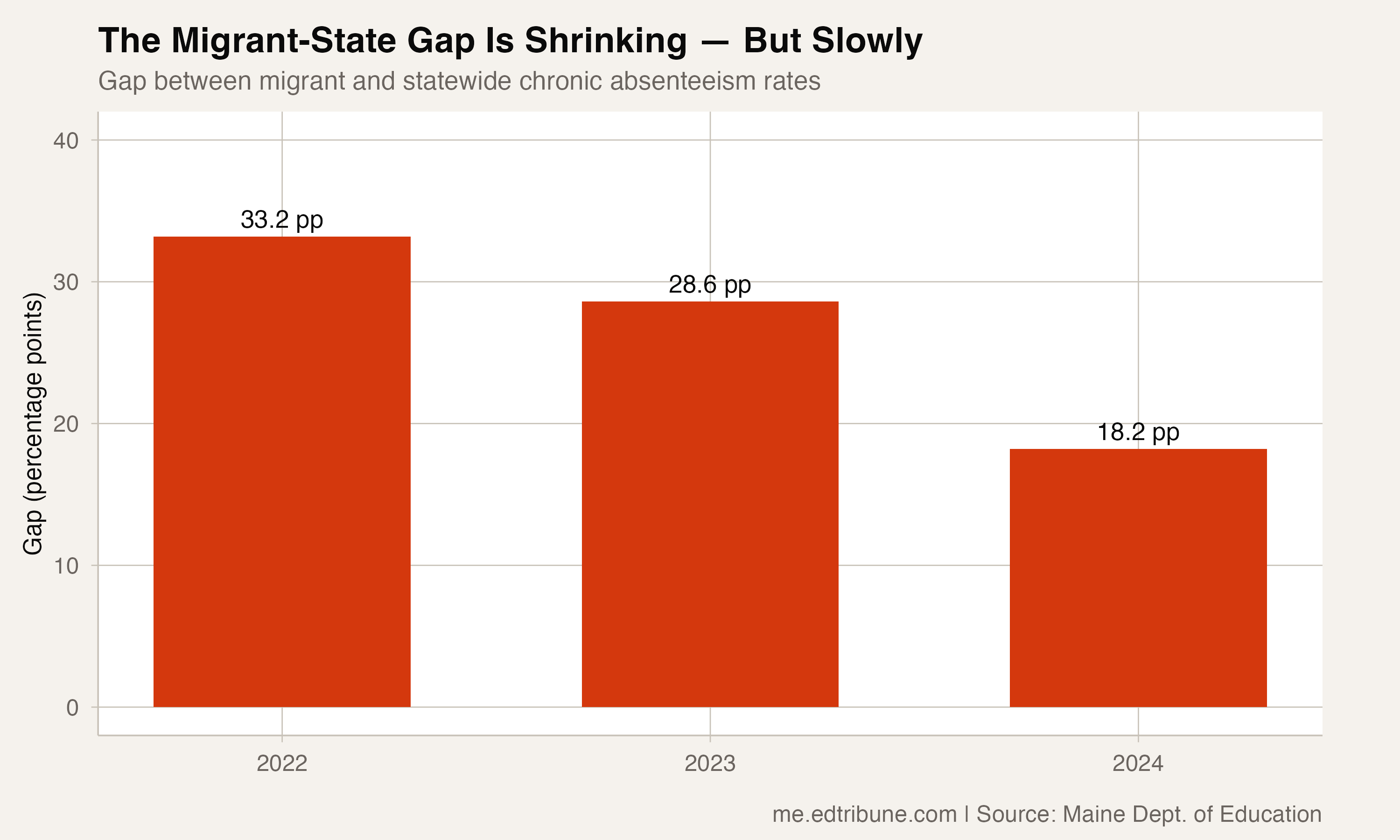
The gap between students from migrant families and the statewide average narrowed from 33.2 percentage points in 2022 to 18.2 in 2024. The rate of narrowing accelerated in the second year. The gap shrank 4.6 points from 2022 to 2023 and 10.4 points from 2023 to 2024. That acceleration is unusual among the subgroup patterns.
Why students from migrant families miss school
The barriers are structural, not attitudinal. Migrant families by definition move for work, and the timing of agricultural seasons does not align with the school calendar. A family arriving in Maine in late July for the blueberry harvest may not leave until October. A family following the harvest from Florida through the mid-Atlantic to Maine may enroll children in three or four schools in a single year. Each transition involves paperwork, new routines, and missed days.
Maine's Migrant Education Program works to minimize this disruption, and the Blueberry Harvest School provides summer continuity. But these programs serve children during the months they are present. The chronic absenteeism data captures the full school year, including the months when a family may be in another state entirely.
The data does not distinguish between a student who misses 20 days spread across the year and a student who is absent for six consecutive weeks because the family relocated. Both are counted as chronically absent. For students in migrant families, the latter pattern is far more common, and the intervention it requires (credit transfer systems, enrollment portability, digital learning during travel) differs fundamentally from the interventions designed for students who miss scattered days due to illness or disengagement.
How every subgroup compares
The 22-point gain is the largest in the state, and other subgroups posted real progress too. The subgroup landscape shows where the gains are concentrated.
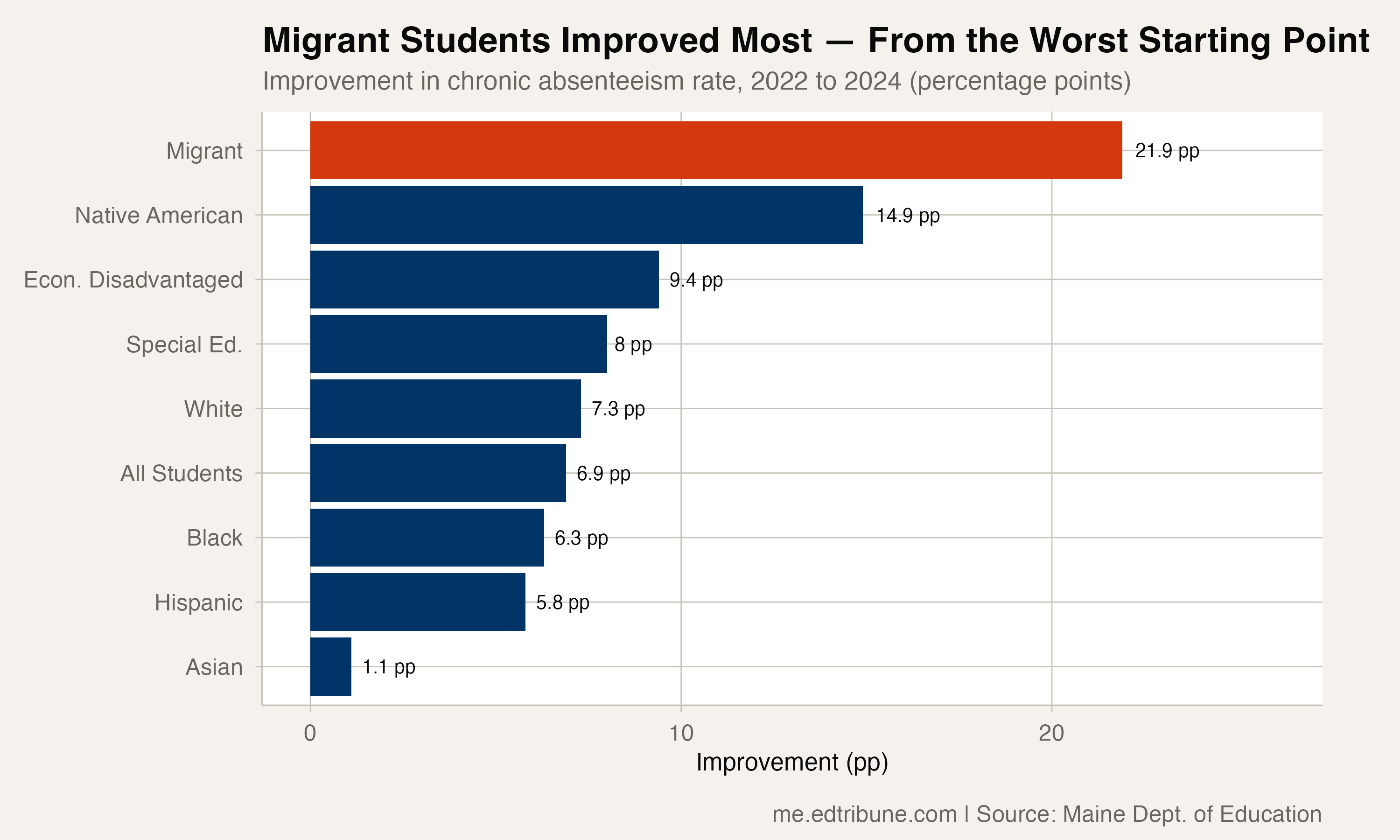
Students who are economically disadvantaged improved 9.4 points, students in special education 8.0 points, and white students 7.3 points. Hispanic students improved 5.8 points, the smallest gain among Maine's major racial groups, and Asian students, who already had the lowest rate, moved 1.1 points.
The pattern suggests that groups with the highest starting rates had the most room for improvement and the most to gain from post-COVID normalization. Whether the improvement reflects genuine engagement gains or the fading of the most extreme pandemic-era disruptions is harder to determine from the data alone.
The immigration enforcement overlay
In January 2026, ICE enforcement operations in the Portland and Lewiston area caused attendance drops of 15-20% at some Portland schools, with more than 4,000 students per day absent at the peak. More than half of multilingual students in South Portland stayed home during the worst days.
Maine's migrant student population overlaps with but is not identical to its broader immigrant student population. The Migrant Education Program serves families who move for agricultural and fishing work, roughly 43% from Mexico, 25% US residents, 16% from Puerto Rico, and smaller shares from Haiti and Honduras. Some families are undocumented; many are not. The fear generated by enforcement operations does not distinguish between migrant farmworker families, recently arrived asylum seekers, and long-established immigrant communities. The attendance impact cascades through all of these groups.
Next August, the blueberry harvest will come again in Washington County, and Mano en Mano will open the school doors as it has for 30 years. The children who walk through them are the same children the attendance data counts, in a different season, in a different row of the spreadsheet, in a system that was not built for families who follow the crop.
Detailed code that reproduces the analysis and figures in this article is available exclusively to EdTribune subscribers.
Discussion
Sign in to join the discussion.
Loading comments...