In this series: Maine Chronic Absenteeism.
Nationally, the story of chronic absenteeism and race follows a predictable pattern. Black students are chronically absent at substantially higher rates than white students. The gap widened during COVID. It has been slow to close. In state after state, the data confirms this pattern, often by 5 to 10 percentage points or more.
Maine is different.
In 2023-24, the share of Black students in Maine who were chronically absent was 24.6%. For white students, it was 23.8%. The gap: 0.8 percentage points. In the 2021-22 COVID peak year, white students had a slightly higher chronic absence rate than Black students, at 31.1% versus 30.9%.
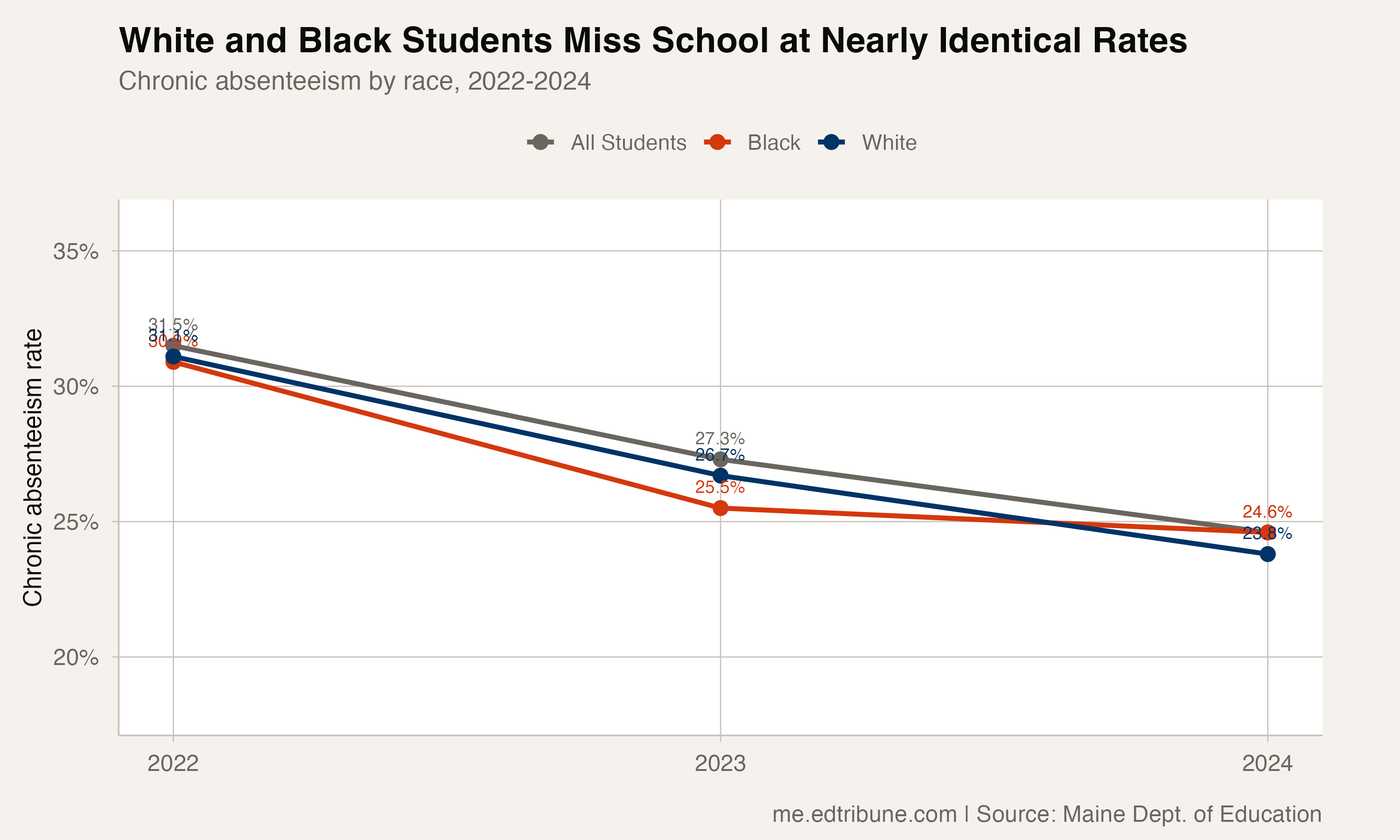
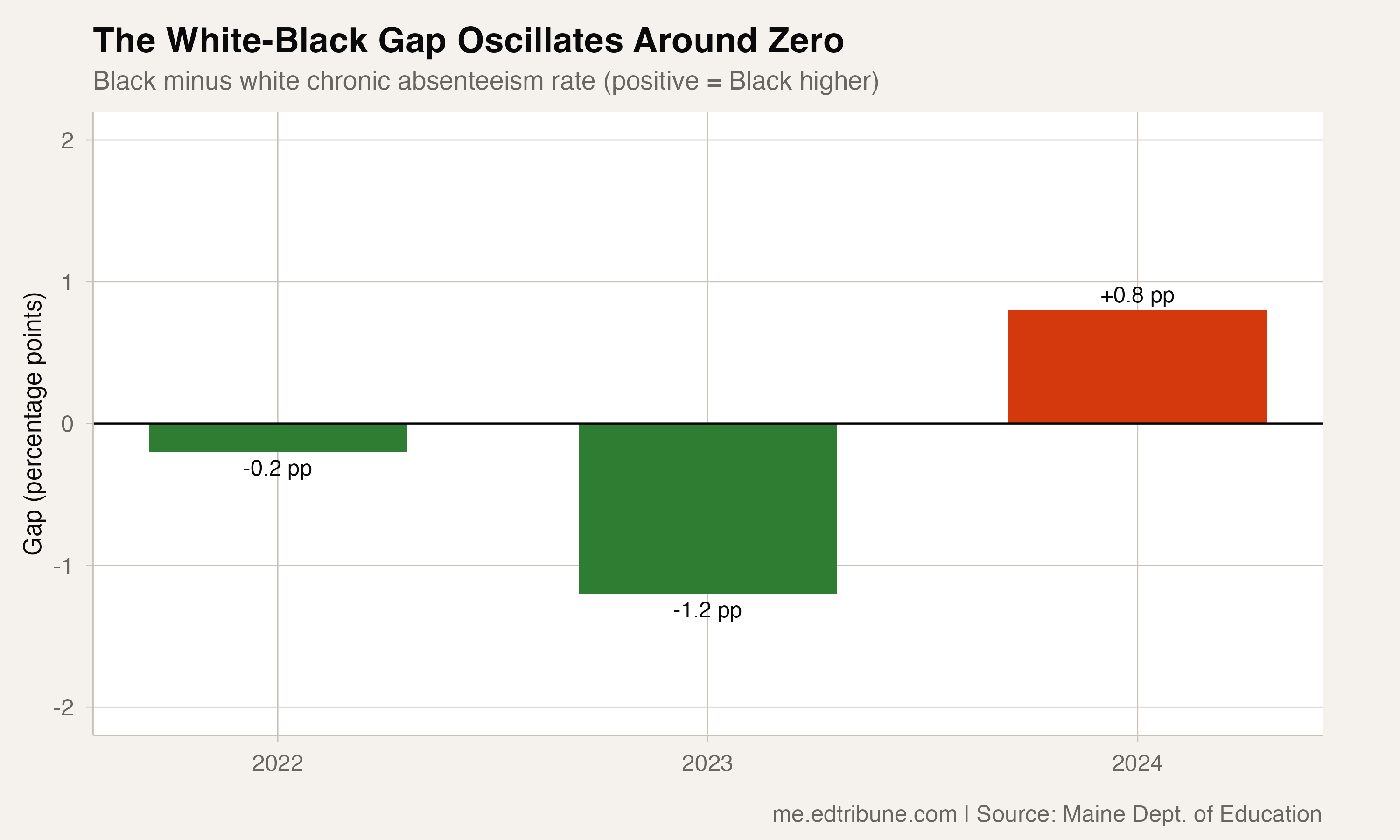
This is not a data quirk. The near-parity has held across all three years of available data, oscillating within a 2-point band. In 2022, white students had the slightly higher rate. In 2023, the gap was 1.2 points in favor of Black students. In 2024, it flipped back to 0.8 points in the other direction.
The composition effect
The most likely explanation is demographic composition. Maine's Black population is small (roughly 2% of the state) and heavily concentrated in Portland↗ET and Lewiston↗ET. Unlike most states, where Black communities have multi-generational roots, a large share of Maine's Black population consists of recent immigrants: Somali, Congolese, Sudanese, and other African communities that began arriving in Portland and Lewiston in the early 2000s.
Immigrant communities often have different attendance patterns than native-born populations. Families who endured years-long refugee resettlement processes or dangerous migration journeys tend to value school access as something hard-won, not guaranteed. Research on immigrant educational engagement consistently finds that first-generation immigrant families show strong school attendance, a pattern researchers call the "immigrant paradox."
That does not mean Maine's Black students face no attendance barriers. The barriers in Portland and Lewiston are more likely to be language access, cultural navigation, and transportation, and they are real. The composition of Maine's Black student population, weighted toward newly arrived African families with strong school-engagement patterns, helps explain why the racial gap in chronic absence looks different here than in many other states.
Where the gaps actually are
The absence of a white-Black gap does not mean racial equity in attendance. It means the biggest gaps in Maine run along different lines.
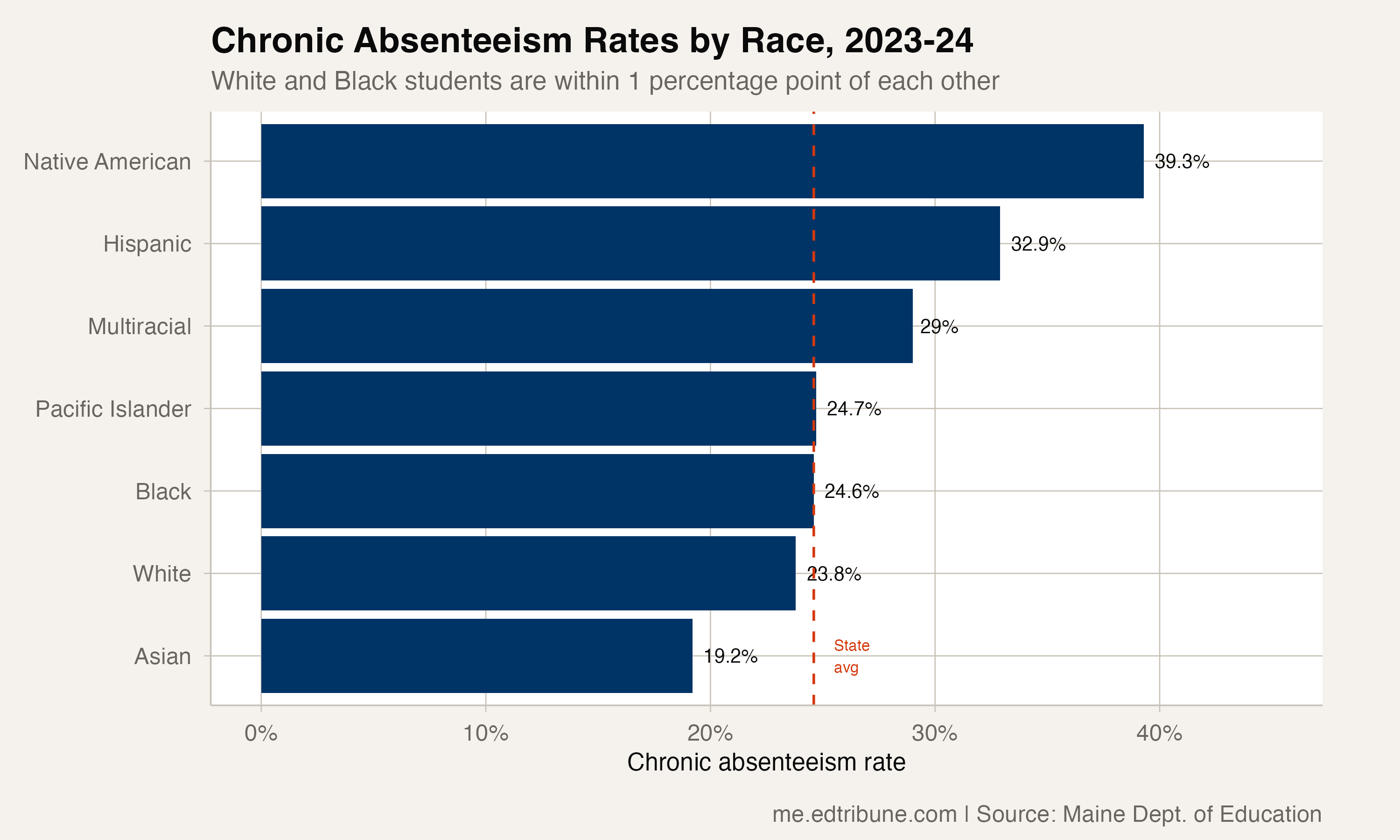
The share of Native American students who were chronically absent in 2023-24 was 39.3%, which is 15.5 points above white students and the widest racial gap in the state. Hispanic students were at 32.9%, a gap of 9.1 points that widened over the two-year period as Hispanic students improved more slowly than white students. Multiracial students were at 29.0%.
The equity story in Maine runs along different lines: Native American students in rural and tribal communities, Hispanic-white divergence, and the income gap (35.0% of students who are economically disadvantaged were chronically absent, versus 17.6% for peers). It is not about the Black-white gap that dominates the national conversation.
What the parity does not tell you
Near-parity in chronic absenteeism rates between Black and white students does not mean near-parity in educational outcomes, school quality, housing stability, or community resources. It means that whatever advantages and disadvantages each group carries into the school year, they result in roughly the same proportion of students crossing the 10% absence threshold.
The January 2026 ICE enforcement operations in Portland and Lewiston hit Black immigrant families hard, with reports of attendance dropping 15-20% at some Portland schools and Black and Hispanic students missing school at rates 30 percentage points higher than white peers during the peak enforcement period. Whether those disruptions pushed the 2024-25 data out of parity, or whether the effect was temporary, will not be visible until next year's numbers arrive.
For now, Maine's Black-white attendance parity is a real finding, and a reminder that state-level data stories do not always follow national templates.
Detailed code that reproduces the analysis and figures in this article is available exclusively to EdTribune subscribers.
Discussion
Sign in to join the discussion.
Loading comments...