In this series: Maine Chronic Absenteeism.
Every metric of student attendance in Maine divides along the poverty line. The question is not whether the divide exists — it does, stubbornly, in every state that reports the data — but how wide it is, whether it is closing, and what that gap means in practical terms for students who already face the most obstacles.
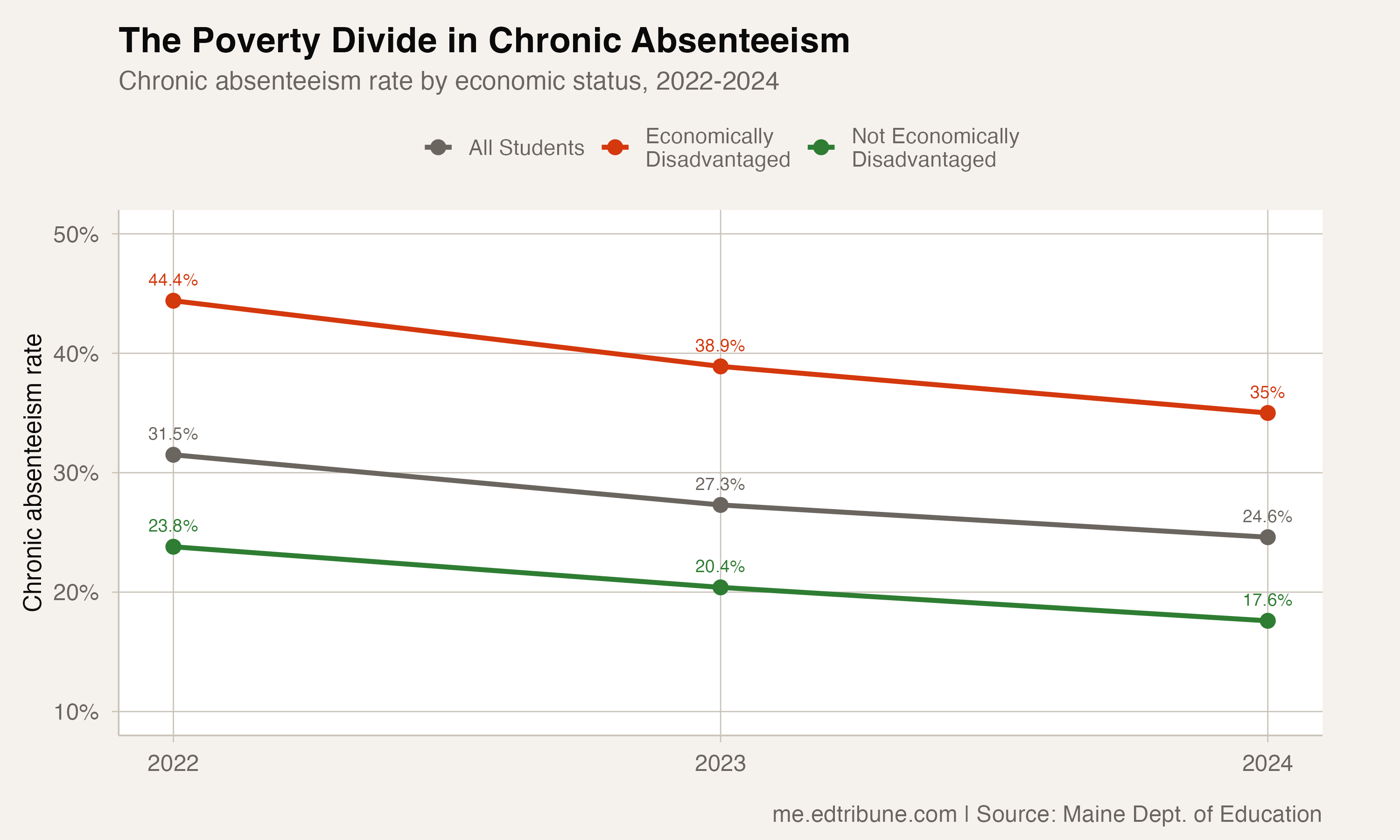
In 2023-24, 35.0% of Maine's economically disadvantaged students were chronically absent. For their non-disadvantaged peers, the rate was 17.6%. That 17.4 percentage point gap is the second-largest equity divide the state tracks, after the gap for migrant students, and it is larger than the gaps for any racial group, any disability status, or any other demographic category.
Narrowing, but the ratio is stuck
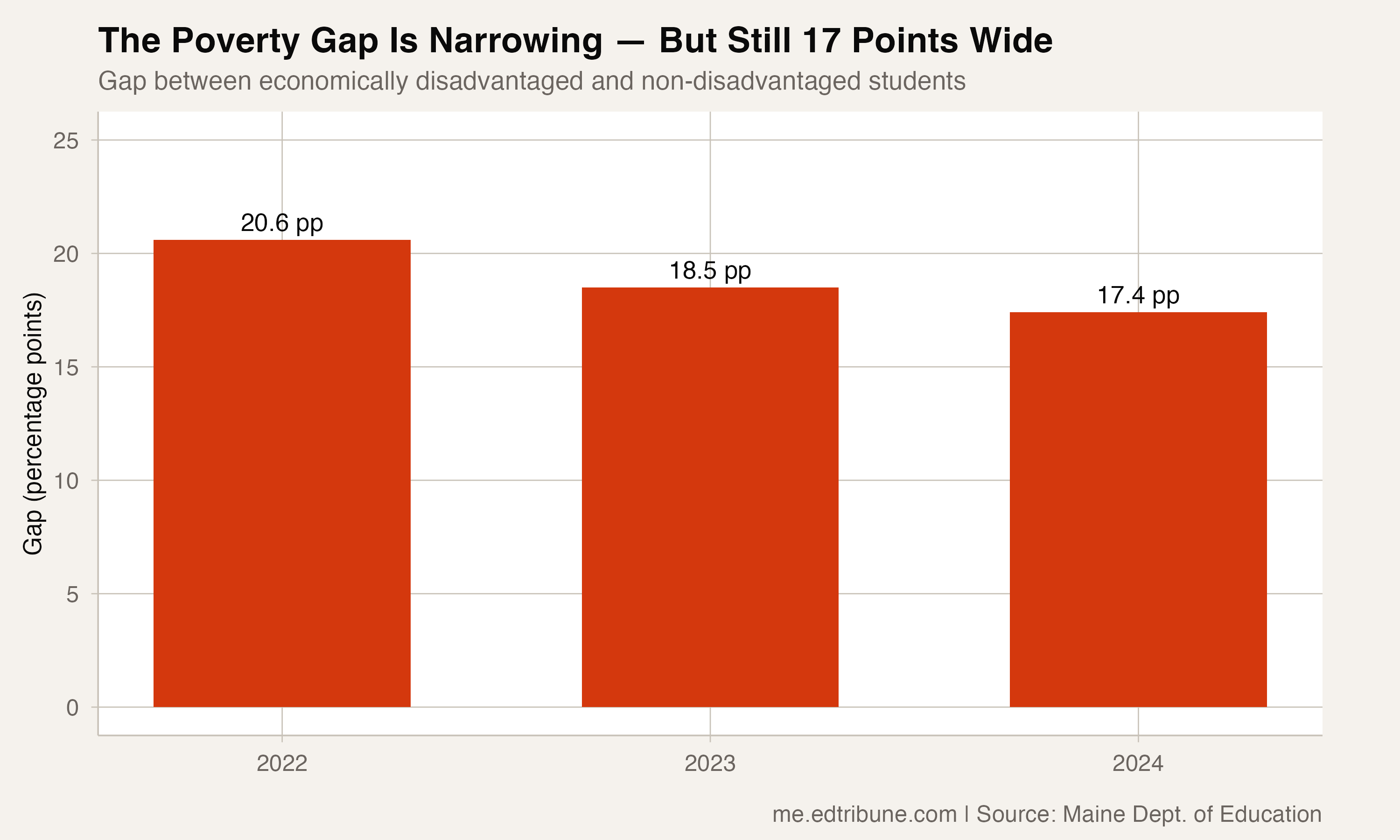
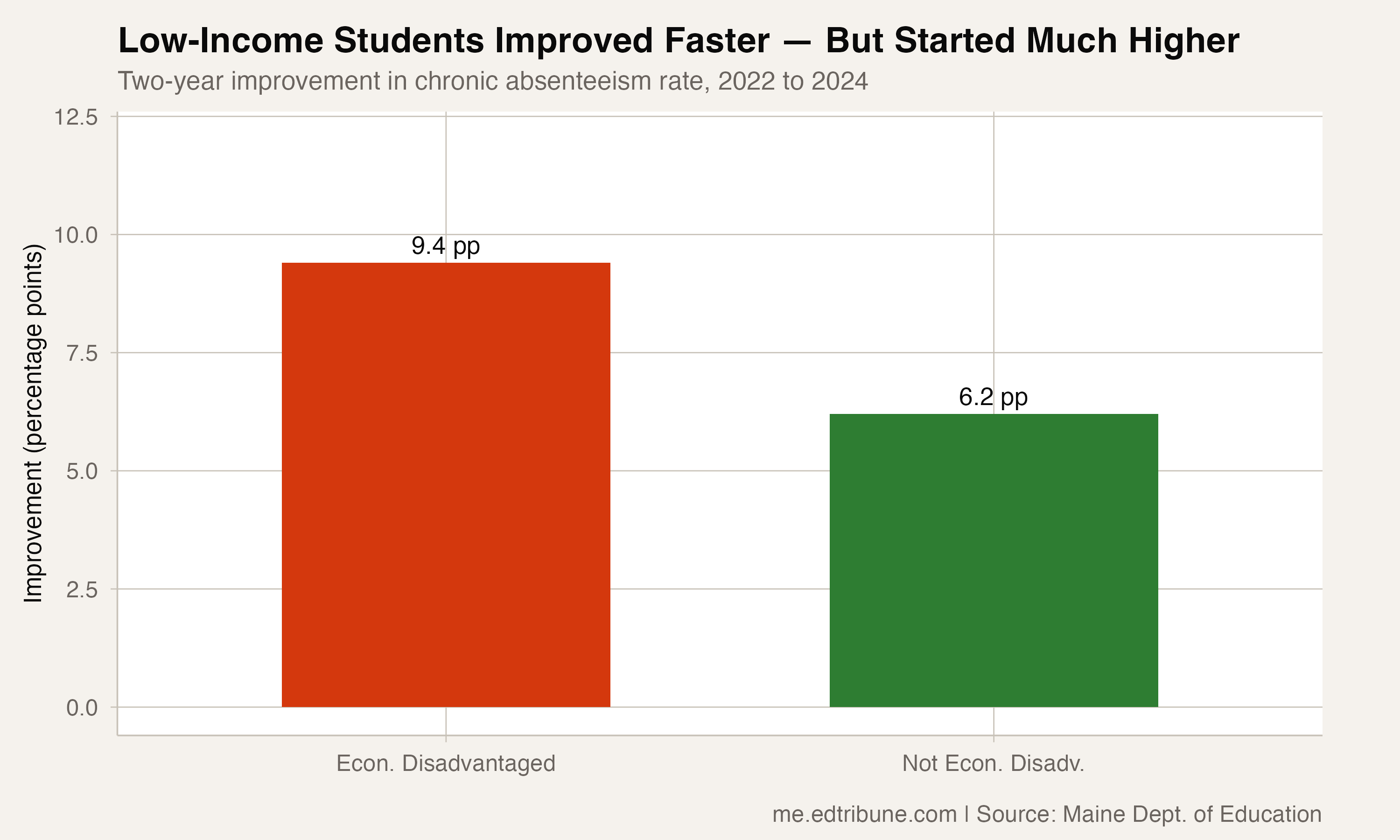
The poverty gap has narrowed. In 2021-22, it was 20.6 points — disadvantaged students at 44.4% versus 23.8% for their peers. By 2023-24, it had closed by 3.2 points to 17.4. That narrowing reflects faster improvement among economically disadvantaged students: they improved 9.4 percentage points over two years, compared to 6.2 for non-disadvantaged students.
But the ratio tells a different story. In 2022, disadvantaged students were 1.9 times as likely to be chronically absent. In 2024, they were 2.0 times as likely. The absolute gap closed, but the proportional burden actually increased slightly. When the denominator is shrinking faster than the numerator, the percentage-point gap can narrow while the ratio holds steady or worsens.
This matters because it determines what "closing the gap" actually requires. If disadvantaged students are always roughly twice as likely to be chronically absent as their peers, then every point of improvement for non-disadvantaged students demands two points of improvement for disadvantaged students just to hold the ratio constant. The structural relationship between poverty and absence is not being disrupted; it is being compressed.
Why poverty drives absence
The mechanisms are well-documented and reinforcing. Low-income families in Maine face a specific set of attendance barriers:
Health access. Maine is a rural state, and many of its poorest communities are the most isolated. A sick child in rural Washington County or Aroostook County requires a long drive to a provider — if a provider is available. Maine has 422 children on behavioral health waitlists, and the number of school-based clinicians decreased by more than 95 in a recent year due to funding cuts. The $9 million state investment in school-based mental health in 2023 was a response to a shortage, not a surplus.
Transportation. In a rural state with many small districts, bus routes can span dozens of miles. A mechanical breakdown, a snow day that cancels the bus but not school, or a parent who cannot afford gas to drive a backup route can mean an absence. Over a school year, the cumulative weight of these logistical barriers pushes low-income students across the chronic threshold.
Housing instability. Maine's housing crisis, driven by rising costs and limited supply, disproportionately affects low-income families. A family that changes housing mid-year may change schools, with the associated enrollment disruption and missed days. Even families that stay in place may face eviction proceedings, doubling up with relatives, or shelter stays that disrupt routines.
The fiscal disconnect
Maine's school funding formula, the Essential Programs and Services model, allocates money based on enrollment, not attendance. A chronically absent student and a student who misses none generate the same revenue for the district. This is not unusual — most states fund on enrollment — but it means that chronic absenteeism imposes educational costs without triggering fiscal consequences for the district.
For students, the consequences are not abstract. Research consistently links chronic absenteeism to lower reading proficiency by third grade, higher rates of course failure in high school, and lower graduation rates. Maine's aggregate graduation rate masks variation by poverty: economically disadvantaged students graduate at lower rates, and the same attendance barriers that drive chronic absence in elementary school compound through middle and high school.
The gap that persists
At 17.4 points, Maine's poverty gap in chronic absenteeism is both narrowing and durable. The narrowing is real: disadvantaged students improved faster in absolute terms, and the gap closed 3.2 points in two years. The durability is also real: the 2:1 ratio has not budged, and the remaining 17.4-point gap is nearly as wide as the entire non-disadvantaged chronic rate (17.6%).
Closing this gap entirely is not plausible without addressing the conditions that produce it. Attendance policies, family engagement, and tracking systems can shave points. But a 35% chronic rate among low-income students is a product of poverty, not a product of school policy. Until the material conditions change — transportation, housing, health access — the attendance data will continue to measure what poverty costs.
Detailed code that reproduces the analysis and figures in this article is available exclusively to EdTribune subscribers.
Discussion
Sign in to join the discussion.
Loading comments...