In this series: Maine Chronic Absenteeism.
The story of chronic absenteeism recovery is usually told through outliers. A district that cut its rate in half. A school that implemented a bold new program. A community that mobilized around attendance. Those stories matter, but they can distort the broader picture by suggesting that improvement is rare, exceptional, the result of specific genius rather than broad trends.
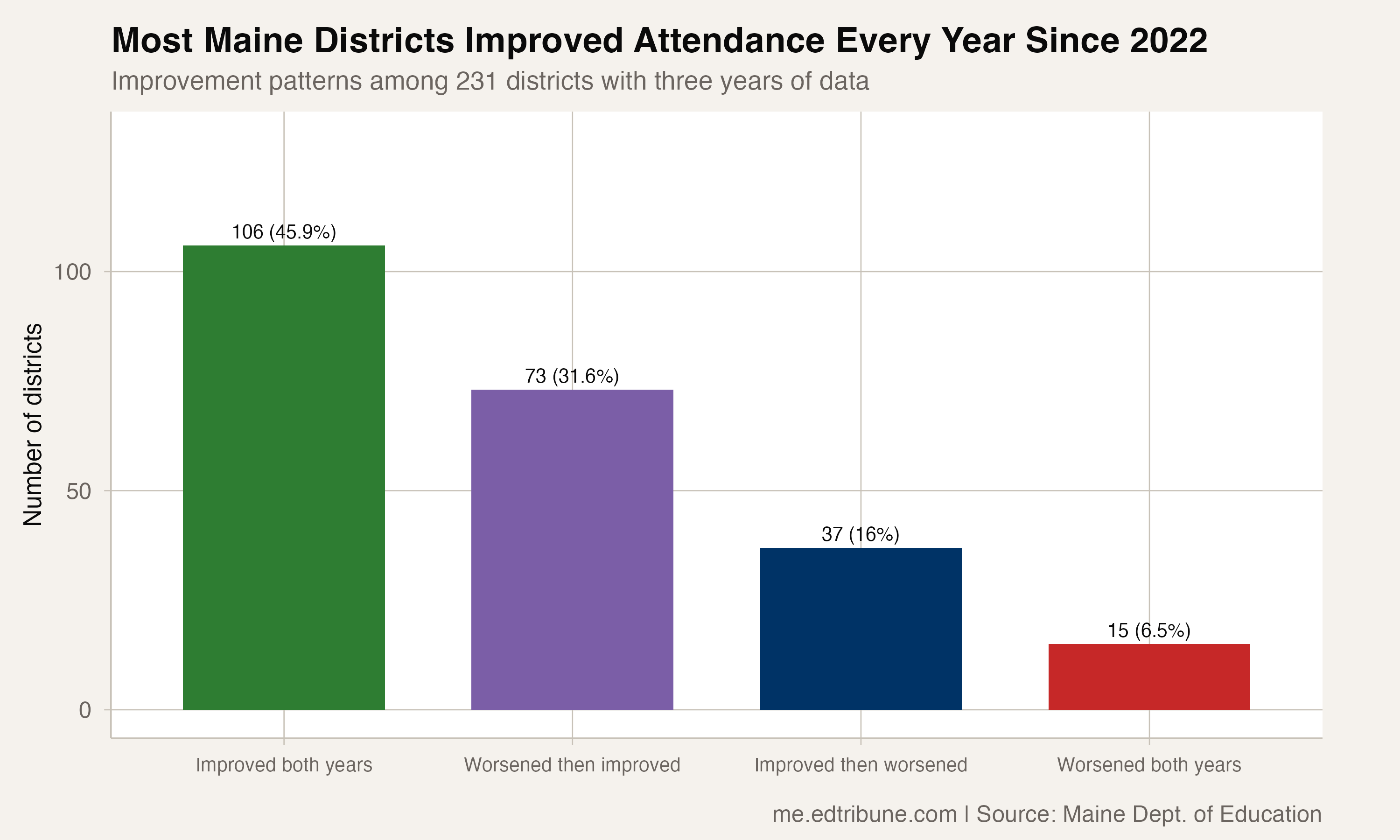
The Maine data tells a different story. Of 231 districts with chronic absenteeism data for all three available years — 2021-22 through 2023-24 — 106 improved in both consecutive years. That is 45.9% of all districts posting uninterrupted improvement over the entire period. Another 73 worsened in the first year but improved in the second, and 37 improved first then backslid. Only 15 districts — 6.5% — worsened in both years.
The breadth of improvement
When 46% of districts improve every year and 72% improve overall, the improvement is not an outlier phenomenon. It is a trend.
The overall picture: 166 of 231 three-year districts improved between 2022 and 2024, a rate of 71.9%. Expanding the lens to include all 248 districts with at least two years of data, 176 improved — 71.0%. The consistency of these numbers across different inclusion criteria suggests the improvement is genuine and broad-based.
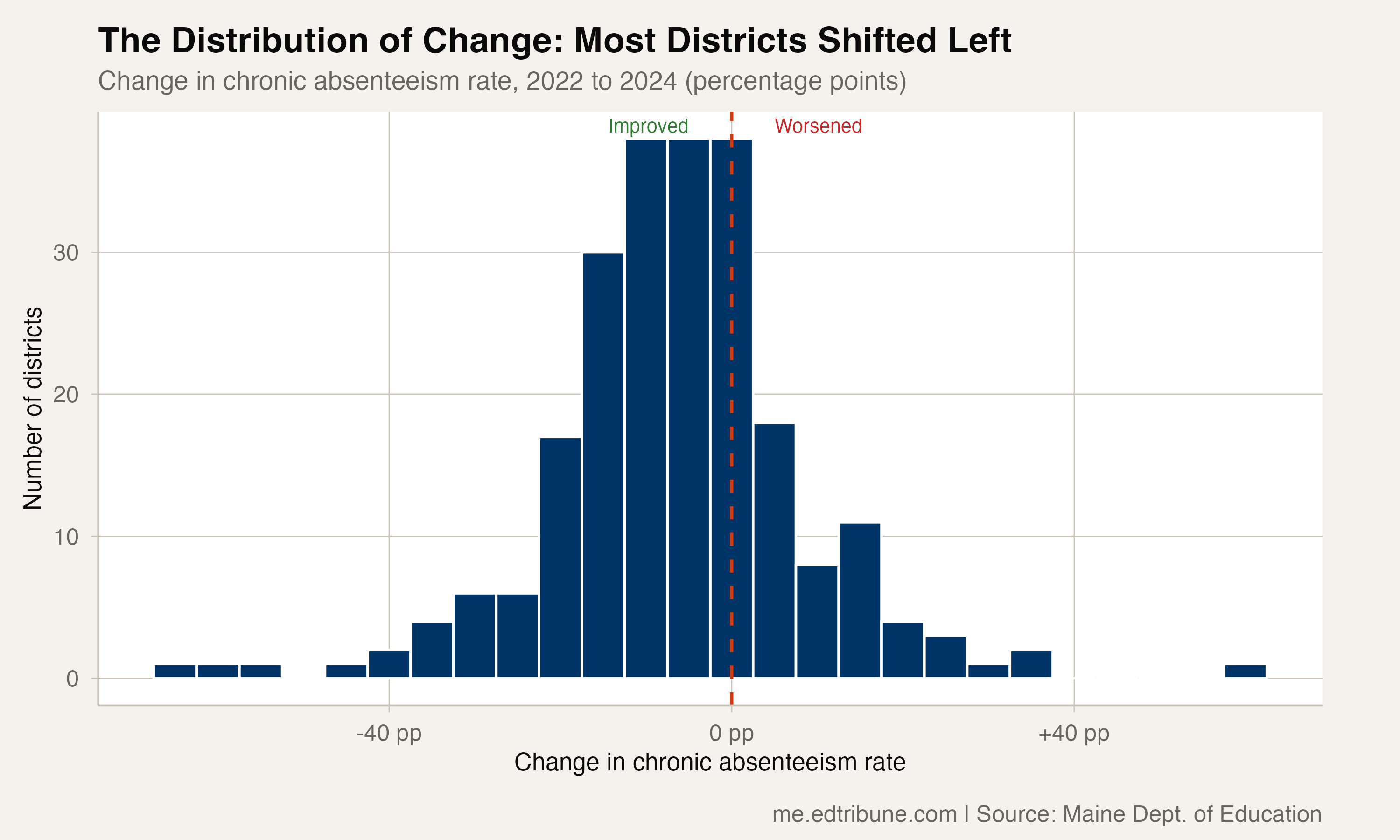
The distribution is heavily skewed toward improvement. Most districts show changes between -5 and -20 percentage points, with a small tail of extreme improvers on the left. The right side — districts that worsened — is thin and mostly populated by small districts and alternative programs where a handful of students can swing the rate dramatically.
The 15 that went the wrong direction
The 15 districts that worsened in both years include several whose 2022 rates were suspiciously low. Saco↗ET Public Schools reported 0% chronic absenteeism in 2022, then 13.2% in 2023 and 15.0% in 2024 — almost certainly a reporting artifact in the baseline year rather than a genuine deterioration. Orrington, Dedham, and Thornton Academy all reported 0% in both 2022 and 2023 before showing rates of 14-18% in 2024, suggesting data reporting that began or improved in the final year.
Among the districts with genuine three-year data, the cases of sustained worsening are concentrated in specific types:
Alternative programs. NFI-Stetson Ranch School went from 15.4% to 50.0%. Aucocisco School went from 7.1% to 30.8%. These are therapeutic and alternative education settings where student populations shift and the chronic absenteeism metric may not capture the same dynamics as in a traditional school.
Island and remote communities. Long Island (28.6% to 41.7%) and Southport (32.0% to 55.6%) are island communities with very small student counts. In districts this small, two or three students can swing the chronic rate by 10 or more points.
A few traditional districts. Brunswick↗ET Public Schools (15.1% to 22.3%) and East Millinocket (27.0% to 32.4%) are traditional districts that worsened without obvious small-sample explanations. Baileyville in Washington County nearly doubled from 13.1% to 25.9%.
What drove the improvement
The breadth of the improvement suggests systemic factors rather than isolated district efforts. Three candidates:
Post-COVID normalization. The 2021-22 data captures the tail end of pandemic-era disruptions — quarantine policies, rolling school closures, parental anxiety, staffing shortages. Much of the 2022-to-2023 improvement likely reflects the end of those disruptions rather than any deliberate intervention. The 4.2-point statewide drop in the first year, compared to 2.7 in the second, is consistent with a natural bounce.
State-level coordination. The Maine Engagement and Attendance Center, launched in January 2024, and the Attendance Toolkit released in August 2024, represent the state's first coordinated approach to chronic absenteeism. Their impact on the 2023-24 data is debatable — the toolkit arrived after the school year began — but the signaling effect of state-level attention may have prompted some districts to prioritize attendance earlier.
School-level initiatives. Mt. Blue High School publicized its attendance committee model with a 30% reduction in chronically absent students. The BARR Model (Building Assets Reducing Risks) expanded to 30 additional Maine schools in May 2024. These are not statewide interventions, but they indicate a cultural shift in how schools approach attendance.
What the pattern means
The consecutive improvement of 106 districts is encouraging, but it comes with a caveat: the data begins at the COVID peak. Every district was starting from an elevated baseline. The 2022 rates were, almost by definition, the worst most districts had ever recorded. Improvement from that point is expected. The question is not whether districts improved — it would be more alarming if they had not — but whether the improvement is fast enough to close the gap with pre-pandemic attendance patterns.
The statewide rate went from 31.5% to 24.6% in two years. The first year accounted for 4.2 points. The second, 2.7. If that deceleration continues, the third year gains roughly 1.7 points. The fourth, about 1 point. The trajectory flattens somewhere around 20% — better than the pandemic peak, worse than where schools were before COVID. That plateau, if it arrives, would mean roughly one in five Maine students still missing too much school, in a state where 106 districts did everything right for two straight years.
Detailed code that reproduces the analysis and figures in this article is available exclusively to EdTribune subscribers.
Discussion
Sign in to join the discussion.
Loading comments...