In this series: Maine 2025-26 Enrollment.
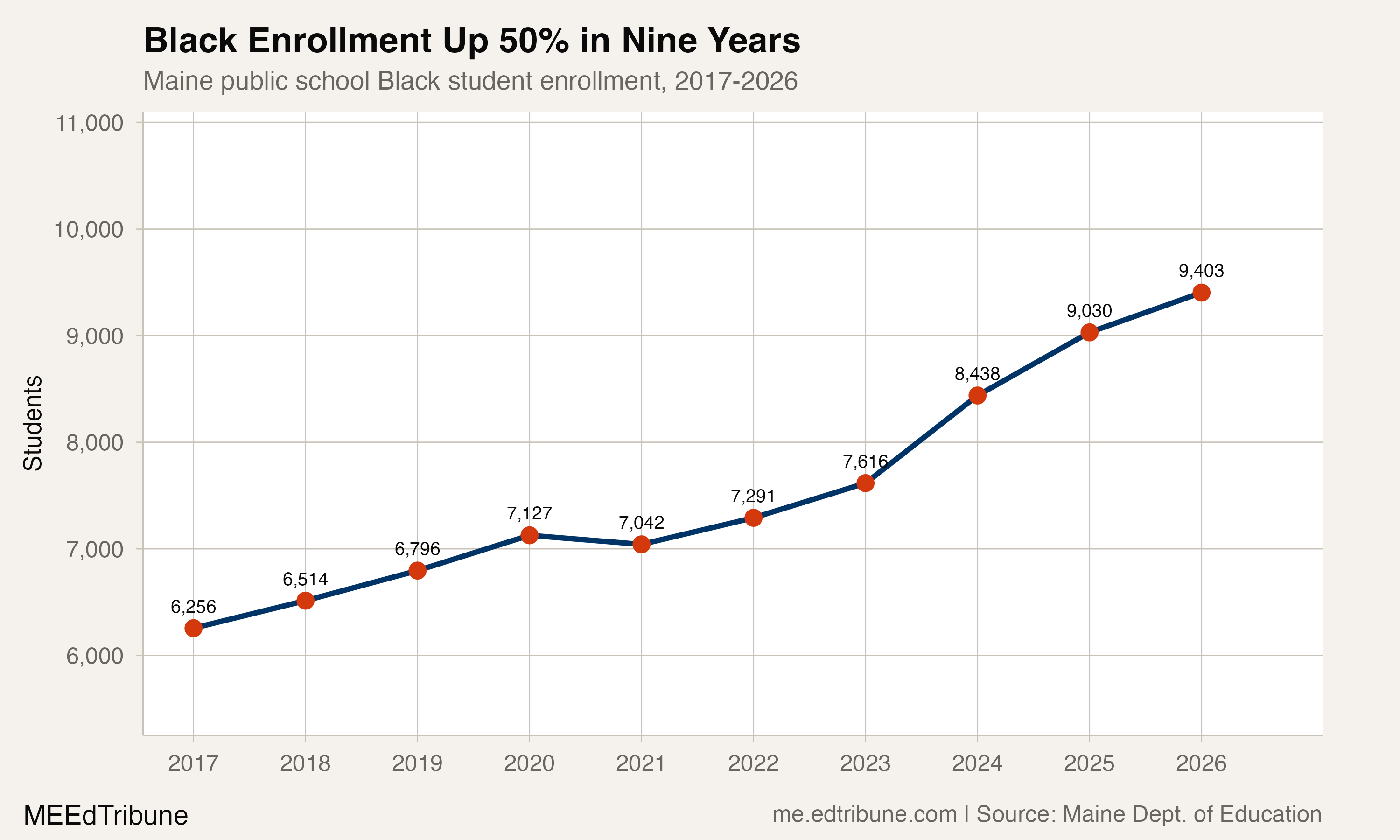
Nine years ago, a Black student in a Maine public school classroom was a statistical rarity: 3.5% of total enrollment, roughly one in 29. By 2025-26, that share had climbed to 5.6%, one in 18. In a state that lost nearly 12,000 students over the same period, Black enrollment grew by 3,147, a 50.3% increase that stands out against nearly every other trend line in the data.
The growth is not abstract. It has specific origins: Somali, Congolese, Angolan, and Sudanese families who settled in Lewiston↗ET and Portland↗ET over the past two decades, first through federal refugee resettlement and more recently through asylum. Their children now fill classrooms where, as recently as the mid-2000s, the student body was more than 95% white.
Three groups, one pattern
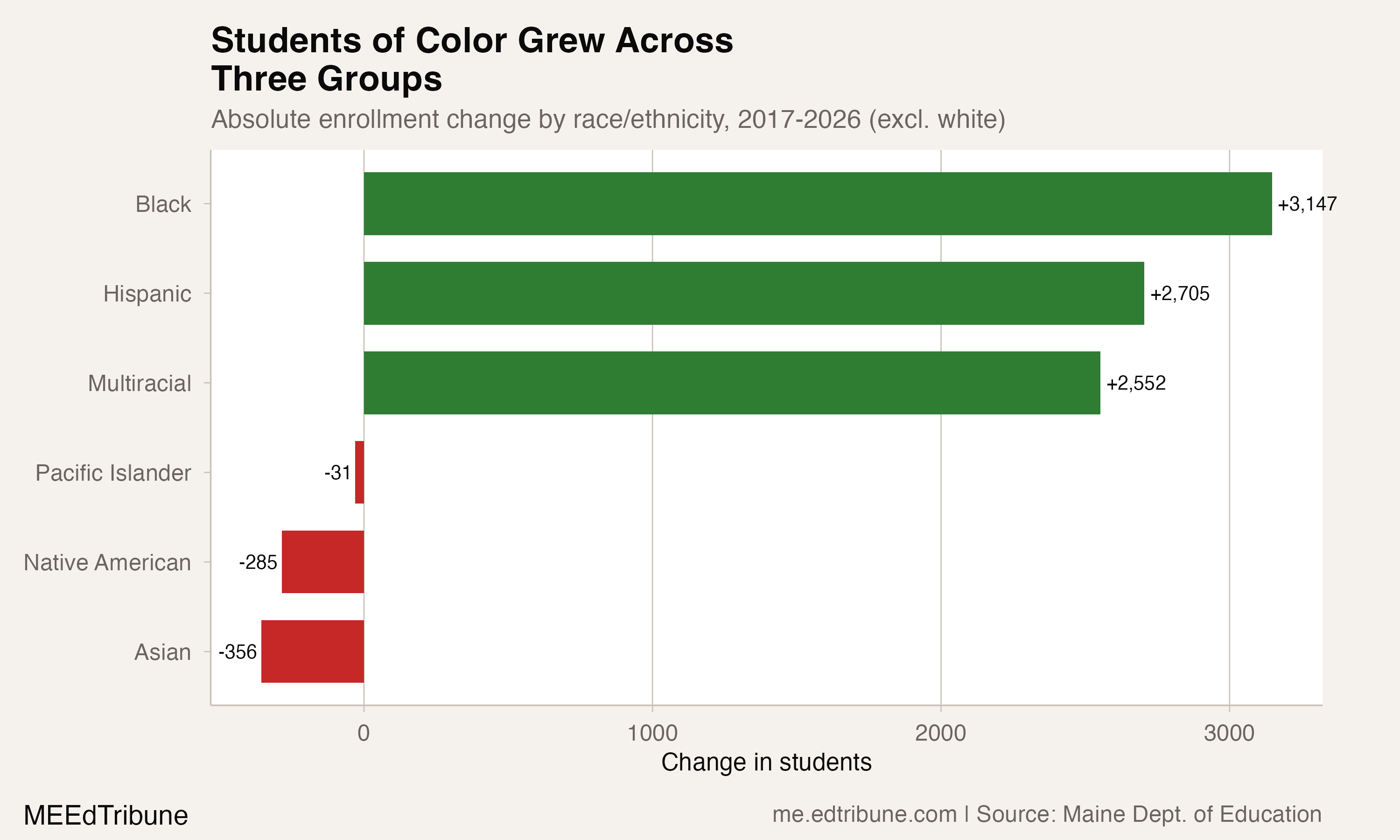
Black students added the most in absolute terms: 3,147 between 2017 and 2026. But Hispanic enrollment grew even faster in percentage terms, up 70.8% (+2,705), while multiracial students rose 62.2% (+2,552). Together these three groups account for all net growth among students of color, splitting the gains almost evenly: Black students contributed 37.4% of the increase, Hispanic students 32.2%, and multiracial students 30.4%.
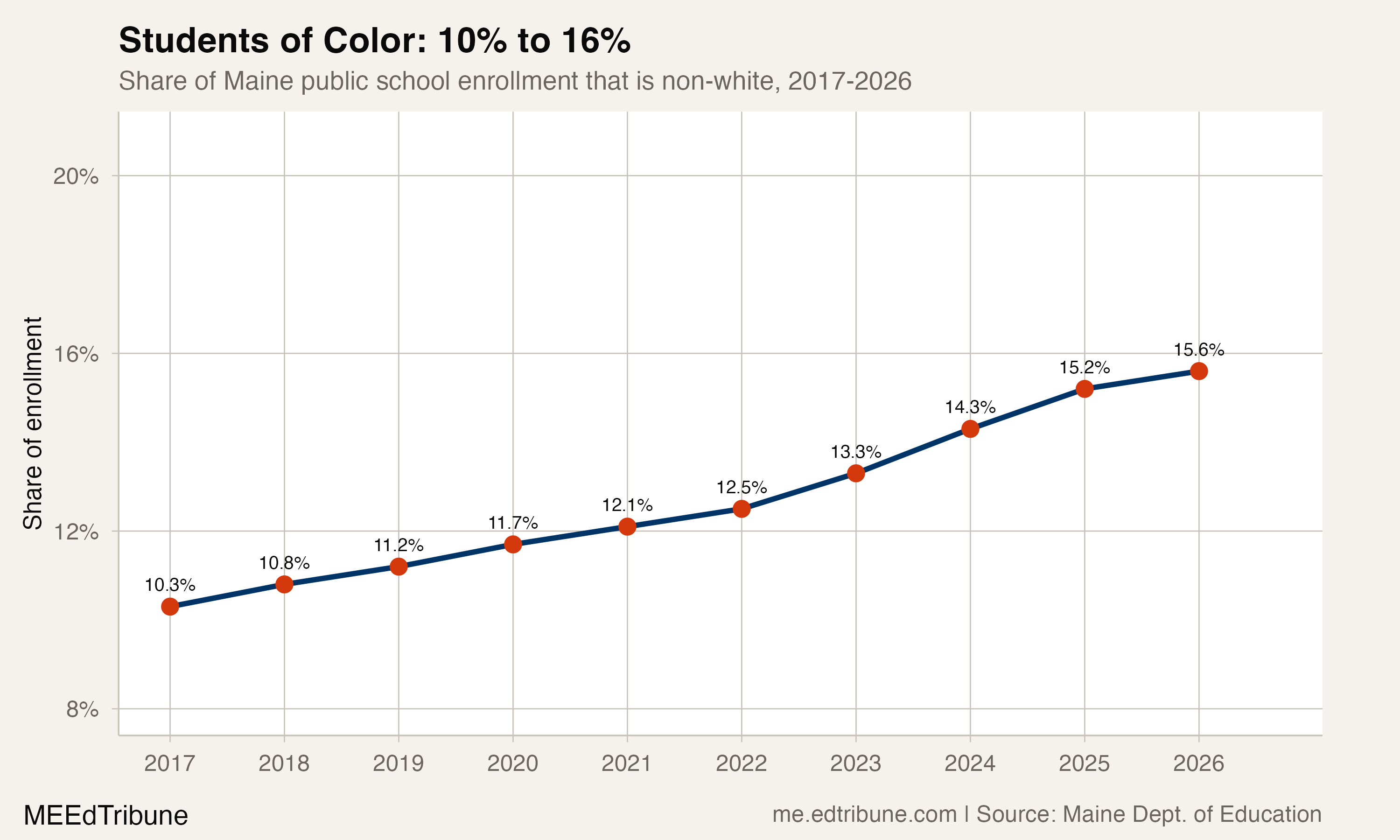
The net result: students of color now represent 15.6% of Maine's public school enrollment, up from 10.3% in 2017, a 5.3 percentage-point shift. That still leaves Maine among the whitest public school systems in the country at 84.4% white, but the trajectory is unambiguous. Every year in the dataset shows the non-white share rising.
Meanwhile, white enrollment fell by 19,746 students, a 12.2% decline. Maine's overall enrollment drop of 11,994 is entirely a white enrollment story. Students of color gained 7,732, offsetting roughly 39% of the white loss.
The acceleration year
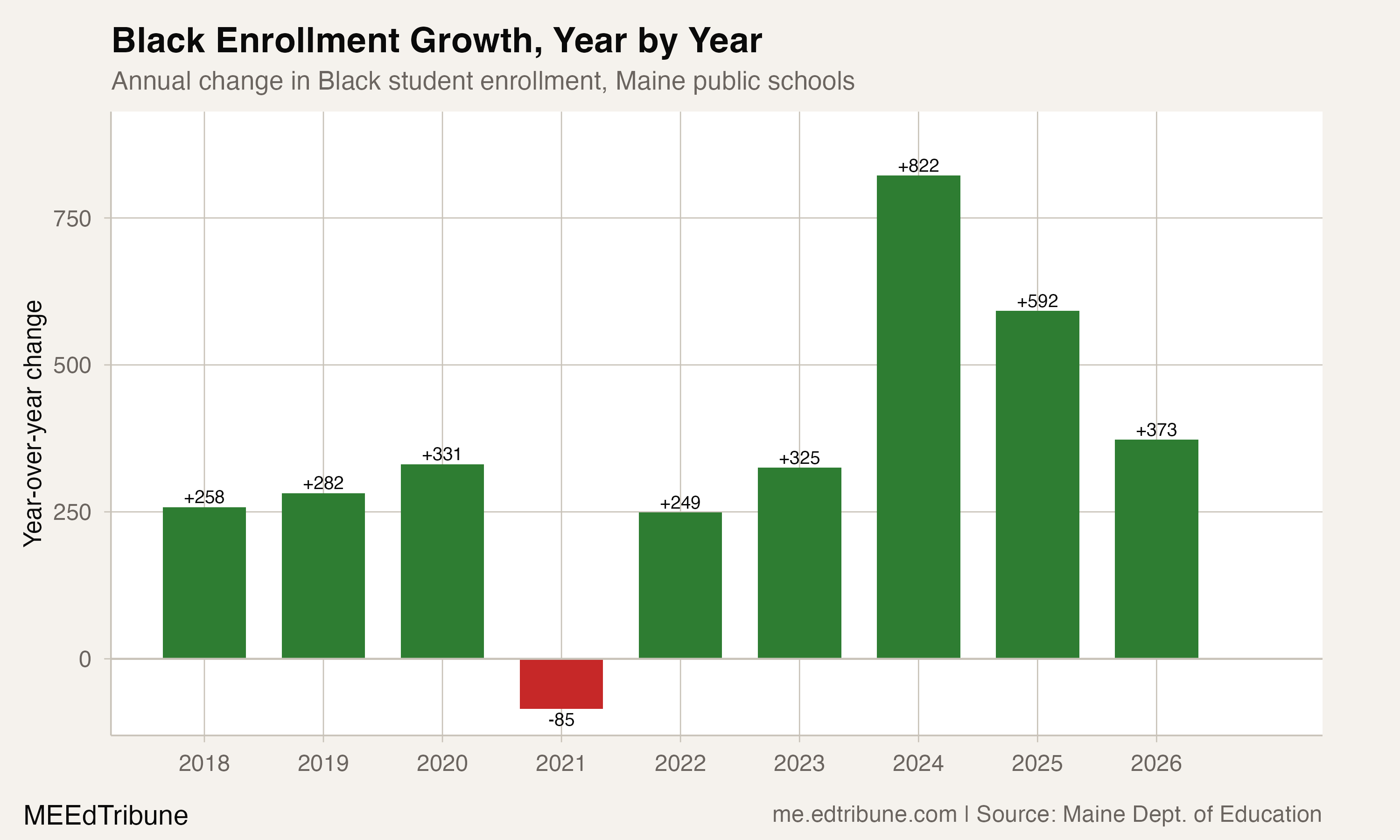
Black enrollment grew in eight of nine years, with the only decline coming during the COVID disruption of 2020-21 (-85 students). But the growth was not evenly distributed across time. From 2017 to 2023, annual gains ranged from 249 to 331 students. Then 2024 happened: Black enrollment jumped by 822 in a single year, the largest annual increase in the dataset by a wide margin. The 2025 gain of 592 and the 2026 gain of 373 were smaller but still above the pre-2024 pace.
The 2024 spike aligns with a period of record refugee resettlement in Maine. The state resettled close to 700 people through the federal admissions program in fiscal year 2024, the highest number on record for over a decade, with the Democratic Republic of the Congo among the top countries of origin. Many settled in Lewiston-Auburn, which overtook Portland as the primary resettlement destination that year.
Asylum seekers arriving independently of the federal program added to the flow. Portland's school district enrolled a record 979 multilingual students in the 2022-23 school year, roughly double the rate of the previous year, with most coming from Central Africa. The district's multilingual learner population now exceeds 2,000.
Multilingual learners as a parallel signal
English learner enrollment tracks closely with Black enrollment growth, and the two are intertwined. Many of Maine's Black students come from families where Somali, French, Lingala, Arabic, or Portuguese is the home language. Statewide, English learner enrollment rose 54.3% from 5,376 to 8,293 between 2017 and 2026, growing faster than any racial subgroup relative to total enrollment.
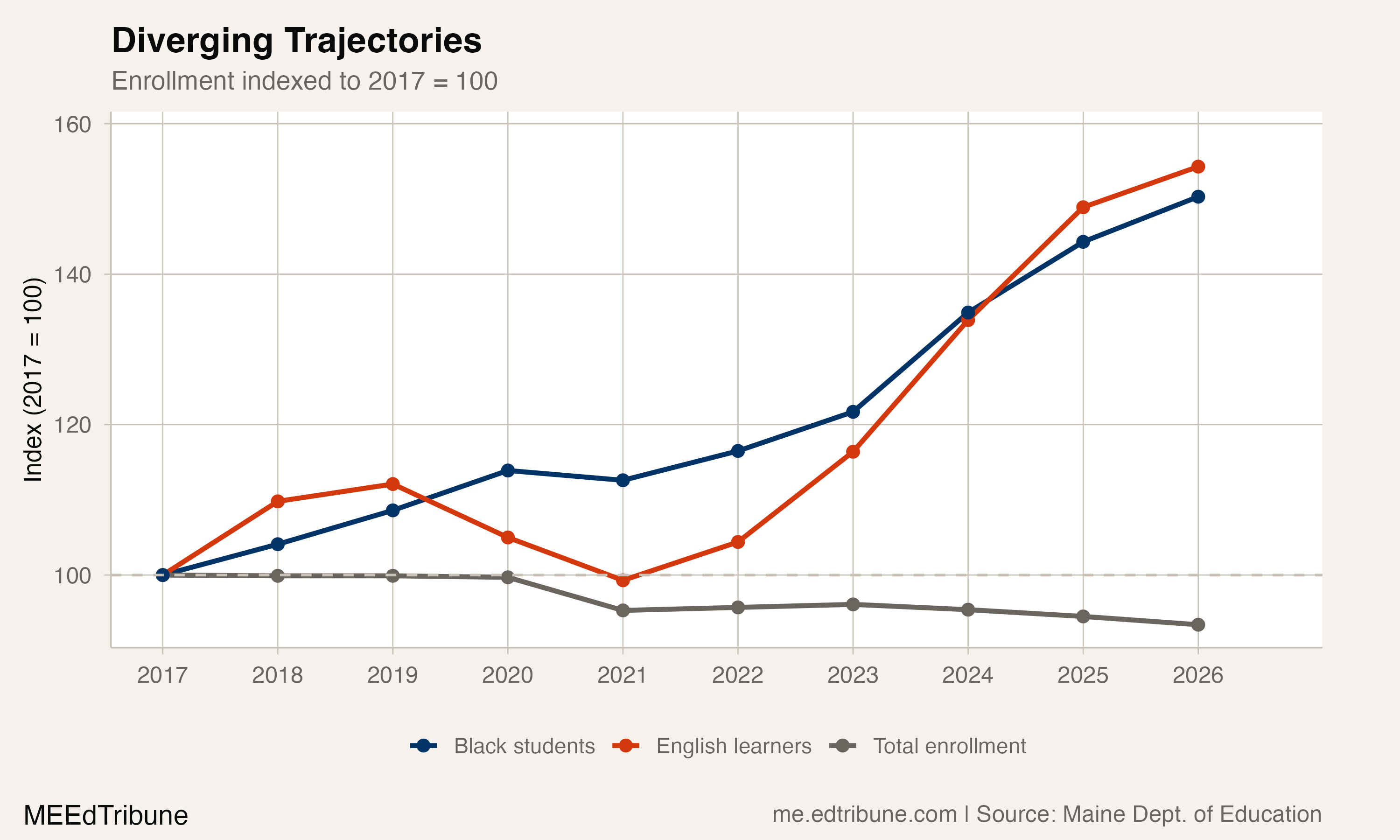
Indexed to 2017, English learner enrollment reached 154 by 2026 while Black enrollment hit 150. Total enrollment, by contrast, fell to 93. The divergence is striking: two populations growing 50% or more inside a system that shrank by 6.6%.
Across Maine, 7,208 students were classified as multilingual learners in the 2023-24 school year, a 28% increase over five years. The top languages have shifted: Portuguese has overtaken Somali as the most common, reflecting newer waves of Angolan asylum seekers.
"We are starting to look a lot more like the rest of the country in terms of multilingual, cultural diversity." -- Carlos Gomez, Portland Public Schools language development director, Maine Public, Oct. 2024
Of Maine's 234 licensed multilingual teachers, 57% work in just three districts: Portland, Lewiston, and South Portland↗ET. The concentration reflects where the students are, but it also exposes the staffing challenge for districts elsewhere that are seeing smaller but growing numbers of multilingual learners without the infrastructure to serve them.
What the numbers cannot show
The data tracks who is enrolled. It does not track why they came, how long they have been in the country, or whether the growth reflects new arrivals versus children aging into higher grades. A family that arrived in Portland in 2018 with a toddler now has a second-grader in the enrollment count. Some portion of the growth is simply these households maturing through the system.
There is also a question about how the current federal immigration enforcement climate will affect future enrollment. In late January 2026, ICE arrested over 200 people in Maine during a multi-day operation, targeting Lewiston's Somali community. Lewiston Mayor Carl Sheline described the detainees as "neighbors, our family members and employees." School attendance reportedly dropped during the enforcement period, and federal refugee resettlement dropped to just 50 people statewide in fiscal 2025, down from the nearly 700 resettled the prior year.
Whether that enforcement pressure translates into an enrollment reversal, or whether the established communities in Lewiston and Portland continue to grow through natural increase and secondary migration, is the open question for the 2026-27 school year and beyond.
A state remaking itself slowly
Maine remains overwhelmingly white. The 5.3 percentage-point shift in the share of students of color, spread over nine years, is not a revolution. It is, however, a structural change with compounding effects. The 26,340 students of color now enrolled represent the future workforce, voter base, and community fabric of a state where the median age is 44.8 years, the oldest in the nation, and where deaths have outnumbered births for years.
In Lewiston, the school district just purchased a former Central Maine Healthcare building on Main Street and requested $1 million to convert it into classroom space. The district is running out of room because of the very families whose enrollment growth defies every other trend line in the state. That is the paradox Maine faces: the students driving its diversity are also the ones keeping classrooms full in a state where most classrooms are emptying. The rest of Maine is watching from the outside.
Detailed code that reproduces the analysis and figures in this article is available exclusively to EdTribune subscribers.
Discussion
Sign in to join the discussion.
Loading comments...