In this series: Maine 2025-26 Enrollment.
South Portland is preparing to cut nearly 80 positions, 42 of them teachers, and close an elementary school. Portland↗ET proposed eliminating 20 jobs from a $180 million budget. Lewiston↗ET is making staffing cuts to balance its books. Three of Maine's largest districts are dismantling staff in the same budget cycle, and the reason is the same in each: fewer students, more costs, and a funding formula that follows the child out the door.
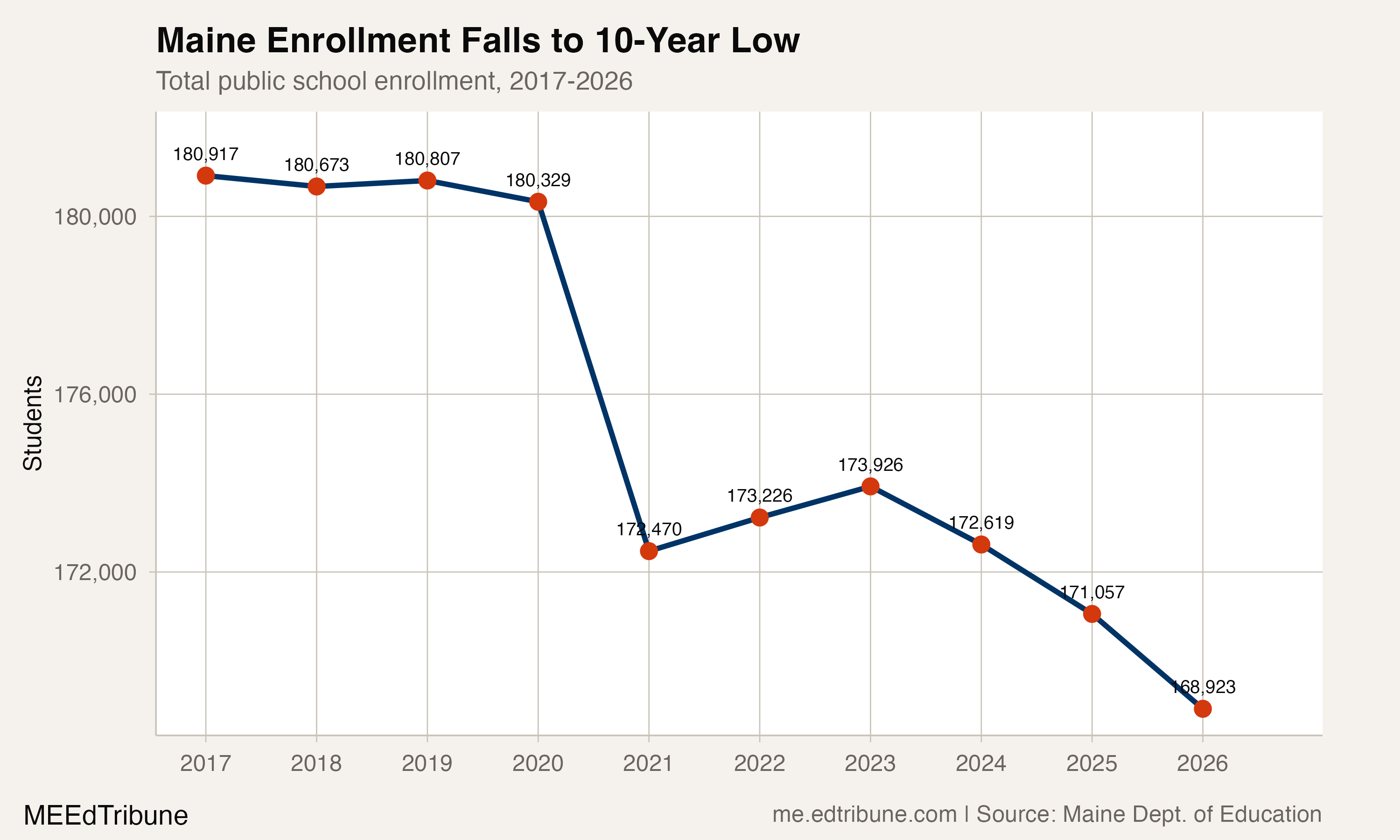
Maine enrolled 168,923 public school students in 2025-26, an all-time low for the decade-long dataset and a loss of 2,134 from the prior year. That is the largest single-year decline since the COVID shock of 2020-21, when 7,859 students vanished from the rolls. The difference is that COVID was a one-time disruption. This is a trend that is picking up speed.
Each year worse than the last
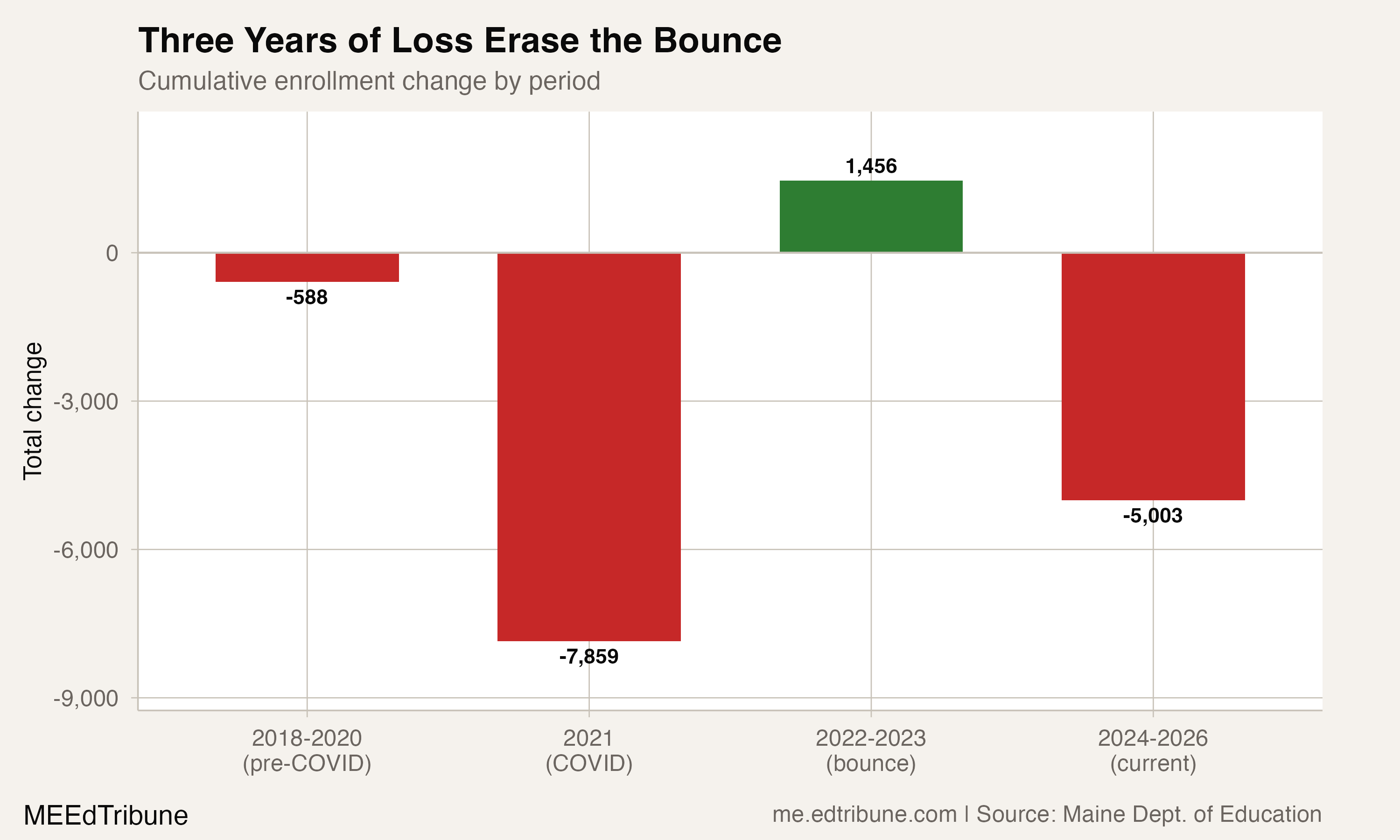
The three-year pattern tells the story more clearly than any single number. Maine lost 1,307 students in 2023-24, then 1,562 in 2024-25, then 2,134 in 2025-26. Each year's loss exceeded the one before, and the combined three-year total of 5,003 students dwarfs the post-COVID bounce of 1,456 that briefly suggested recovery in 2021-22 and 2022-23.
That bounce is now fully erased. The 5,003-student loss over three years exceeds it by a factor of 3.4, meaning the state has not merely returned to its pre-pandemic trajectory but has fallen well below it. Before COVID, Maine was losing an average of 196 students per year. The current three-year average is roughly 1,670 per year, more than eight times the pre-pandemic pace.
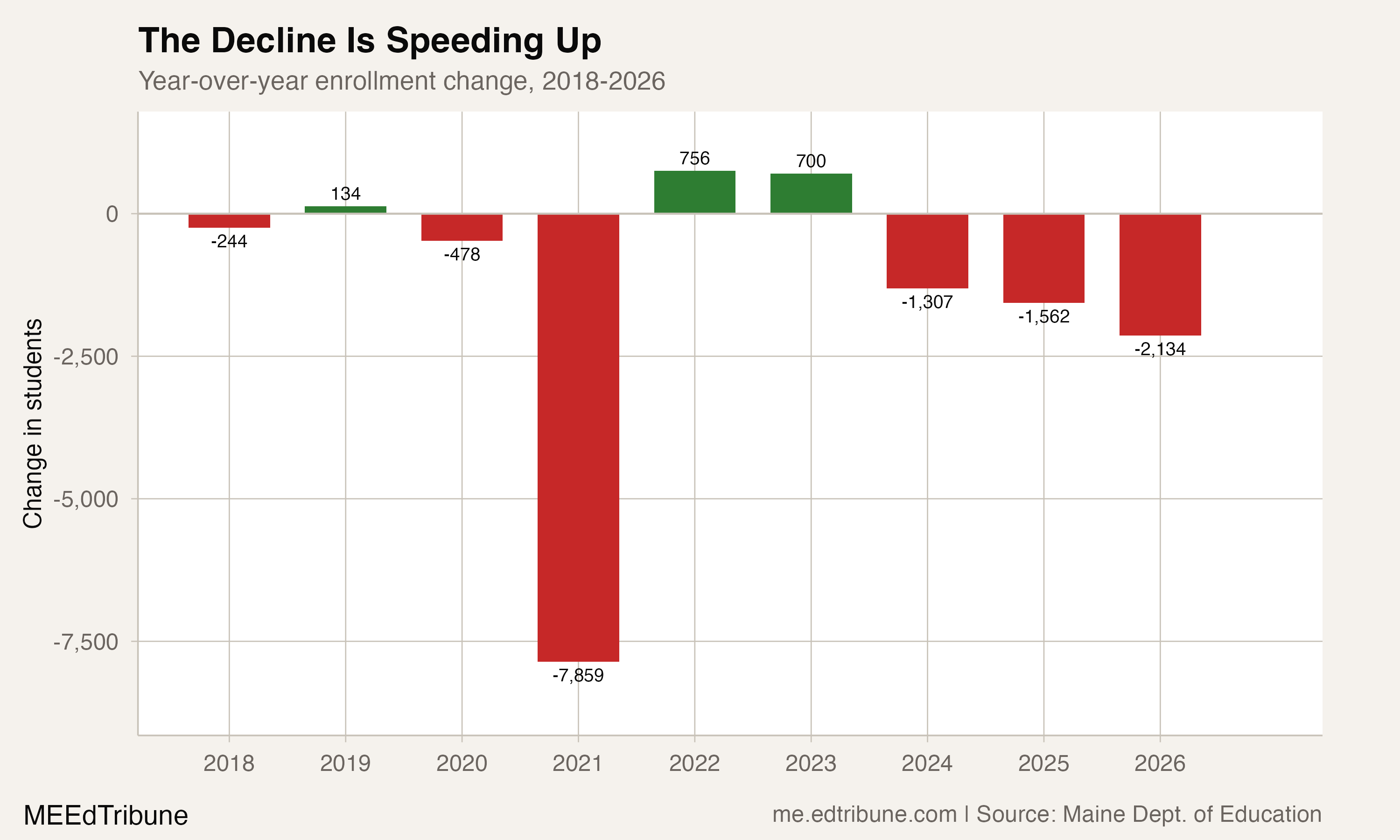
The 1.2% decline in 2025-26 may sound modest in isolation. It is not. It is the largest percentage decline in any non-COVID year in the dataset, and it follows two years that already ranked among the worst. Put together, the three-year run from 2024 through 2026 erased 5,003 students while the two-year COVID bounce recovered only 1,456.
The pipeline is shrinking from the bottom
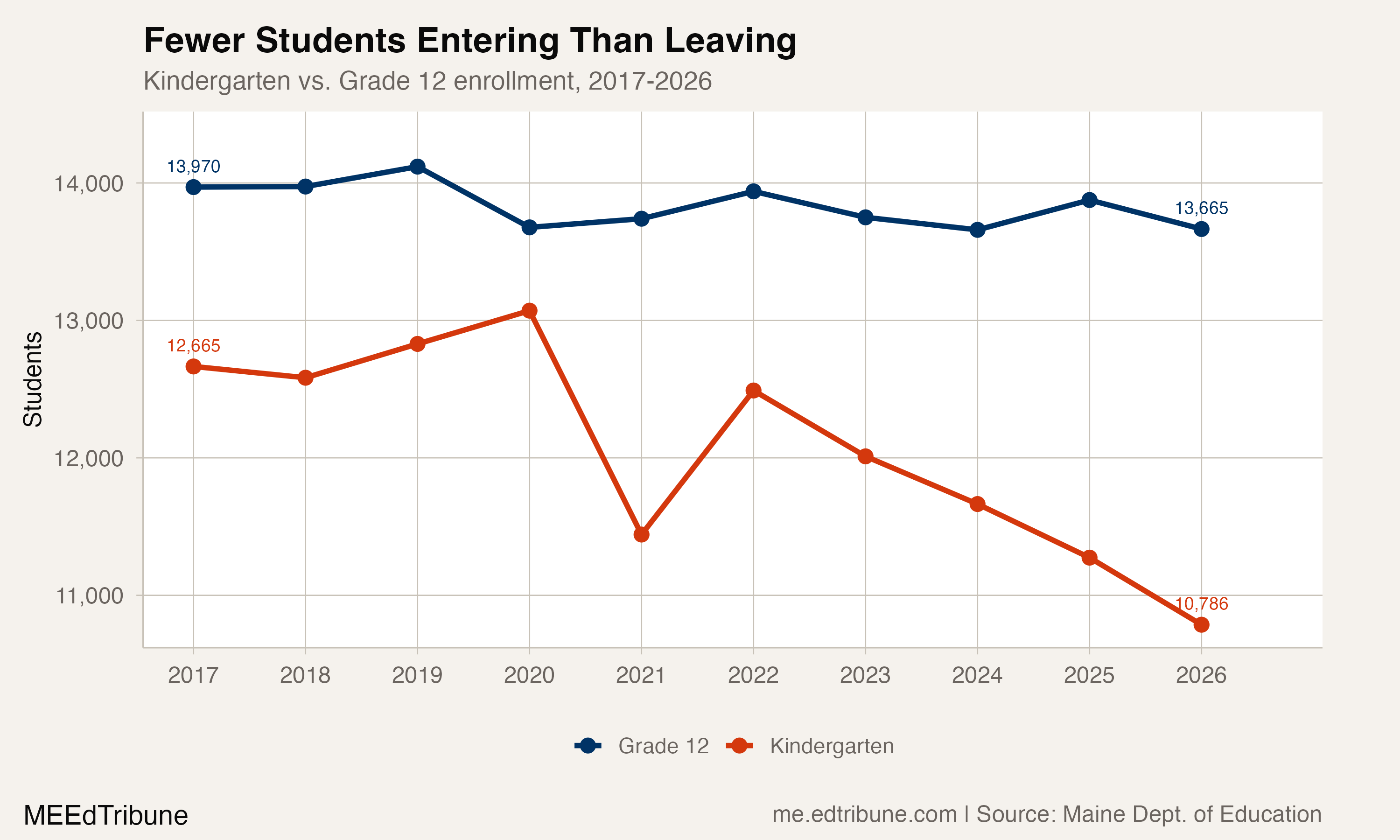
The enrollment math is relentless. In 2025-26, Maine enrolled 10,786 kindergartners and graduated 13,665 seniors, a K-to-12th-grade ratio of 78.9. For every 100 students leaving, roughly 79 are entering. That ratio stood at 95.6 in 2020, when kindergarten briefly peaked at 13,071. After a COVID-year dip and partial recovery, it has fallen steadily since 2022 and now sits well below the 90.7 recorded in 2017.
The kindergarten decline is steep: 10,786 in 2026, down 17.5% from the 2020 peak. Grade 12 enrollment, by contrast, has been roughly flat, fluctuating between 13,659 and 14,119 over the past decade. The result is a widening gap at the bottom of the pipeline that guarantees continued enrollment losses even if not a single family leaves the state.
Pre-K tells a different story. Maine enrolled 7,016 pre-kindergartners in 2025-26, up 30% from 5,395 in 2016-17, reflecting expanded public pre-K programs. But that growth has not translated into kindergarten gains, suggesting either that pre-K is absorbing children who would not otherwise have entered the public system until kindergarten, or that the families using public pre-K are choosing other options for elementary school.
The oldest state's structural problem
Maine is the oldest state in the nation by median age, at 44.8 years, with 23% of its population over 65. It is one of 17 states that experienced natural population decline in 2024, meaning more deaths than births. The state's total population grew 0.5% in 2025, but that growth came entirely from migration: 7,406 domestic migrants and 4,040 international migrants, not from births.
The national birth rate has fallen more than 20% since 2007, but the decline hits Maine harder because the state had fewer women of childbearing age to begin with. Maine's fertility rate stood at 47.0 per 1,000 women ages 15-44 in 2023, according to the March of Dimes, below the national average. When a state's school-age pipeline is already thin, even modest birth rate declines translate directly into classroom losses.
Housing affordability is a competing explanation. Tracy Richter, vice president of planning services at HPM, a national school facilities consultancy, told Maine Public that birth rates alone do not explain the pattern:
"I think that the birth rates are going to stay low, but that's not all of it."
Richter pointed to the lack of affordable housing options that keeps young families from putting down roots in communities with school-age children. In Maine, where housing costs in southern coastal communities have risen steeply, that pressure may be pushing families to cheaper housing markets outside the state or into rural areas with even smaller school systems.
162 districts shrank, 93 hit bottom
The decline is not evenly distributed, but it is widespread. Of 254 districts and SAUs reporting enrollment in 2025-26, 162 lost students, 68 gained, and 13 were flat. Nearly two out of three districts are shrinking.
More strikingly, 93 districts recorded their lowest enrollment of the past decade, 36.6% of all reporting entities. RSU 10, covering the Rumford and Mexico area, lost 883 students over the decade, a 34.4% decline. RSU 02 in the Farmington area fell 31.5%. RSU 03 in Unity dropped 28.0%.
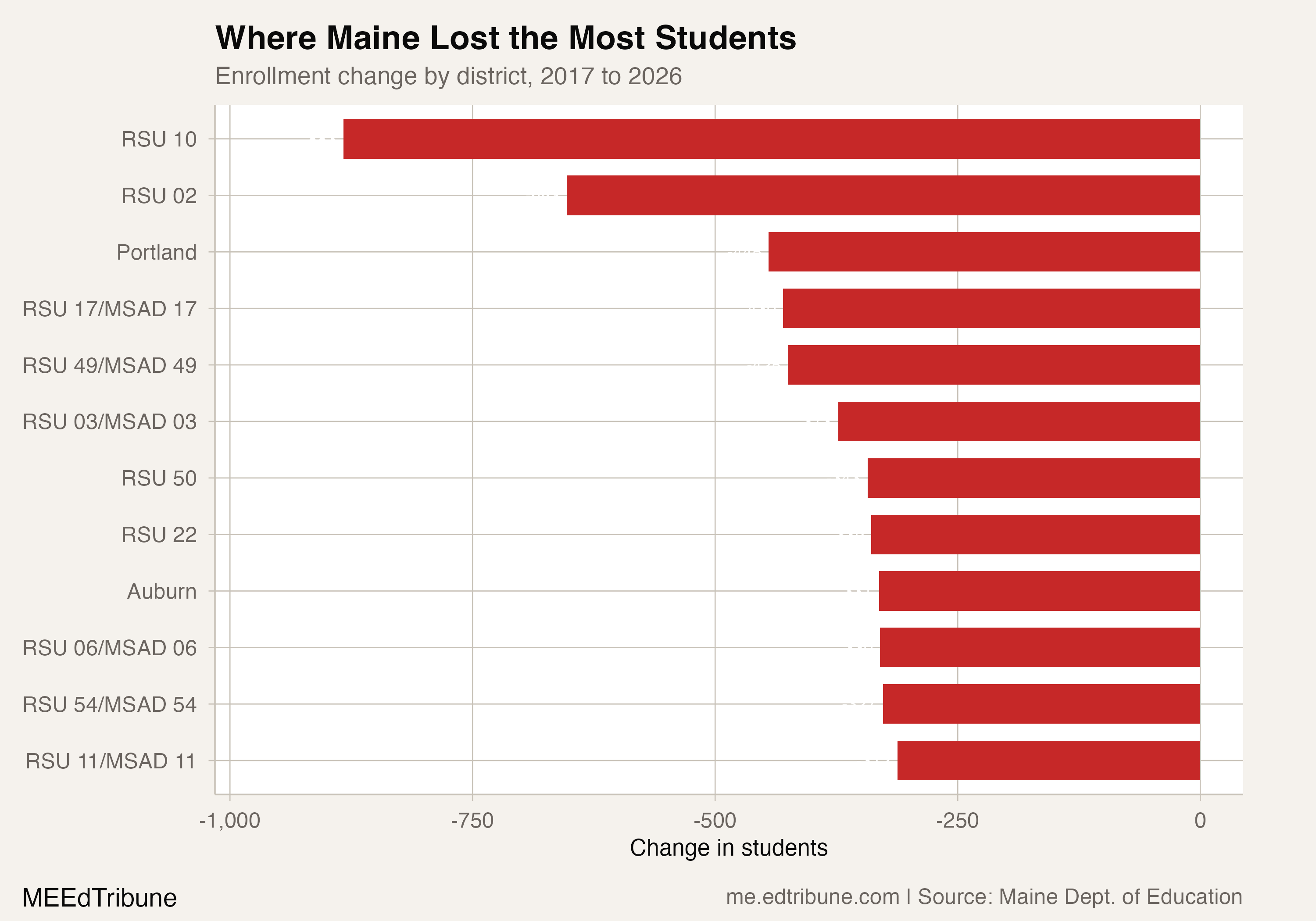
Portland, Maine's largest district, lost 253 students in a single year, dropping from 6,555 to 6,302. Over the full decade, the city has shed 445 students, a 6.6% decline. South Portland↗ET fell to 2,750, its lowest point in the dataset, down 9.4% from 2017.
Two of the state's largest districts bucked the trend. Lewiston↗ET added 36 students in 2025-26, reaching 5,349, though it remains well below its pre-COVID level of 5,574 in 2018-19. Auburn↗ET gained 66, its second consecutive year of growth after a seven-year slide that bottomed out at 3,179 in 2023-24. Both cities have significant immigrant and refugee populations, particularly Somali and African communities, that have partially offset the demographic pressures squeezing other districts.
Two out of three Maine districts now enroll fewer than 500 students. Eighty-five enroll fewer than 100. At that scale, losing even five students can mean losing a teacher, and losing a teacher can mean combining grades or cutting a program.
The budget math is arriving
The consequences are no longer hypothetical. Maine's Essential Programs and Services (EPS) funding formula allocates state aid on a per-pupil basis. When enrollment falls, so does state funding, but the fixed costs of maintaining buildings, heating classrooms, and running bus routes do not fall at the same rate.
"The only way that you're going to cut millions of dollars from a budget is by cutting positions." — Jesse Hargrove, Maine Education Association, March 2026
Across Portland, South Portland, and Lewiston, preliminary 2026-27 budgets proposed cutting more than 125 positions combined. About 40% of Maine's districts will see their state share decrease next year. South Portland's proposed cuts would eliminate 42 teaching positions, 16 educational technicians, and potentially close an elementary school to hold its tax increase to 6%.
Eric Waddell of the Maine School Management Association warned that the cuts may disproportionately target support staff:
"All these incredibly critically important jobs in our school that aren't necessarily viewed as providing direct care."
The school closure pace is accelerating in tandem. Fifteen schools closed in the first half of 2025, compared with 14 in all of 2024. In RSU 34, superintendent Matthew Cyr noted the district had "nine empty classrooms" between two small elementary schools before closing Viola Rand Elementary. MSAD 17 unified Waterford Memorial School and Harrison Elementary after neither building had enough students to justify a principal, saving roughly $400,000.
The budget season ahead
South Portland is weighing whether to close an elementary school. The district proposed eliminating 42 teaching positions, 16 educational technicians, and holding its tax increase to 6%. Across town, the heating bills have not changed. The bus routes have not shortened.
The EPS formula reform bill now before the Legislature proposes nine changes, including adjustments for community poverty and regional cost of living. District leaders have called the current formula outdated and inequitable. But the reform addresses how money flows, not how much there is. Augusta will vote on the formula. Birth certificates will determine the enrollment. And in RSU 34, the nine empty classrooms that prompted Viola Rand Elementary's closure are already being repurposed -- the question every superintendent in Maine is asking is which building is next.
Detailed code that reproduces the analysis and figures in this article is available exclusively to EdTribune subscribers.
Discussion
Sign in to join the discussion.
Loading comments...