In this series: Maine 2025-26 Enrollment.
From 2018 through 2024, Auburn↗ET lost students every single year. Not one year of reprieve. The district fell from 3,639 to 3,179, shedding 460 students, a 12.6% decline, over seven consecutive years. Across the Androscoggin River, Lewiston↗ET lost students too, but its trajectory bent differently. By 2023-24, Lewiston had already reversed course and started growing again. Auburn kept falling.
The two cities share a metropolitan area, a chamber of commerce, and a newspaper. They do not share an enrollment trend.
A Bridge Between Two Trajectories
Auburn and Lewiston are Maine's fourth- and second-largest school districts, enrolling a combined 8,657 students in 2025-26. They sit on opposite banks of the Androscoggin River, connected by bridges that carry thousands of commuters daily. Their economies are intertwined. Their school enrollment patterns are not.
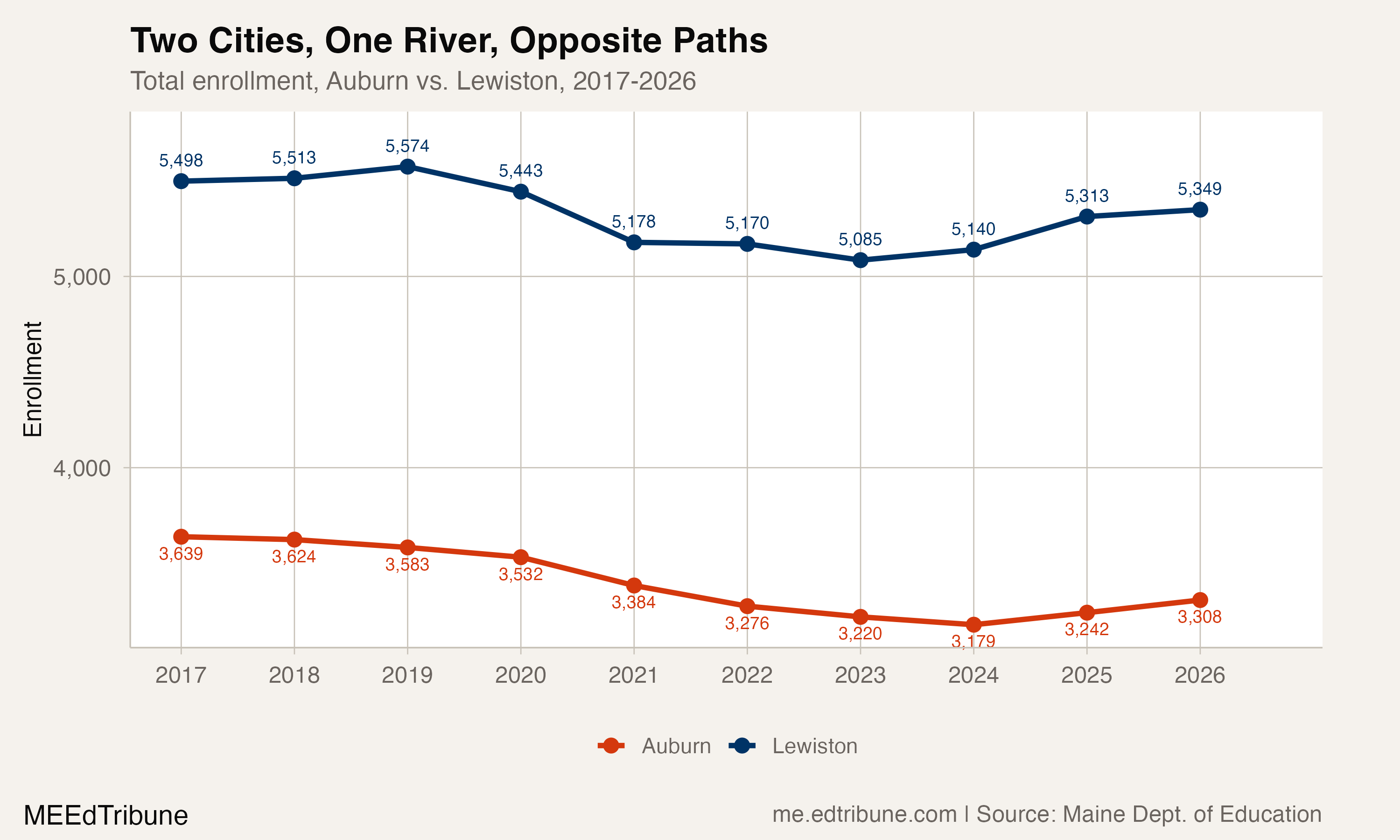
Between 2017 and 2026, Auburn's enrollment dropped 9.1%, from 3,639 to 3,308. Lewiston's fell 2.7%, from 5,498 to 5,349. That gap in decline rates, more than triple, is striking for districts separated by a few hundred yards of water.
The divergence is most visible in timing. Auburn declined in every year from 2018 through 2024, one of five Maine districts to sustain a seven-year losing streak. Lewiston hit its own trough in 2023 at 5,085, but then added 264 students over the next three years, a 5.2% rebound. Auburn's rebound came a year later and has been more modest: 129 students recovered over 2025 and 2026, a 4.1% bounce off its low.
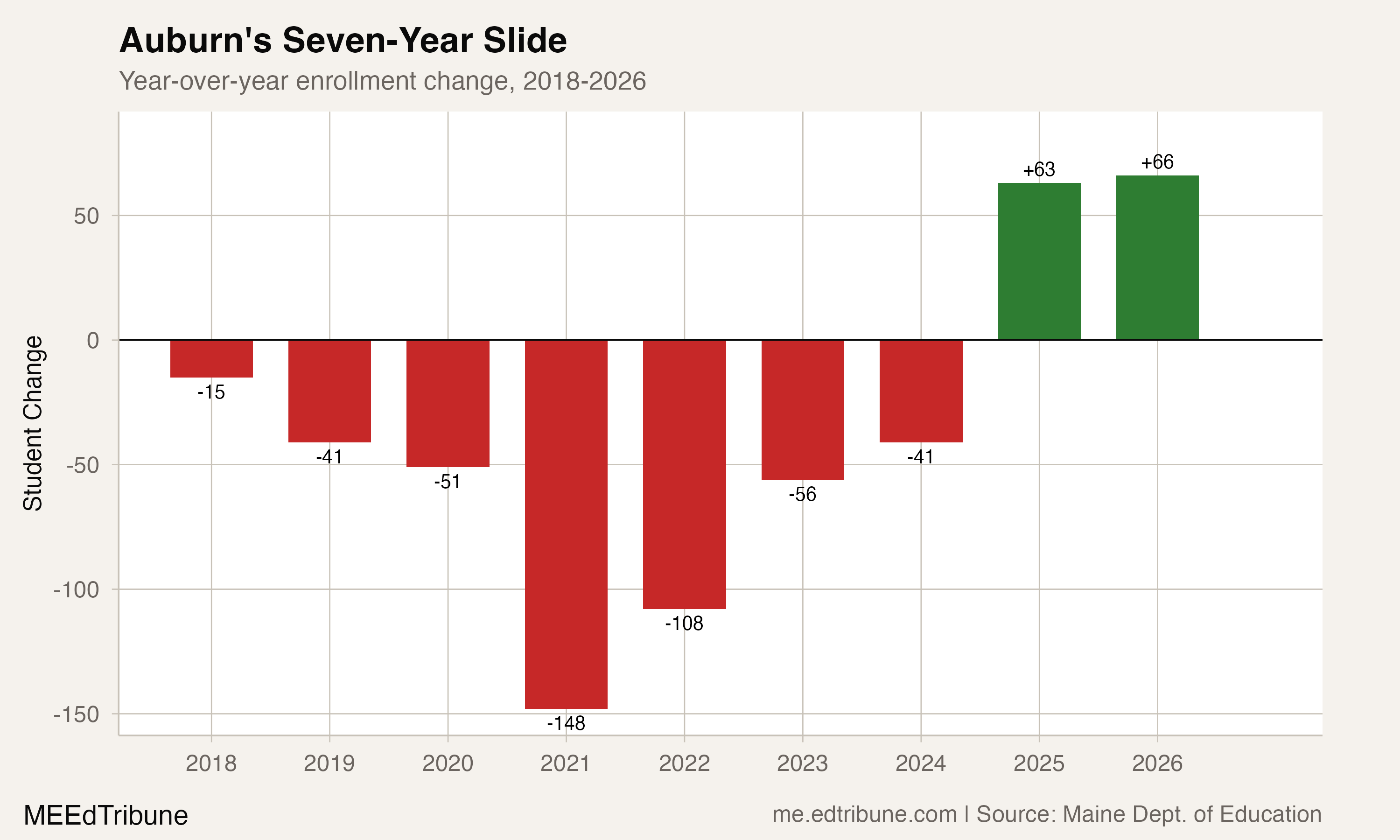
The worst single year for both was the pandemic. Auburn lost 148 students between 2020 and 2021, a 4.2% drop. Lewiston lost 265, a 4.9% decline. But the pre-pandemic and post-pandemic stories diverge sharply. Before COVID, Auburn was already declining at roughly 1% per year. Lewiston was growing. After COVID, Lewiston began recovering. Auburn kept sliding.
The Immigration Factor
The most likely explanation for the divergence is Lewiston's role as a gateway for immigrant communities. Beginning in 2001, Somali refugees began settling in Lewiston, drawn by affordable housing, low crime, and the state's public school system. Over two decades, the community grew to become a defining feature of the city's identity.
The enrollment data cannot distinguish immigrant-driven growth at the district level because Maine's data package provides demographics only at the state level. But the statewide numbers are suggestive: Black enrollment in Maine's public schools grew 50.3% between 2017 and 2026, from 6,256 to 9,403 students, in a state where overall enrollment fell 6.6%. English learner enrollment grew 54.3%, from 5,376 to 8,293. Those gains are concentrated in a handful of communities. Lewiston and Portland receive more than half of the state's Title III funding for multilingual learners.
Auburn, despite sharing a metro area, has not attracted comparable immigrant settlement. Its population has plateaued near 24,000 since the 1960s. Its racial composition remains over 90% white, compared to Lewiston's roughly 83%. Without a significant inflow of new families, Auburn's enrollment trajectory tracks Maine's broader pattern of birth-rate-driven decline. Other factors may contribute: Maine's school choice framework allows families to use public tuition at private academies, and inter-district transfers could shift students between adjacent SAUs in ways the enrollment data does not capture. But immigration is the variable that most obviously distinguishes the two cities.
The Christian Science Monitor reported that approximately 6,000 African refugees and asylum seekers now live in Lewiston, a city that was economically declining before their arrival but has since become "more vital than it was two decades ago."
The pattern is not unique to Auburn. Across Maine, districts without significant immigration are losing students faster than the state average. What makes the twin cities notable is the proximity: the same housing market, the same labor market, the same county, and yet a threefold gap in enrollment decline rates.
The Region Is Shrinking
Auburn's decline is severe relative to Lewiston, but it is not an outlier among Androscoggin County peers. RSU 04, which serves Sabattus and Wales just south of the twin cities, lost 14.6% of its enrollment over the same period. Lisbon, downstream on the Androscoggin, declined 4.6%. RSU 16, serving Mechanic Falls, lost 4.5%.
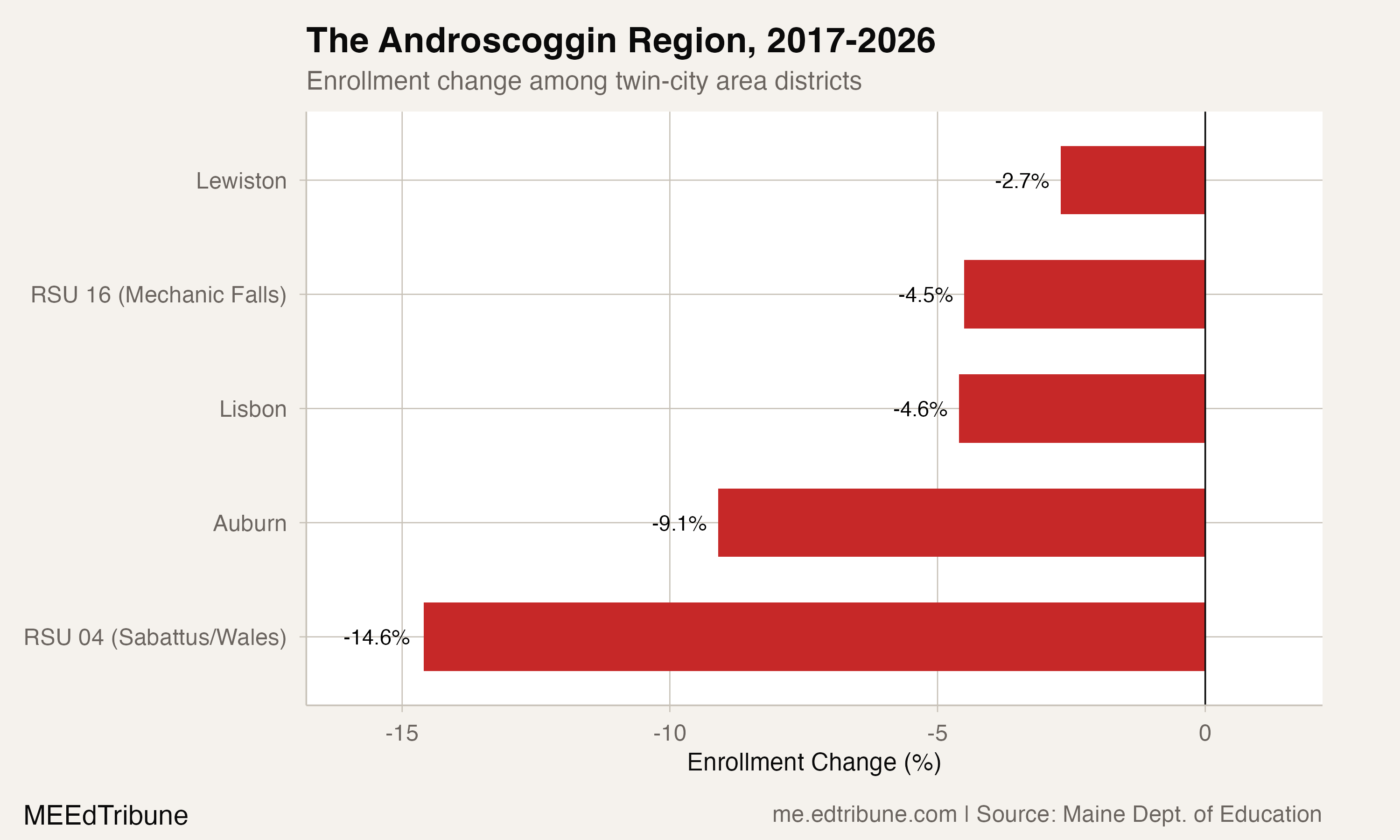
Every district in the area shrank. Lewiston simply shrank least.
Auburn's 9.1% decline also outpaced the statewide rate of 6.6%, placing it ninth among all Maine districts in absolute student losses. Among the state's 10 largest districts, Auburn's percentage decline trails only RSU 17 (-12.6%) and RSU 06 (-9.2%). The state's four biggest districts are all smaller than they were in 2017: Portland lost 445 students (-6.6%), Lewiston lost 149 (-2.7%), Bangor lost 284 (-7.6%), and Auburn lost 331 (-9.1%).
What the Recovery Looks Like
The seven-year streak broke in 2025, when Auburn added 63 students, followed by 66 more in 2026. Whether this is a genuine reversal or a dead-cat bounce is impossible to determine with two years of data.
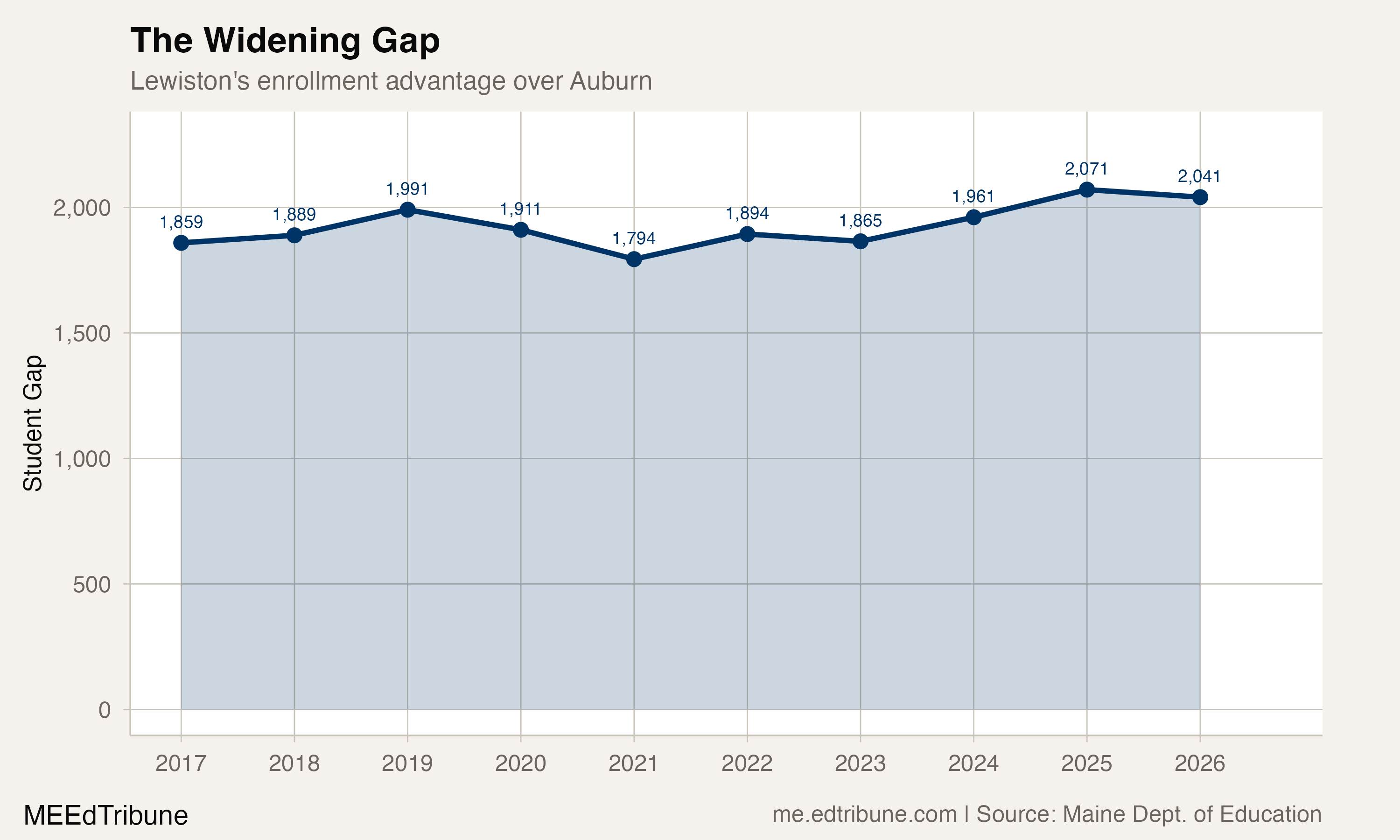
Even with the rebound, the enrollment gap between the twin cities has widened. Lewiston enrolled 1,859 more students than Auburn in 2017. In 2026, that gap is 2,041, an increase of 182 students. Lewiston's recovery from its own trough has been faster and steeper.
Neither city has recovered to its pre-COVID enrollment. Auburn's 3,308 in 2026 remains 224 students below its 2020 level of 3,532. Lewiston's 5,349 is 94 below its 2020 mark of 5,443. But Lewiston peaked later (2019, at 5,574) and is closer to its high-water mark than Auburn is to its own.
Budget Pressure Without Easy Answers
For Auburn, the enrollment decline translates directly into reduced state funding. Maine's Essential Programs and Services formula allocates state aid based on pupil counts. Each student lost means less revenue. Roughly 40% of Maine districts will see their state funding share decrease in 2025-26, a pattern driven in part by enrollment trends.
The funding formula is itself changing. Maine enacted LD 2226 in April 2026, directing updates to the EPS system that the Department of Education says begin with FY2028 calculations. For shrinking districts, the formula creates a structural bind: fewer students mean less state aid, but fixed costs for buildings, transportation, and administration do not scale down proportionally.
Auburn gained 63 students in 2025 and 66 in 2026. After seven years of contraction, two years of growth feel like relief. But the district is still 331 students below its 2017 level, still 224 below its pre-COVID mark. Across the river, Lewiston's superintendent is looking for new classroom space. Auburn's superintendent is looking at a budget where every lost student takes state dollars out the door while the heating bill stays the same. The Androscoggin runs between them, and so does a gap that keeps widening.
Detailed code that reproduces the analysis and figures in this article is available exclusively to EdTribune subscribers.
Discussion
Sign in to join the discussion.
Loading comments...