In this series: Maine 2025-26 Enrollment.
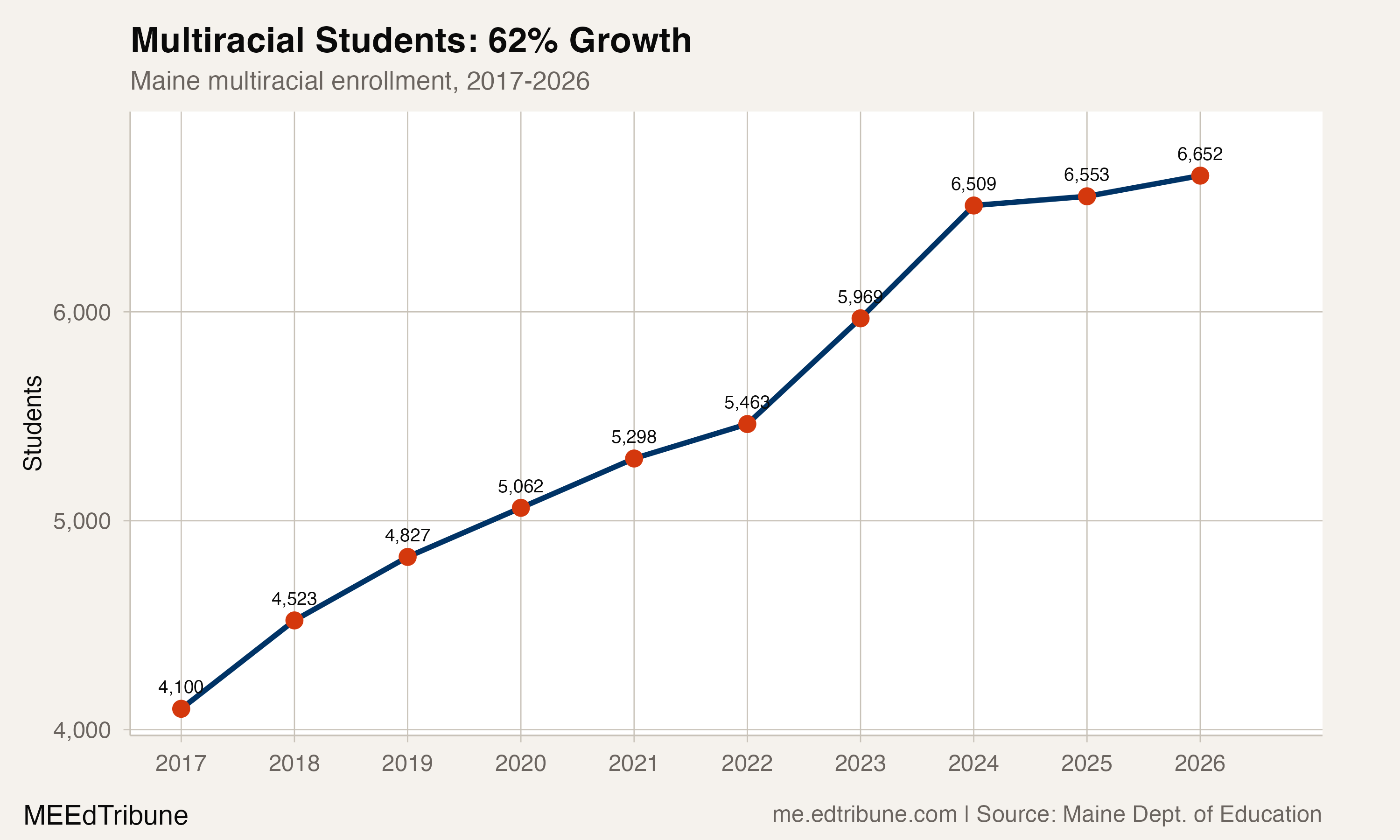
In the nation's whitest state, the fastest-growing student population is one that did not exist as a federal reporting category until 2008. Maine's multiracial students have grown 62.2% since 2017, rising from 4,100 to 6,652. They now represent 3.9% of public school enrollment, tying Hispanic students for the third-largest racial or ethnic group behind white and Black.
The growth is real and consistent, second only to Hispanic students (+70.8%) among demographic groups. But it is happening inside a system that is losing students overall: Maine enrollment hit an all-time low of 168,923 in 2026, down 6.6% from its 2017 peak. The multiracial surge is not adding students to the system so much as changing who is in it.
Nine years of unbroken growth
Multiracial enrollment has increased every single year since 2017. The trajectory has two distinct phases: steady growth of 165 to 423 students per year from 2017 through 2022, then a sharp acceleration in 2023 and 2024 when the category added 506 and 540 students respectively. Growth decelerated again in 2025 and 2026, adding just 44 and 99 students, though the category still grew while overall enrollment fell.
The share shift tells the fuller story. Multiracial students went from 2.3% to 3.9% of enrollment, a gain of 1.7 percentage points. That may sound marginal, but in a state where white enrollment still accounts for 84.4% of all students, any non-white group approaching 4% represents a proportionally visible shift.
Nationally, multiracial students comprised about 5% of public school enrollment as of fall 2022, projected to reach 6% by 2031 according to the National Center for Education Statistics. Maine's 3.9% still trails the national average, but the gap is narrowing: in 2017, Maine's 2.3% multiracial share was less than half the national rate.
A three-way convergence
The multiracial surge is part of a broader pattern. Three demographic groups are converging toward similar enrollment shares, each growing through different mechanisms.
Hispanic enrollment rose 70.8% over the same period, from 3,823 to 6,528 students, gaining 1.8 percentage points of share. Black enrollment grew 50.3%, from 6,256 to 9,403, the largest absolute gain of any non-white group at 3,147 students. Together, these three groups now account for 13.4% of Maine enrollment, up from 7.8% in 2017.
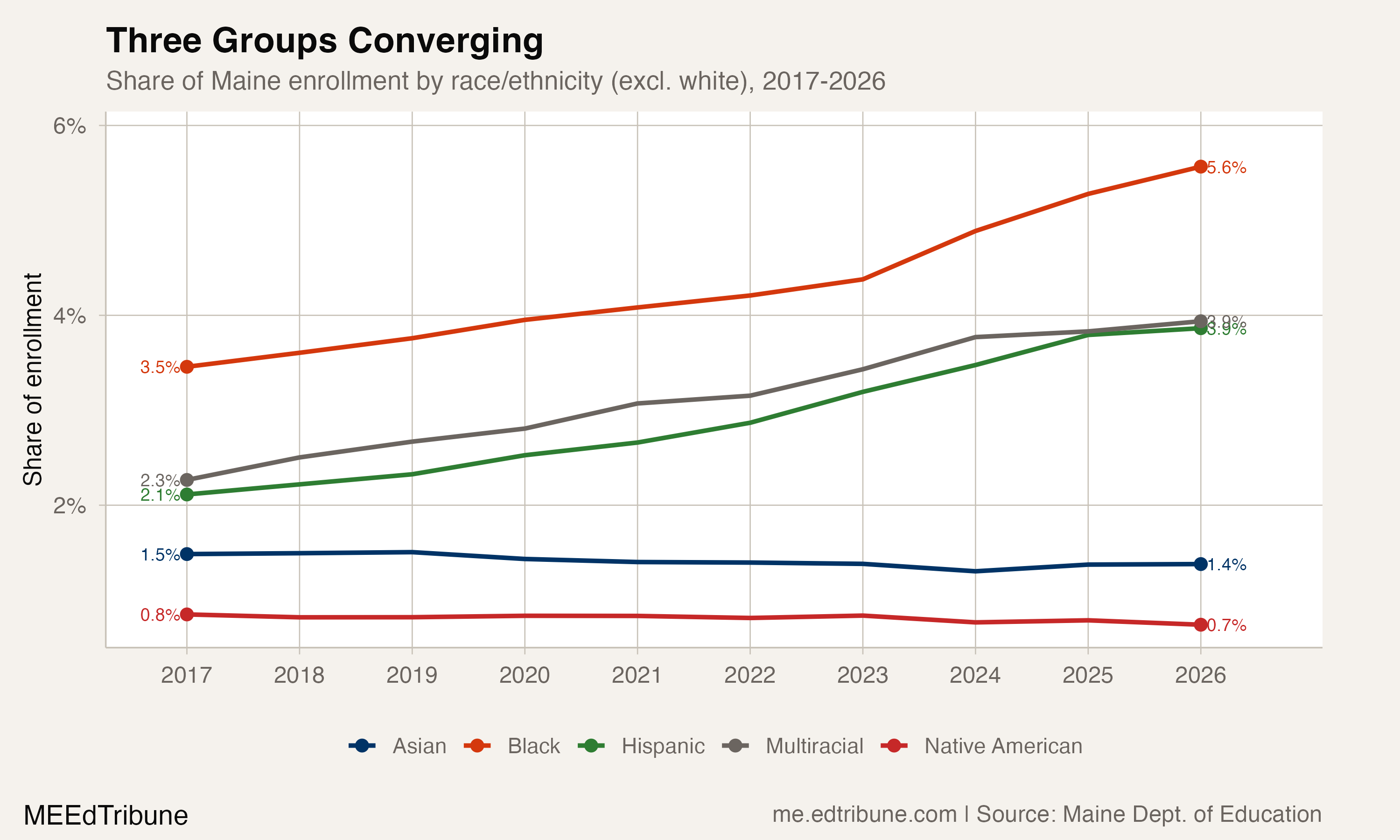
The convergence is visible in the share chart: Black students lead at 5.6%, while Hispanic and multiracial students are essentially tied at 3.9%. In 2017, a full percentage point separated each group. By 2026, the top three non-white groups are within two percentage points of each other.
But each group is growing for different reasons. Black enrollment growth in Maine is driven substantially by immigration from East and Central Africa. Maine Public reported that 7,208 students were classified as multilingual learners in 2023-24, a 28% increase over five years. Portuguese, Somali, Spanish, and Arabic are the most common non-English languages, reflecting asylum seeker arrivals from Angola and continued Somali secondary migration to Lewiston and Portland.
Hispanic growth tracks both immigration patterns and broader demographic trends visible across New England. Multiracial growth, by contrast, is likely driven primarily by two forces: an increase in multiracial families, and a cultural shift in how families identify their children.
The reclassification question
Any discussion of multiracial growth carries an asterisk that other demographic categories do not. When Black enrollment rises, it almost always reflects actual new students entering the system. When multiracial enrollment rises, some portion may reflect families choosing a different box on the enrollment form for children who were already there.
Princeton researchers Paul Starr and Christina Pao found that the 2020 Census's reported 276% increase in multiracial Americans was largely a methodological artifact: changes to the questionnaire design caused an algorithm to reclassify single-race respondents as multiracial based on ancestry write-ins. The actual demographic shift was far smaller than the headline number suggested.
School enrollment data is not identical to Census data. Schools use a consistent federal reporting framework that has included a "two or more races" category since the 2008-09 school year, and the classification is typically parent-reported at enrollment. There is no algorithm reclassifying students after the fact. But the underlying cultural dynamic is the same: as multiracial identity becomes more socially visible and more families encounter the category on forms, identification rates rise even when the underlying population of children with parents of different races may be growing more modestly.
This distinction matters for planning purposes. If multiracial growth reflects primarily new identification of existing students rather than new arrivals, it does not change total enrollment, classroom sizes, or staffing needs. It changes demographic composition reporting, equity tracking, and the accuracy of comparisons to prior years.
The data cannot distinguish between these mechanisms. Maine's nine-year trend of unbroken growth, including years of sharp acceleration (2023, 2024) and deceleration (2025, 2026), is consistent with a combination of both real demographic change and evolving identification practices.
The scale of white decline
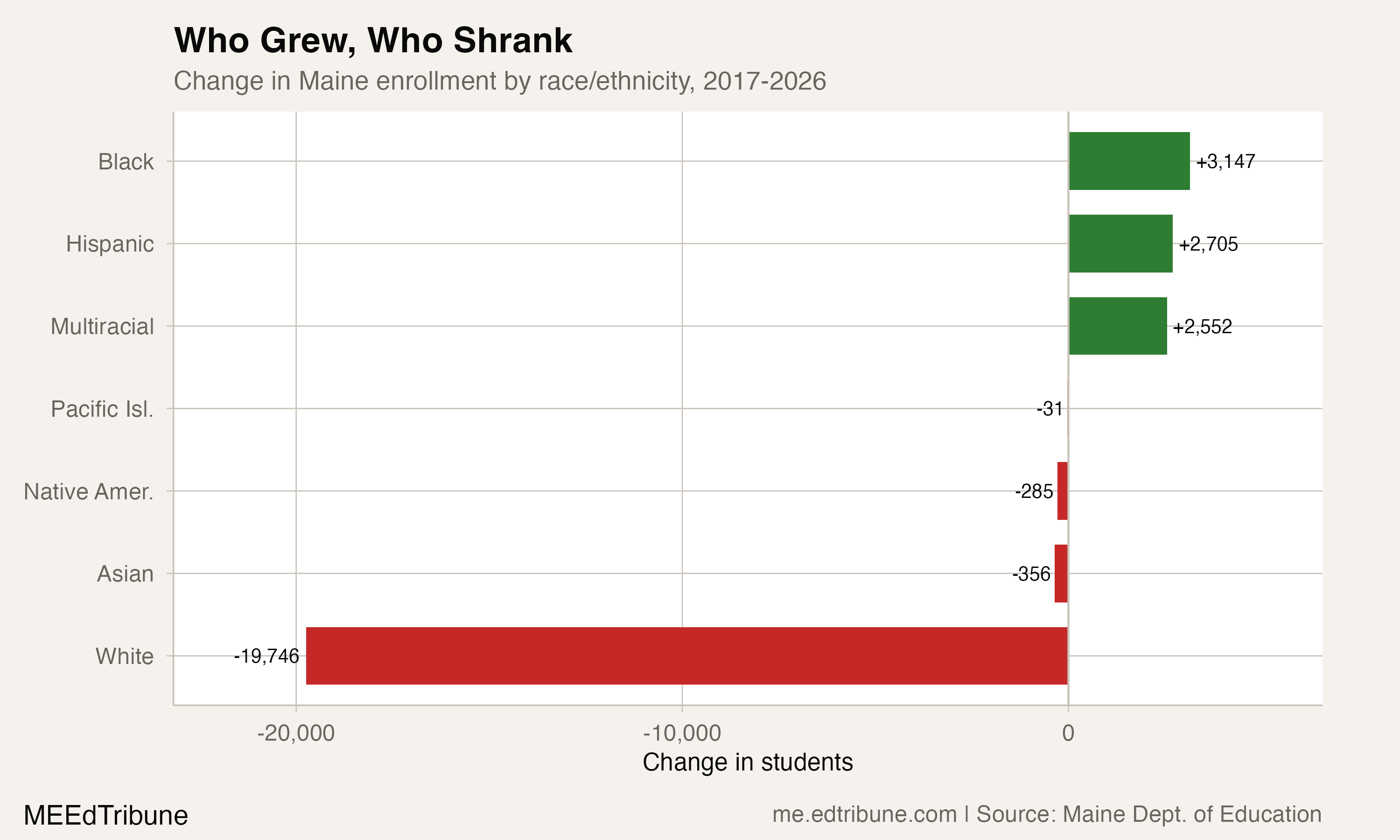
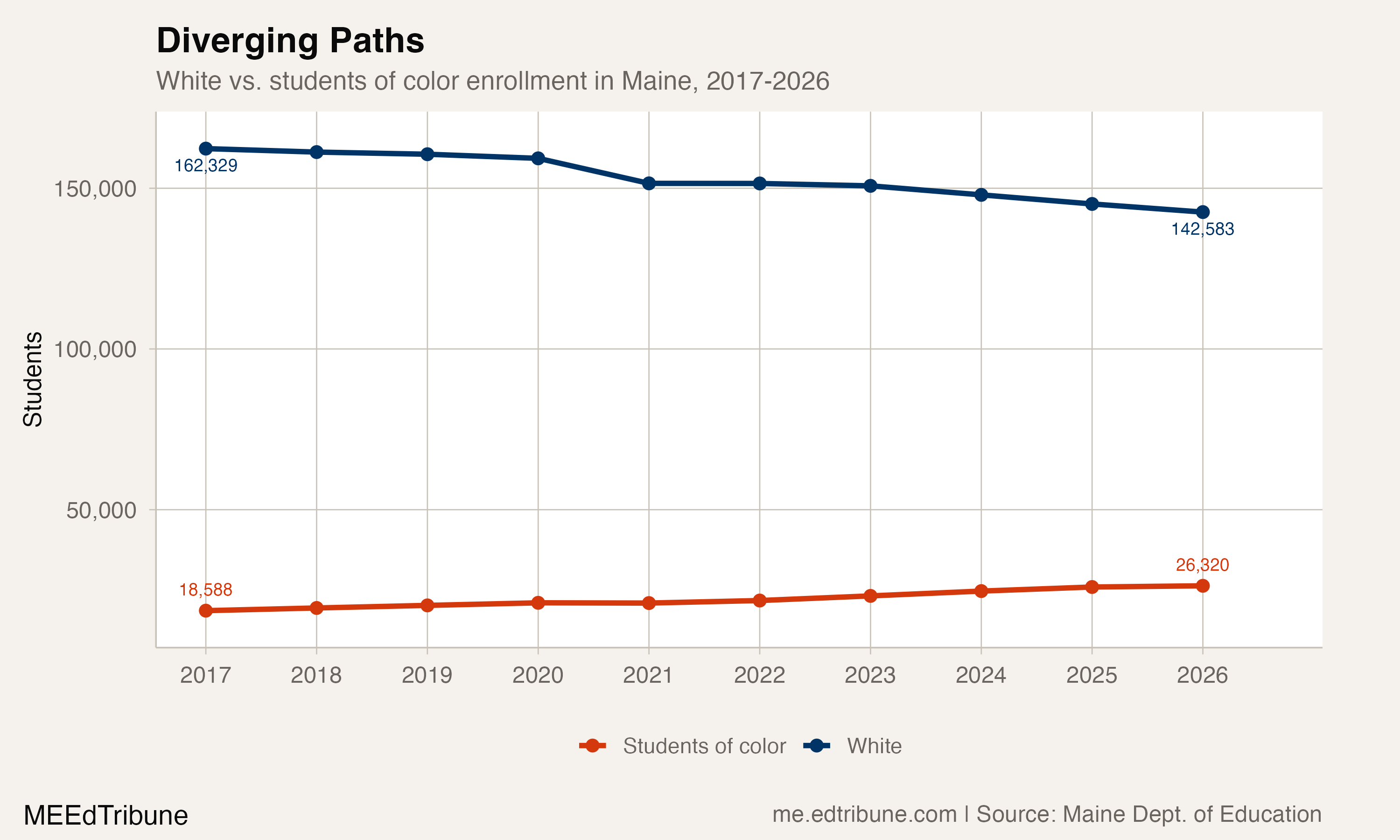
The growth in non-white enrollment is meaningful, but it is not replacing what is being lost. White enrollment fell by 19,746 students since 2017, a 12.2% decline. The combined growth of all non-white groups over the same period was 7,732 students. Maine's student body is becoming more diverse, but it is becoming more diverse inside a shrinking system.
White students' share dropped from 89.7% to 84.4%, a decline of 5.3 percentage points. That still leaves Maine with one of the most racially homogeneous public school systems in the country. The state's general population is about 91% white according to Census Bureau estimates, meaning the school-age population is diversifying faster than the population as a whole.
Maine's demographic fundamentals explain why. The state has recorded more deaths than births for over a decade, with 1,300 more deaths than births in a recent annual count. The families shrinking the birth pipeline are disproportionately white and long-established. The families growing the school-age population, through immigration and higher birth rates among younger demographic groups, are disproportionately Black, Hispanic, and multiracial.
What the year-over-year pattern reveals
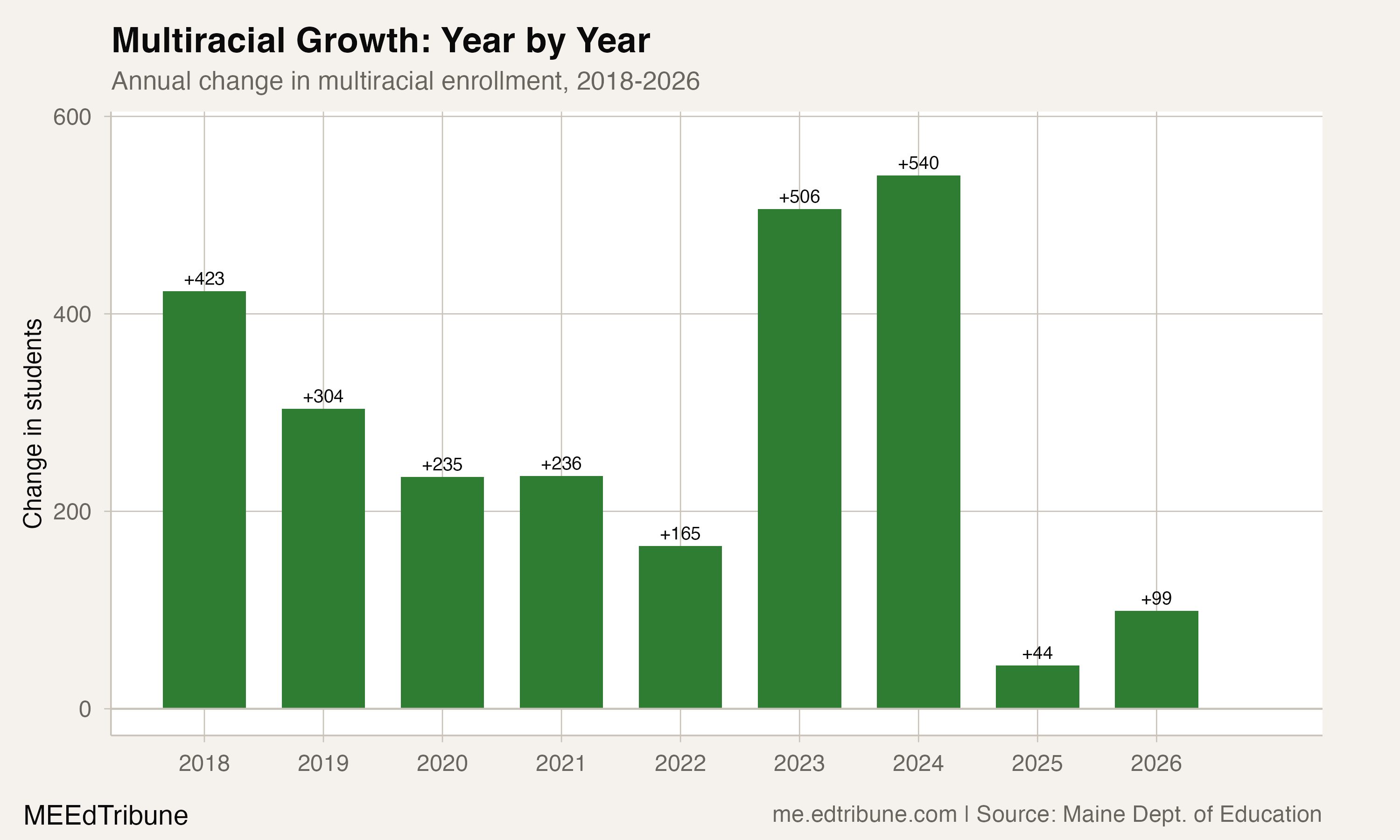
The year-by-year multiracial growth pattern is uneven in ways that resist simple explanation. Growth was strongest in 2018 (+423), dipped through 2022 (+165), surged in 2023 and 2024 (+506 and +540), then dropped sharply in 2025 (+44) and 2026 (+99).
The 2023-2024 acceleration coincides with a period of increased immigration to Maine. Carlos Gomez, Portland Public Schools' director of multilingual programs, told Maine Public that the state is "starting to look a lot more like the rest of the country in terms of that multilingual, cultural diversity." The 2025-2026 deceleration coincides with increased ICE enforcement activity in Maine, which the Portland Press Herald reported led to thousands of student absences and anxiety across immigrant communities, though the connection between immigration enforcement and multiracial identification is indirect at best.
The sharp slowdown in 2025-2026 could also reflect a plateau in the identification effect. If families inclined to select the multiracial category have largely already done so, future growth would depend more on actual demographic change than on reporting shifts. Whether the deceleration is temporary or marks a new baseline will not be clear until 2027 data arrives.
The staffing question no one is asking
Maine's diversity data stops at the state level. The Department of Education does not publish district-level racial or ethnic breakdowns, which means there is no way to track where multiracial, Black, or Hispanic enrollment growth is concentrated. State-level trends suggest growing diversity, but individual districts cannot assess how their demographic profile compares or whether their staffing reflects their students.
"We'd love to have more people that can speak multiple languages on our staff." -- Carlos Gomez, Portland Public Schools, Maine Public, Oct. 2024
Portland and Lewiston, the state's two largest districts, are almost certainly absorbing most of the Black and Hispanic growth. The multiracial population may be more geographically dispersed. Without district-level data, the question of whether growing demographic diversity is translating into equitable resource allocation cannot be answered with enrollment numbers alone.
Nine years ago, Maine's public schools were 89.7% white. They are now 84.4% white. That is still one of the most homogeneous student populations in the country, by a wide margin. But the rate of change is no longer negligible, and it is compounding. The families driving the shift -- immigrant households in Portland and Lewiston, mixed-race families across southern Maine -- are younger than the population they are joining. In a state where deaths have outnumbered births for over a decade, the classroom is where Maine first encounters its demographic future. It does not look like its past.
Detailed code that reproduces the analysis and figures in this article is available exclusively to EdTribune subscribers.
Discussion
Sign in to join the discussion.
Loading comments...