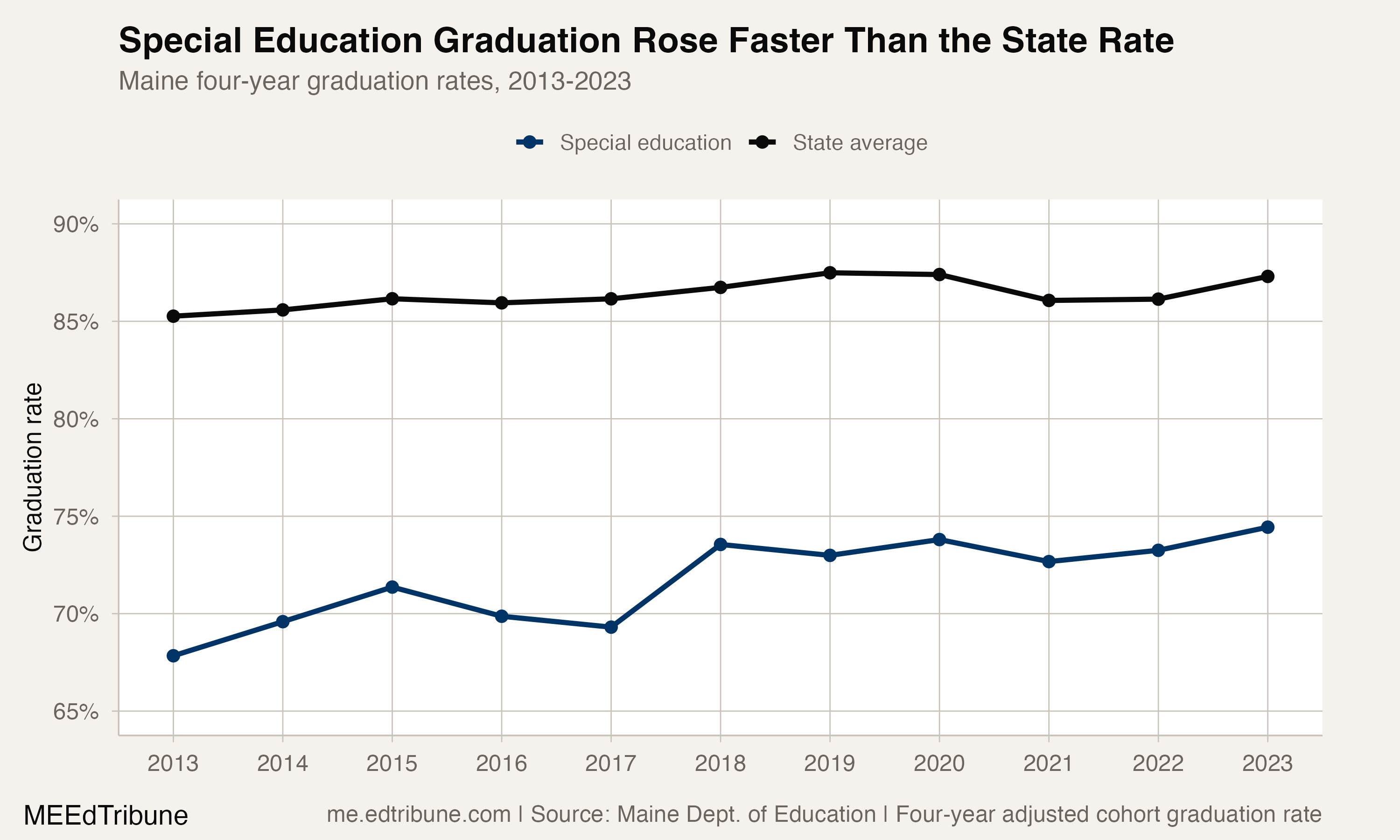
Maine's special education graduation rate rose from 67.8% in 2013 to 74.4% in 2023, a gain of 6.6 percentage points. The statewide rate increased more slowly, from 85.3% to 87.3%, a 2.0-point gain.
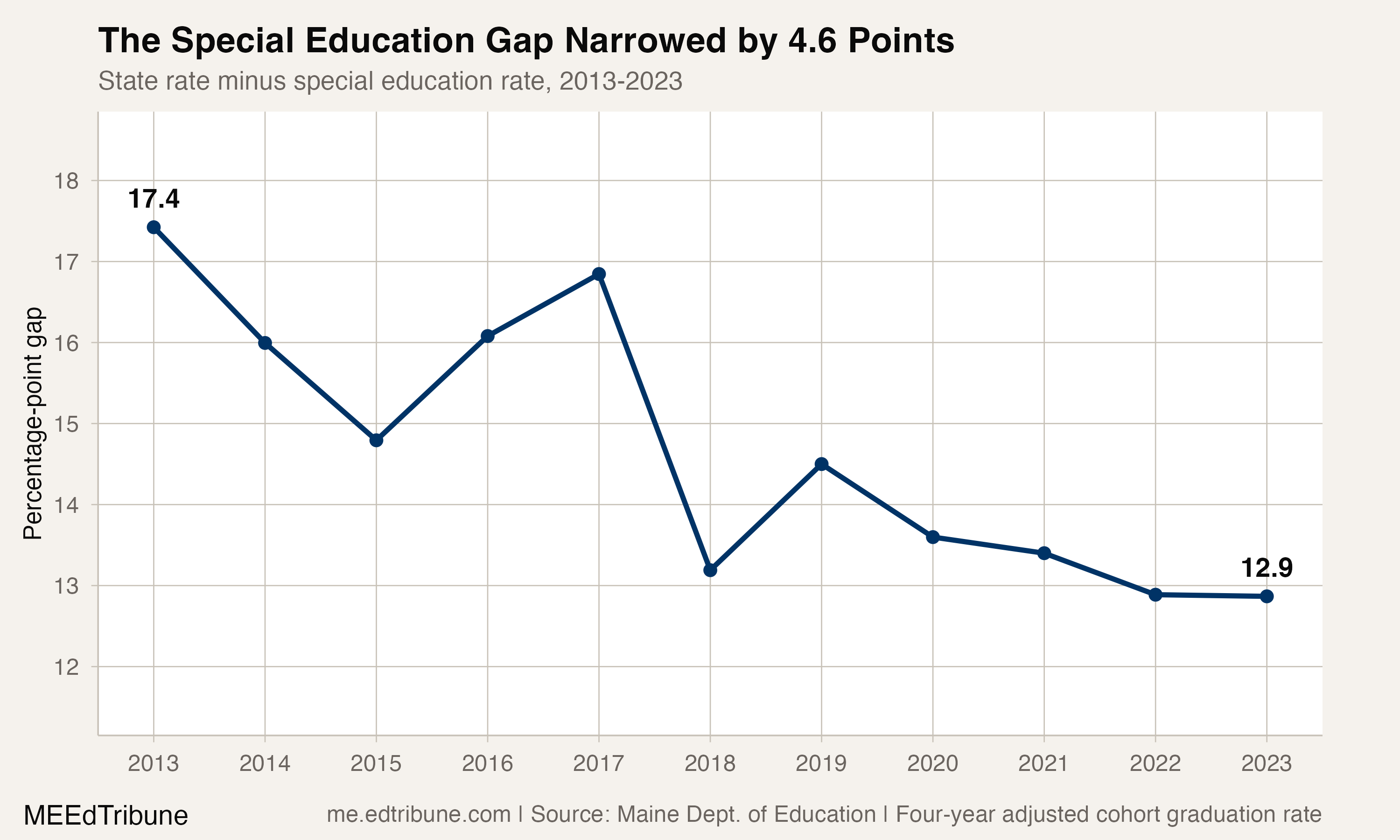
That difference in pace narrowed the gap between the two rates from 17.4 percentage points to 12.9 points. Measured from the same endpoints, the special education gap closed by 4.6 points.
The path included reversals
The improvement was not a straight line. Across the ten annual transitions in the panel, the gap narrowed seven times and widened three times.
That matters for interpreting the result. The endpoint improvement is real, but it does not establish a year-after-year program effect or identify a single turning point. The graduation file reports rates and cohort counts; it does not report which services, policies or student circumstances drove the change.
The change also did not come from a shrinking reported cohort. Maine's four-year special education cohort grew from 2,388 students in 2013 to 2,750 in 2023. That was an increase of 362 students, or 15.2%.
The larger cohort does not prove why the rate rose. It does show that the improvement coexisted with a broader reported base rather than a smaller one.
Other selected service-group gaps moved the other way
The special education result stands apart from three other service-group comparisons available at both endpoints.
The gap for students experiencing homelessness widened from 30.1 points in 2013 to 32.3 points in 2023. The English learner gap widened from 11.8 to 16.0 points. The gap for students eligible for free or reduced-price lunch widened from 7.3 to 8.5 points.
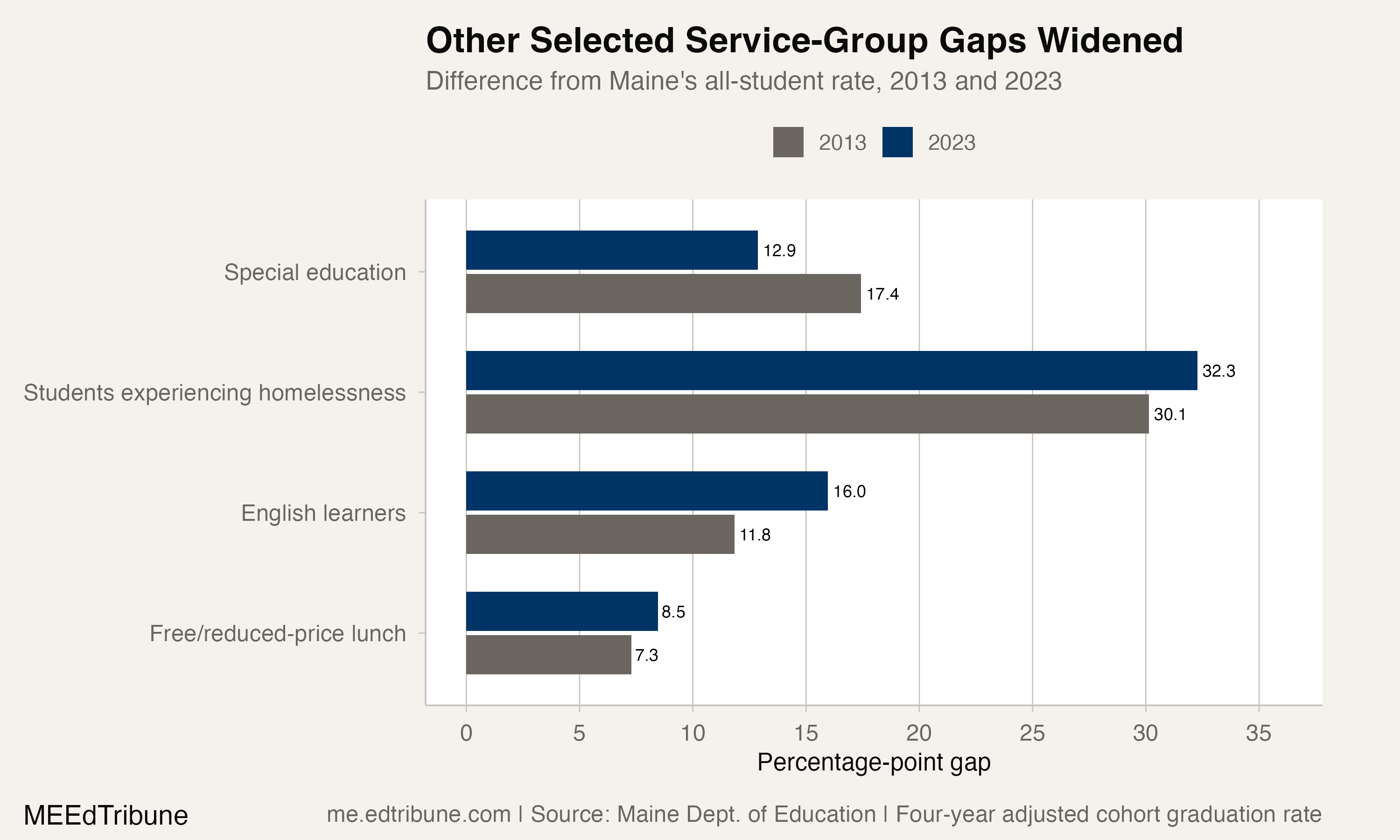
Those comparisons use the subgroup names published in the source. Free or reduced-price lunch eligibility is not relabeled as poverty or economic disadvantage, and the groups can overlap.
Special education was not the only reported gap to narrow. The female-male graduation-rate difference fell from 4.5 points to 2.7 points. The narrower conclusion is that special education was the only one of the four selected service-group gaps in the chart to improve over these endpoints.
What the trend can establish
The analysis supports an outcome statement, not a causal one. Between 2013 and 2023, Maine's special education graduation rate gained more than the statewide rate, and the difference between them narrowed. The data cannot attribute that change to federal accountability, transition planning, inclusive classrooms or any other specific practice.
The remaining 12.9-point gap is still substantial. The result is therefore evidence of partial convergence, not parity: stronger relative progress over a decade, with a sizeable difference still present at the latest endpoint in this series.
About the data
Figures come from the Maine Department of Education's four-year adjusted cohort graduation data for 2013 through 2023. The analysis uses source-published statewide all-student and subgroup rows and does not reconstruct statewide rates from schools.
Detailed code that reproduces the analysis and figures in this article is available exclusively to EdTribune subscribers.
Discussion
Sign in to join the discussion.
Loading comments...