Correction (Sept. 26, 2026): An earlier version described the gender gap as narrowing steadily and the male improvement as sustained, understated the 2022-to-2023 change in the gap, and offered subgroup, geographic and causal explanations the available data cannot test. This version limits those conclusions and rebuilds the evidence from Maine's full published statewide gender series.
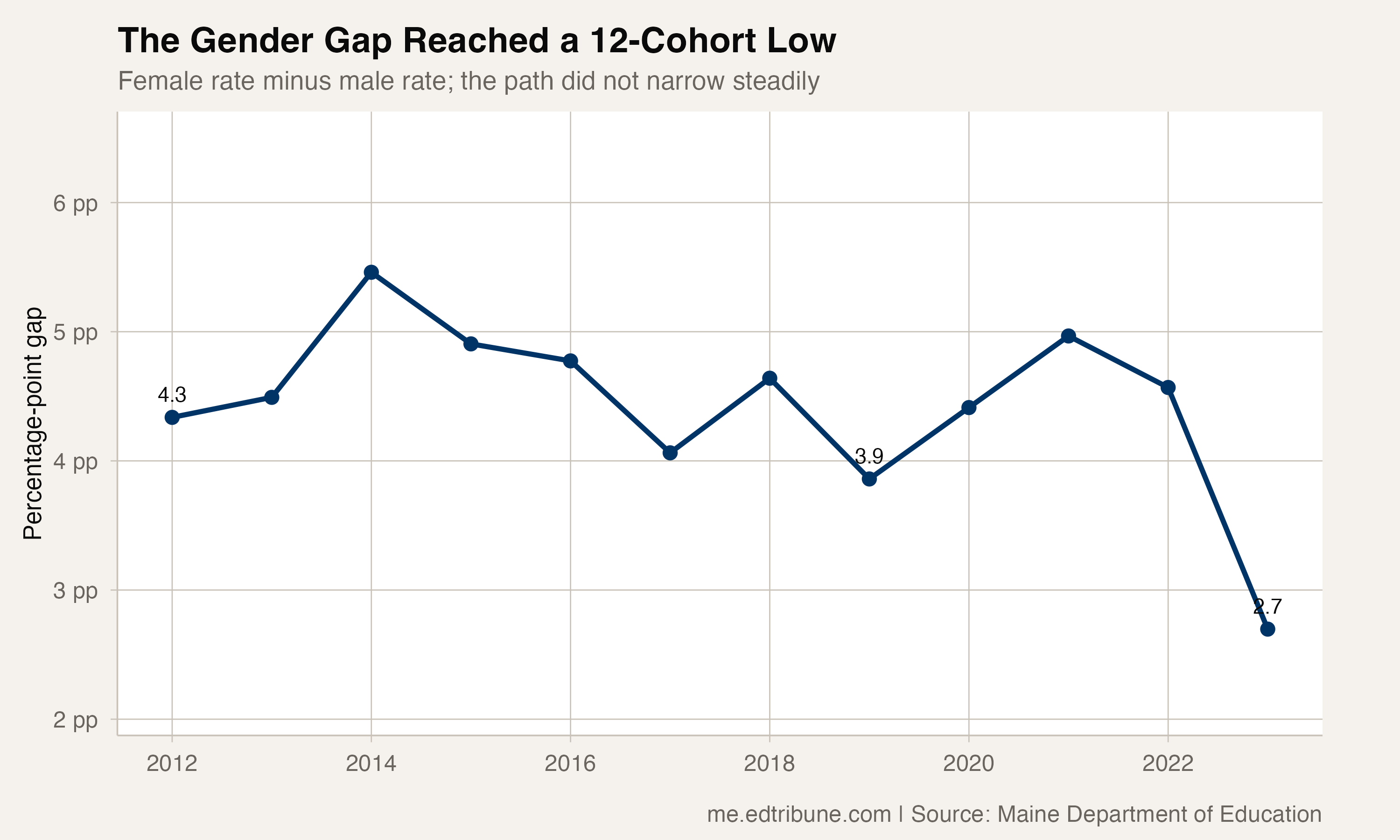
Maine's statewide four-year graduation gap between female and male students was 2.7 percentage points in 2023. That was the smallest gap across the 12 cohorts available from 2012 through 2023.
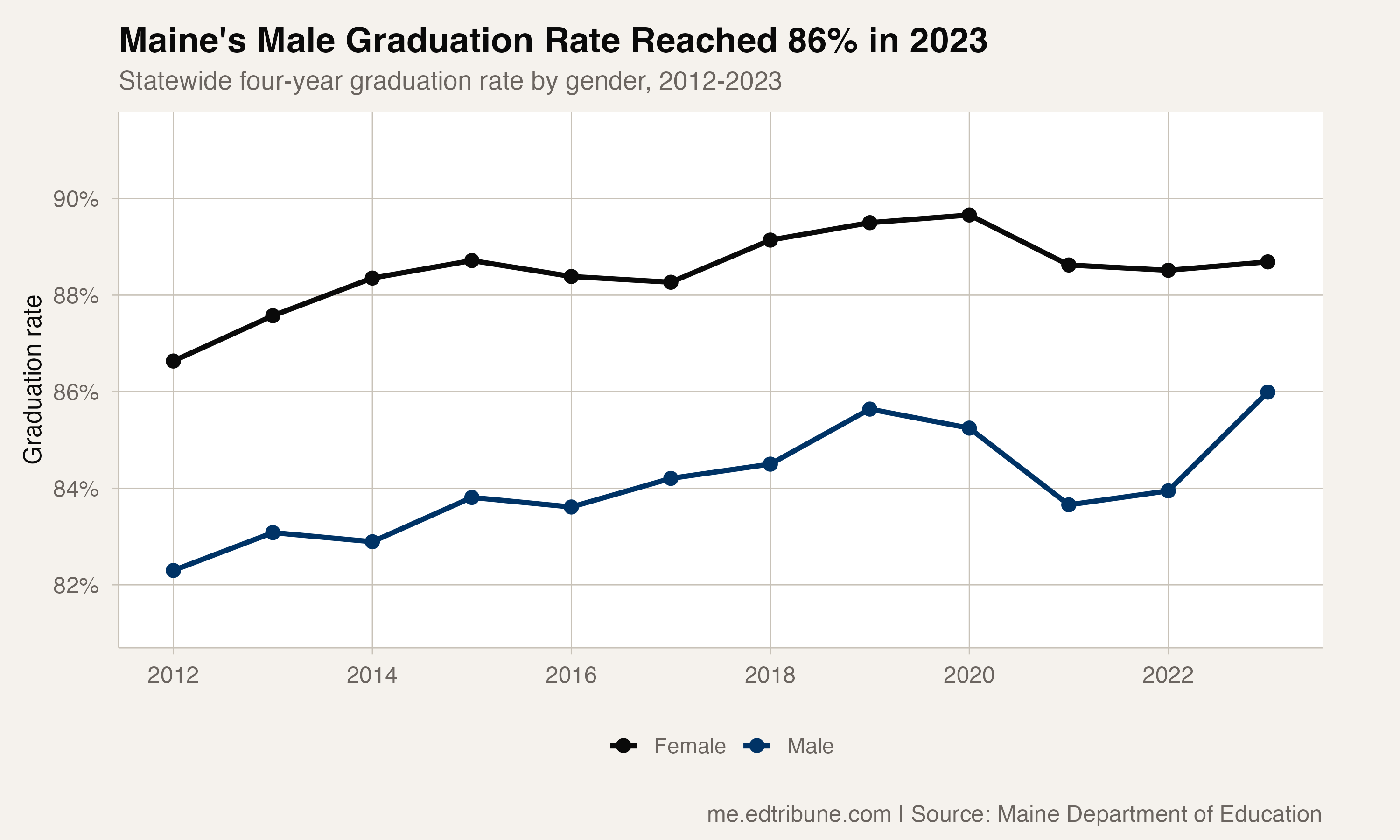
Female students graduated at 88.7%, compared with 86.0% of male students. A year earlier, the rates were 88.5% and 83.9%, leaving a 4.6-point gap. The gap therefore narrowed 1.9 points in one year as the male rate rose 2.0 points and the female rate rose 0.2 points.
The endpoint is real. The path was uneven.
In 2012, the female rate was 86.6% and the male rate was 82.3%, a 4.3-point difference. By 2023, the male rate had gained 3.7 points and the female rate had gained 2.1 points. Their gap was 1.6 points narrower than at the start of the series.
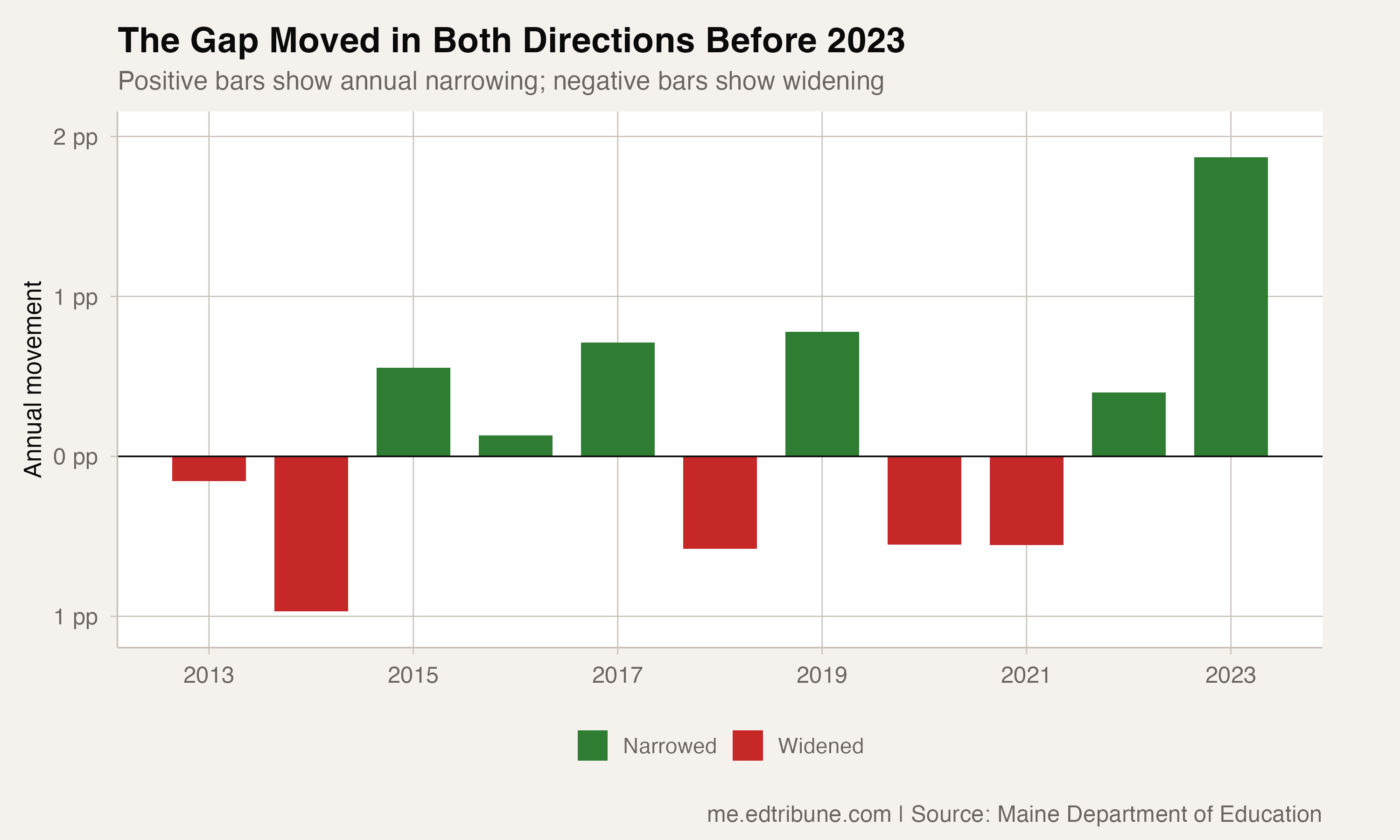
Those endpoints do not describe a steady trend. Across the 11 annual transitions in the published panel, the gap narrowed six times and widened five times. Before 2023, its smallest value was 3.9 points in 2019. The 2023 gap sat another 1.2 points below that previous low.
The female rate stayed within a relatively tight band from 2014 through 2023: a low of 88.3%, a high of 89.7% and a total span of 1.4 points. It ended that interval 0.3 points higher. That supports a narrow description of limited movement during those years, not a fixed ceiling.
The male path was more variable. Its rate was 85.6% in 2019, fell to 83.7% in 2021 and reached 86.0% in 2023. The latest 2.0-point increase accounted for 55.4% of the male rate's full 3.7-point gain from 2012. The available series therefore cannot establish that improvement was sustained before the latest cohort.
Published counts anchor the rates
The 2023 statewide row reports 7,160 male students in the four-year cohort and 6,157 graduates, which produces the published 86.0% rate. It reports 6,781 female students and 6,014 graduates, producing 88.7%. The two cohort counts sum to the independently published statewide total of 13,941.
That denominator check matters because a statewide rate can move when both outcomes and cohort composition change. It does not, however, show why the one-year gap changed. The aggregate gender rows do not identify a program, policy or school-level mechanism.
What the statewide rows cannot answer
The available file publishes gender, race, disability, English learner status and other characteristics as separate statewide subgroup rows. It does not cross-classify gender with those characteristics. Although it includes school rows, it has no wealth or regional classification supporting the earlier southern, rural and economic generalizations. The evidence therefore cannot show that one racial group, service group or region explains Maine's statewide gender gap.
The evidence supports a specific result: 2023 brought the narrowest gender gap in the 12 published cohorts, and the change from 2022 was unusually large relative to the earlier record. It does not yet show whether that one-year move began a lasting shift. The gap had moved in both directions before, and the most defensible conclusion is the measured one: Maine reached its closest point to statewide gender parity in the available four-year graduation series.
Data source: Maine Department of Education graduation data. Analysis covers statewide four-year cohorts published for 2012 through 2023.
Detailed code that reproduces the analysis and figures in this article is available exclusively to EdTribune subscribers.
Discussion
Sign in to join the discussion.
Loading comments...