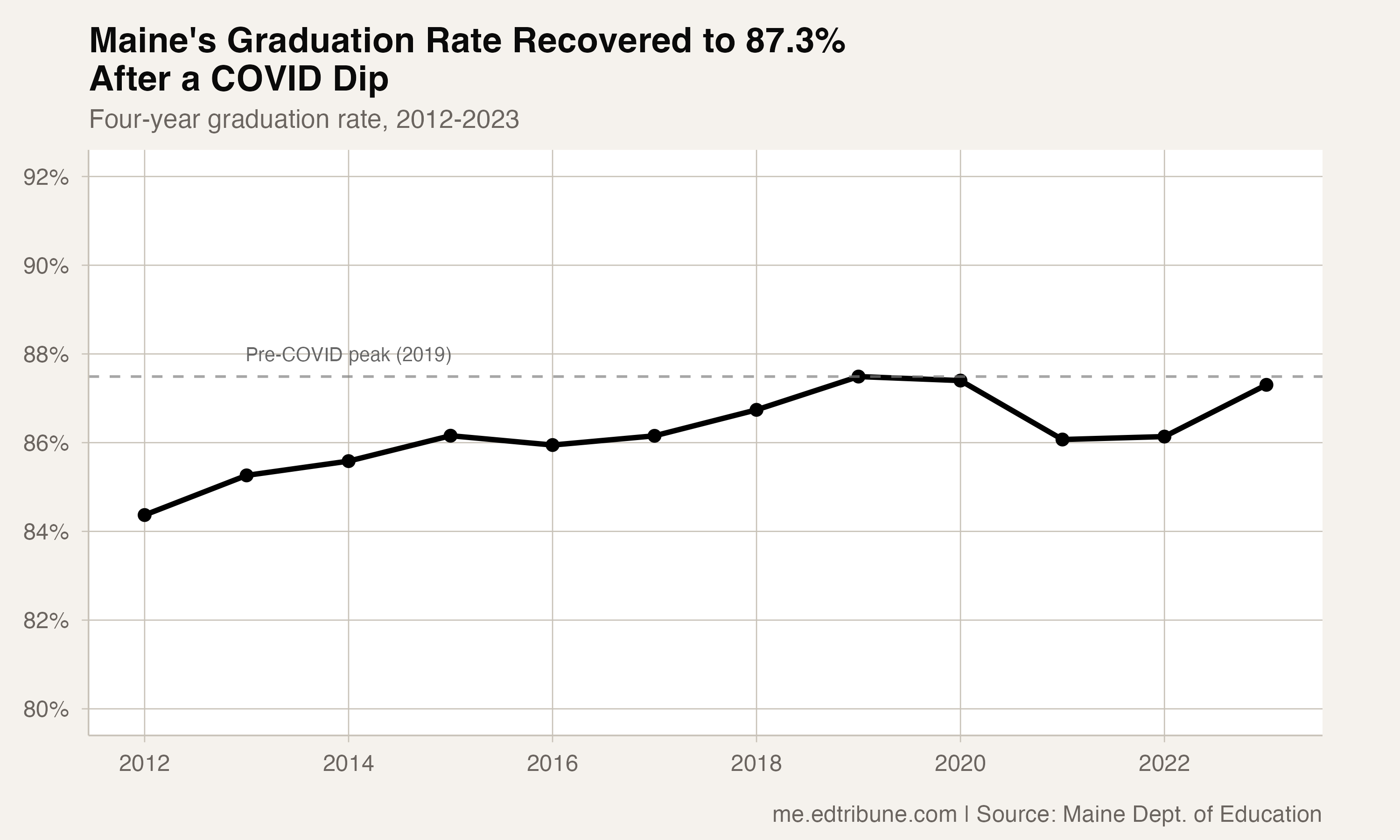
Maine graduates more of its students than it did a decade ago. In raw numbers, the improvement is real: the four-year graduation rate climbed from 84.4% in 2012 to 87.3% in 2023, a gain of nearly three percentage points. The state weathered a COVID-era dip to 86.1% in 2021 and bounced back within two years.
But behind the recovery, a harder truth persists. Several gaps separating vulnerable students from the state average were wider in 2023 than in 2012.
A slow, steady climb
Maine's graduation trajectory has been remarkably stable. The rate rose gradually from 84.4% in 2012 to a pre-COVID peak of 87.5% in 2019. The pandemic knocked it down to 86.1% in 2021 before it recovered to 87.3% by 2023.
The cohort has also been shrinking. In 2012, Maine's four-year graduation cohort included 15,373 students. By 2023, that number had fallen to 13,941 — a decline of 1,432 students. In absolute terms, Maine graduated 12,171 students in 2023 compared with 12,970 in 2012, meaning fewer students graduated within four years even as the rate improved.
The gaps that stayed
The overall improvement masks a troubling pattern: equity gaps have not narrowed, and several have widened.
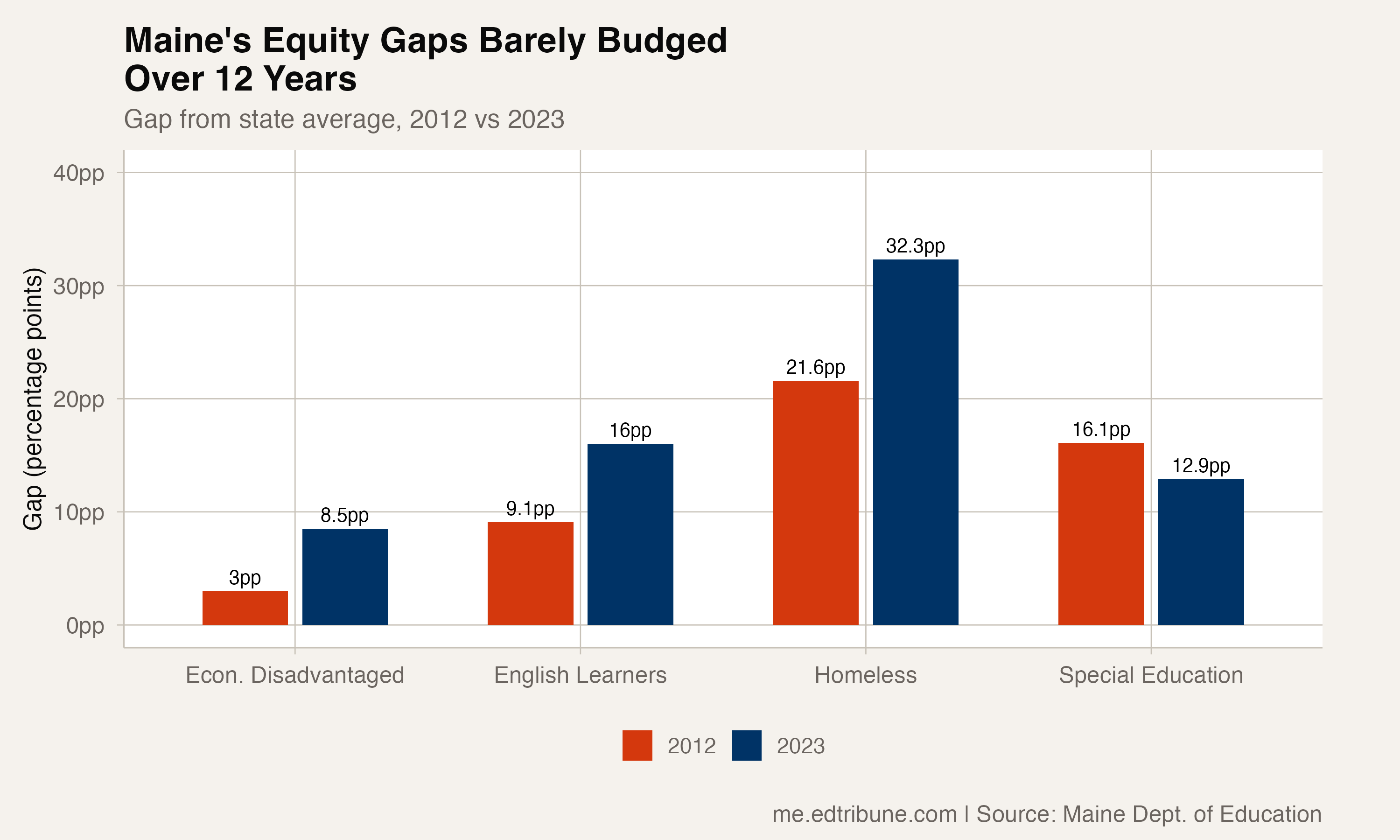
The most dramatic example is the student who is currently homeless gap. In 2012, students who are currently homeless graduated at 62.7%, trailing the state average by 21.6 percentage points. By 2023, the state rate had gained nearly three points while the homeless rate fell to 55.0%, widening the gap to 32.3 points.
The poverty gap followed a different but equally concerning trajectory. Economically disadvantaged students started almost at parity in 2012, trailing by just 3.0 percentage points. By 2016, the gap had widened to 11.1 points. It has since stabilized around 8.5 points, but the early-decade parity never returned.
English learners present the starkest recent deterioration. The LEP gap was as narrow as 5.6 percentage points in 2015. By 2023, it had tripled to 16.0 points, making English learners one of the fastest-widening gaps in the state's graduation data.
Where progress happened
Not every subgroup stagnated. Students with disabilities made the clearest and most sustained gains, narrowing their gap from 17.4 percentage points in 2013 to 12.9 points in 2023. Their graduation rate climbed from 67.8% to 74.4%, outpacing the overall improvement.
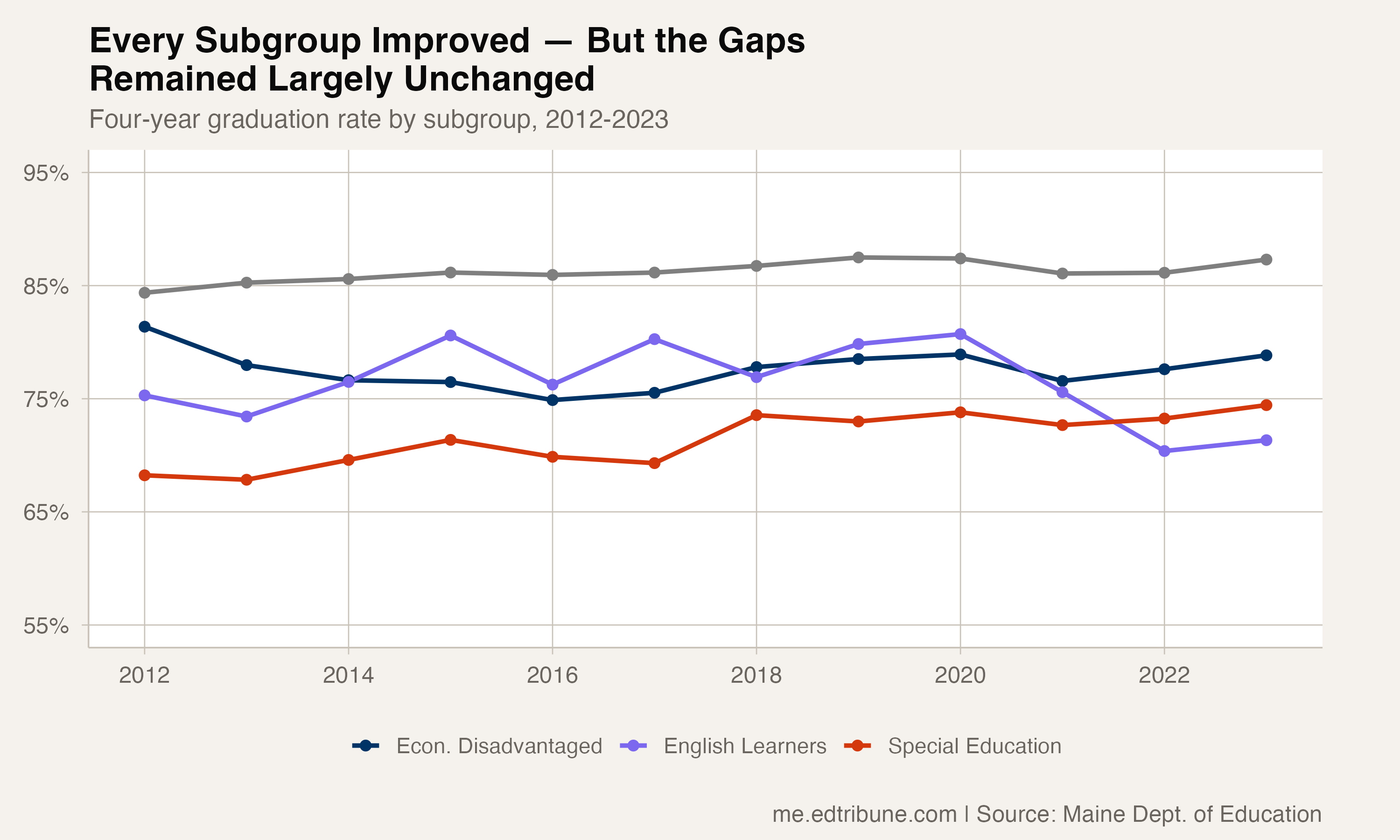
The gender gap also narrowed, from 4.3 points to 2.7 points, as male students gained faster than female students over the 12 annual cohorts. These are real wins, even if they are overshadowed by the persistence of larger gaps.
What 87.3% means
Maine's 87.3% graduation rate means roughly one in eight students still does not earn a diploma within four years. For a state with fewer than 14,000 students per cohort, that translates to about 1,770 students each year who do not graduate on time.
The state has made progress since 2012. But the same data that shows a rising average also shows that several large subgroup gaps remained in 2023.
Detailed code that reproduces the analysis and figures in this article is available exclusively to EdTribune subscribers.
Discussion
Sign in to join the discussion.
Loading comments...